If you’re comparing drone surveillance services ontario, start by asking whether an aerial view would add useful information that ground-based surveillance can’t provide as effectively. A drone isn’t automatically the best way to document a person, property or activity. The answer depends on the investigation’s objective, location and practical constraints.
Aerial observation may offer a different vantage point, but privacy, aviation requirements and information handling also need consideration. Drone-assisted surveillance is a case-specific tool, not a substitute for sound planning or a guaranteed route to evidence. The right approach may combine aerial and ground-based methods, or rely on ground surveillance alone.
This guide explains when drone surveillance may suit an Ontario investigation, where its limitations matter and what to ask before authorizing work. You’ll also learn how to assess an agency’s planning, oversight and approach to applicable requirements. Canadian Special Investigations is a Toronto-based, fully licensed private investigation agency serving clients across Ontario. Its investigators can assess whether UAV surveillance fits within a broader investigative plan. The goal is a deliberate, case-specific choice, not technology for its own sake.
Key Takeaways
- Assess whether an aerial view serves the investigation’s objective, location and conditions before choosing a method.
- Compare drone and ground surveillance based on the information sought, visibility and practical operating constraints.
- Before approving drone surveillance services in Ontario, confirm how the agency will assess current aviation requirements and site conditions.
- Use a consultation checklist to clarify the objective, alternatives, documentation and communication. Share sensitive details thoughtfully.
- Ask how privacy and information handling will be considered in the circumstances. Avoid assuming one approach fits every case.
When can drone surveillance services in Ontario help an investigation?
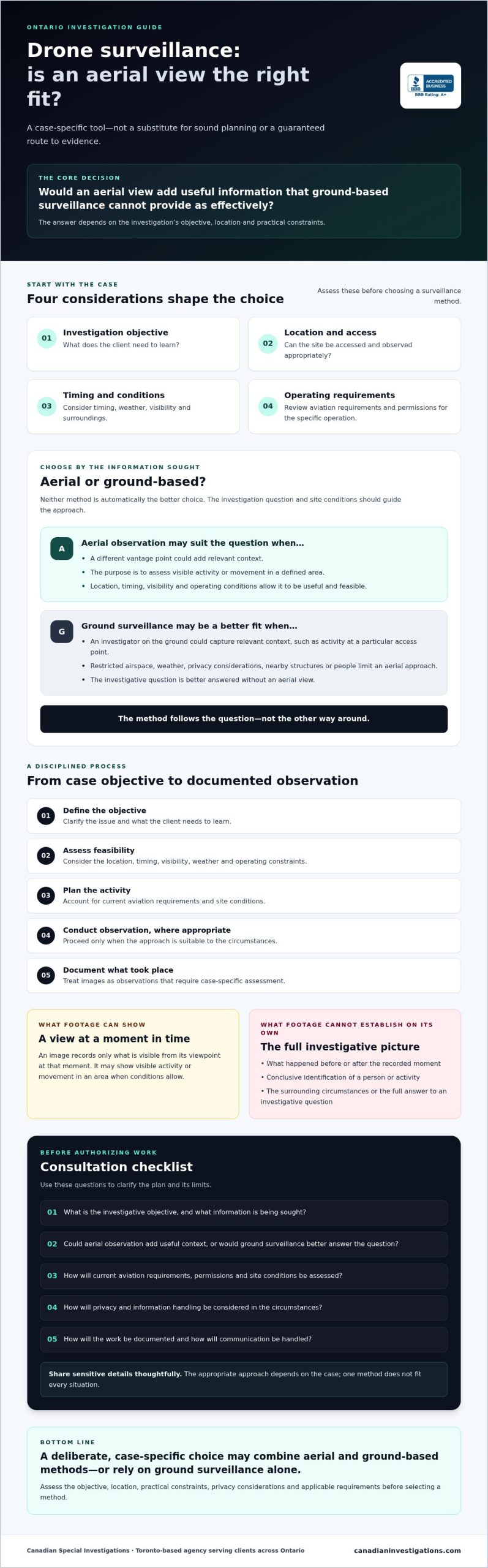
Drone-assisted surveillance uses an unmanned aircraft system as one possible method of investigative observation. It isn’t suitable for every case or location. The objective, site access, timing, weather, surroundings and lawful operating options all affect whether an aerial perspective is feasible and useful.
For insurance, corporate, legal or private investigations, ask whether observation from above could add relevant context to the information being sought. A drone may provide a different view of activity in an area, but it won’t guarantee useful footage, establish proof on its own or deliver a particular investigative outcome. Planning should focus on the case, not the appeal of the technology.
What investigative questions might aerial observation support?
Aerial observation may help assess visible activity or movement in a defined area when the setting and operating conditions allow. To judge feasibility, consider whether the location can be accessed appropriately, when relevant activity may occur, what can be seen from the proposed vantage point and whether conditions permit the operation. Aerial observation is not general-purpose photography or a promise of continuous monitoring. It should serve a clear investigative objective. For general context on authorities’ use of drones and related privacy concerns, see this overview of drone use in law enforcement.
When may another surveillance method be a better fit?
Restricted airspace, weather, privacy considerations, nearby structures or people may limit an aerial approach. Even if a flight is feasible, an investigator on the ground may be better placed to capture relevant context, such as activity at a particular access point. Choose the method based on the question being investigated, not the other way around. For a broader comparison of options, see the Ontario specialized surveillance guide.
When evaluating drone surveillance services ontario, ask the agency to assess the objective, location and constraints before recommending an approach. Canadian Special Investigations lists UAV surveillance among its investigative services and can consider whether it fits within a broader investigative plan. Depending on the circumstances, the appropriate method may be aerial, ground-based or another suitable approach.
How drone-assisted surveillance works, and what it cannot establish
A disciplined investigation begins with a question, not a flight. Before considering drone surveillance services in Ontario, an agency should clarify what the client needs to learn, assess whether aerial observation could contribute and review the location and operating constraints. If the approach is suitable, planning must account for current aviation requirements and conditions at the site.
At a high level, the process involves defining the objective, assessing feasibility, planning the activity, conducting observation where appropriate and documenting what took place. The specific plan depends on the case. Location, timing, weather, visibility and required permissions may affect whether an operation can proceed. Transport Canada’s guidance on Canadian drone aviation rules is an authoritative starting point, while commercial specialists like Caswell Aviation Ltd highlight the importance of flight training, maintenance, and equipment reliability. Requirements should be checked for the specific aircraft, pilot, airspace and operation.
From case objective to operational plan
Investigators first need to understand the issue the client wants addressed. Is the goal to observe a particular activity, or would another method better answer the question? The answer guides the feasibility assessment. Location, timing, visibility and weather can affect what may be observed, while aviation requirements and permissions may restrict operational options. Don’t assume a drone can be deployed simply because a site appears accessible.
What aerial footage can, and cannot, show
An image records only what is visible from its viewpoint at that moment. It may not establish what happened before or after, identify a person or activity conclusively, or explain the surrounding circumstances. Context, continuity, identification and image quality all require case-specific assessment. Footage alone may not answer the client’s full investigative question. When complex investigations require translating aerial perspectives into physical reconstructions, scaled scene models, or custom camera mounts, professionals often turn to digital fabrication tools; visit 3D Printing Canada to explore 3D printers, scanners, and materials suited for technical projects.
Recorded images should also be distinguished from an investigator’s observations, notes and wider case context. These materials are related but not interchangeable. An image may show an event, while observations and other information can help describe when and where it occurred. Ask the agency what it proposes to document and provide, and how those materials will be considered alongside the investigation. Don’t equate a recording with proof of fraud, misconduct or a legal conclusion.
Canadian Special Investigations lists UAV surveillance among its investigative services. If you’re weighing an aerial approach, you can discuss the case objective and location with the agency and ask whether drone-assisted surveillance fits a broader investigative plan.
Drone surveillance versus ground surveillance: choosing the right method
Aerial and ground surveillance answer different questions. A drone may offer an elevated view of visible activity in a suitable setting, while an investigator on the ground may capture details and context from a closer vantage point. Neither method is automatically superior. Let the case objective, location, visibility and operational constraints guide the choice.
Open areas or locations that are difficult to observe from nearby ground positions may make an aerial perspective worth assessing, subject to applicable restrictions and site conditions. Urban density, nearby people, structures and other activity can change that assessment. Ground-based observation may be more relevant when the investigation depends on details at an access point or on understanding how events unfold from a particular position.
Compare the methods against the case objective
Use this comparison to focus the discussion with an investigator. These are planning considerations, not promises about what either method will capture.
| Consideration | Drone-assisted surveillance | Ground surveillance |
|---|---|---|
| Viewpoint | May provide an elevated view where the operation is feasible. | May provide closer, ground-level context. |
| Setting | Depends on location, visibility, surroundings and operating constraints. | Depends on access, positioning and conditions on the ground. |
| Information sought | May support observation of visible activity across an area. | May suit questions requiring detail or context from a specific position. |
| Key limitations | Conditions and restrictions may rule out or limit an aerial approach. | Access, obstructions or limited visibility may affect observation. |
Questions to ask before choosing
Ask the investigator to connect each proposed method to a specific case question. A useful comparison should explain what each approach may contribute, what it may not reveal and which constraints have been considered. If circumstances change or initial observations leave gaps, investigators may reassess the plan and consider another method such as GPS tracking. Keep that decision tied to the objective rather than a preference for a particular tool.
- What specific information is each method intended to help establish?
- What location, visibility or operational limitations could affect the plan?
- What alternative approach has been considered if the preferred method isn’t suitable?
For claim-related matters, consider the method in relation to the information needed for the investigation. Read more about insurance fraud surveillance in Ontario. A case-specific assessment can help determine whether drone surveillance services ontario, ground surveillance or a combination is the appropriate direction. Don’t assume any option is available or conclusive in every situation.
Ontario drone surveillance: privacy, aviation rules, and evidence checks
Before authorizing an aerial operation, confirm that the proposed plan has been assessed for the specific aircraft, pilot, airspace and activity. Transport Canada requirements can depend on those details, and conditions at the location may affect what is feasible. Ask the agency to explain its assessment and identify any matters requiring further verification. Don’t rely on a general statement that a drone operation is permitted.
Privacy and information handling also require case-specific consideration. The circumstances, what is observed and how material is collected or shared can all matter. A recording may be relevant to an investigation, but its usefulness or admissibility can’t be guaranteed in advance. For questions about legal use or admissibility in a particular matter, seek advice from a lawyer familiar with the case.
What to verify before any proposed flight
Use this checklist to clarify responsibilities before engaging drone surveillance services in Ontario. Treat current legal and regulatory details as items for professional verification, not assumptions.
- Aviation requirements: How will the agency assess applicable Canadian Aviation Regulations and Transport Canada requirements for the aircraft, pilot, airspace and proposed operation?
- Site constraints: Have location, airspace, nearby people and conditions at the site been considered? What could make the proposed approach unsuitable?
- Permissions and responsibility: Who will confirm any required permissions, make operational decisions and document the plan?
- Privacy and handling: How will collected material be documented, stored, accessed and shared with you? Who can access it, and what should you expect to receive?
- Evidence context: What limitations could affect the material’s relevance or interpretation, and which questions should be referred to your lawyer?
Privacy, handling, and evidentiary context
Ask for a clear explanation of how information will be managed in the circumstances of your case. A recording is only one part of an investigation. Its context and the way it is documented may affect how a lawyer or other decision-maker assesses it. Avoid treating footage as a legal conclusion or assuming it will be accepted for a particular purpose.
Law firms considering investigative support can review legal support investigators in Toronto. To discuss an investigative objective and location, contact Canadian Special Investigations and ask how the proposed approach, requirements and information handling would be assessed.
Selecting drone surveillance services in Ontario: what to ask CSI
Choosing an investigative agency means assessing more than whether it offers drone surveillance. The proposed method should fit your objective, location and constraints, and the agency should explain its limitations. Canadian Special Investigations is a Toronto-based, fully licensed private investigation agency serving clients across Ontario, with UAV surveillance among its investigative services. Assess its suitability for your case individually.
Use these questions to structure an initial discussion about drone surveillance services ontario:
- Objective: How would the proposed method address the specific question the investigation needs to answer?
- Location and constraints: What site conditions, operational requirements or privacy considerations could affect the assignment?
- Alternatives: If an aerial approach isn’t suitable, what other investigative method might better fit the objective?
- Documentation: What information or materials does the agency expect to document and share, and what limitations could affect them?
- Communication and scope: Who will be your point of contact, how will updates be handled, and what scope and billing arrangements should you confirm before authorizing work?
Ask for a case-specific assessment rather than assuming a drone will be used. A sound plan should explain why a method is being considered, what could restrict it and how the agency will communicate if circumstances change. Confirm details directly with the investigator. Don’t rely on assumptions about capabilities, deployment conditions or deliverables.
Prepare for a confidential case discussion
A concise briefing helps the agency assess the situation without requiring you to disclose every sensitive detail at the outset. Before the discussion, organize:
- A short summary of the concern and the decision or next step the investigation should inform.
- Relevant locations and timing, including any known constraints or changes in circumstances.
- Information already available, such as records or observations, and what remains uncertain.
Share relevant facts, but avoid sending unnecessary personal or confidential information before you’ve established an appropriate way to discuss the matter. Ask how the agency would assess the objective, whether drone-assisted surveillance or another approach may fit, and what further details it needs to evaluate feasibility.
For a confidential inquiry, contact Canadian Special Investigations to discuss the objective and location. The agency can assess whether its UAV surveillance service or another investigative method may be appropriate, without promising a particular outcome.
Choose an investigative approach with confidence
Drone surveillance is a case-specific option, not a guaranteed shortcut to useful evidence. The right approach depends on the question you need answered, the location and operating constraints. Compare aerial and ground methods, confirm how privacy and information handling will be addressed, and ask what limitations may affect the investigation.
When evaluating drone surveillance services ontario, look for a clear explanation of why a method may fit your case and what alternatives are worth considering. Canadian Special Investigations is a fully licensed private investigation agency based in Toronto, offers drone and UAV surveillance, and serves clients across Ontario. The agency can assess whether aerial observation or another investigative approach may suit your objective.
Discuss your Ontario investigation confidentially with Canadian Special Investigations. A focused conversation about your concern and location can help clarify the next step. With a case-specific plan, you can move forward with greater confidence.
Frequently Asked Questions
Are drone surveillance services legal in Ontario?
Drone surveillance may be lawful in Ontario, but there’s no blanket approval for every flight or recording. Assess the proposed operation against applicable Transport Canada requirements for the aircraft, pilot, airspace and activity, along with privacy considerations and any relevant site permissions. Requirements can depend on the circumstances. Ask the agency how it will assess the specific plan, and seek legal advice for questions about your situation.
Can a private investigator use a drone to record someone in Ontario?
A private investigator may use a drone only if the proposed operation and recording are appropriate under applicable requirements and the case circumstances. A person’s presence in a public or visible area doesn’t, by itself, resolve every privacy or information-handling concern. Ask what the investigator intends to observe, how the operation will be assessed and how any material will be handled. Consult a lawyer about case-specific privacy questions.
When is drone surveillance more useful than ground surveillance?
Drone surveillance may be worth assessing when an aerial viewpoint could contribute information that’s difficult to observe from the ground, provided the site and operating conditions allow it. Ground surveillance may offer more relevant detail when the investigation depends on activity at a particular access point or the surrounding context. Compare methods by the case objective, setting, visibility and constraints. A drone isn’t automatically more effective or available.
What should I ask before hiring a drone surveillance investigator in Ontario?
Ask how the proposed method relates to your specific investigative objective and what limitations could affect the assignment. Confirm that the agency will assess current aviation requirements, location and privacy considerations. Clarify what it expects to document, how information will be shared, how updates will be communicated, and what scope and billing arrangements apply. Also ask what alternative approach may fit if drone surveillance isn’t suitable for your case.
Can drone footage be used as evidence in an Ontario court?
Drone footage may be relevant to a case, but no investigator can guarantee that it will be admitted or establish a particular conclusion. Its potential use depends on the circumstances, including what the recording shows, its context and how it was obtained and documented. Discuss admissibility and legal use with a lawyer familiar with your matter. Ask the agency how it records observations and handles collected material.
Does drone surveillance work in urban areas such as Toronto or Mississauga?
It may be considered, but urban density, nearby people, buildings, airspace and site conditions can affect feasibility. The same assessment applies in Brampton, Oakville, Burlington, Hamilton, Ancaster, Niagara Falls, Kitchener, Waterloo, Scarborough, North York, Richmond Hill, Barrie, Milton, Etobicoke and Guelph. Canadian Special Investigations is based in Toronto and serves clients across Ontario, but suitability and operating options must be assessed for each location.
How does an Ontario investigator decide whether drone surveillance is suitable?
An investigator should first clarify the question the client needs answered, then assess the location, timing, visibility, conditions and applicable operating requirements. The investigator can compare aerial observation with ground surveillance and explain relevant limitations, including privacy and documentation considerations. Drone surveillance services ontario should be planned around the case objective, not chosen simply because a drone is available. The assessment may conclude that another method is a better fit.

