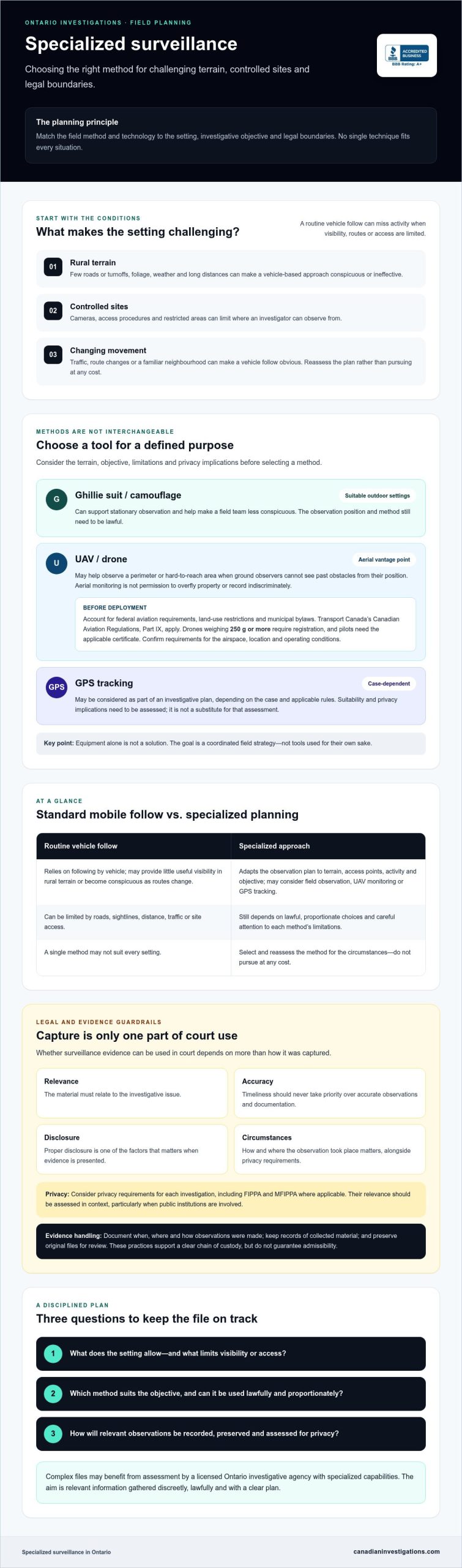
What if the evidence you need is difficult to observe because of rural terrain or a controlled site? A routine vehicle follow may miss important activity when roads, sightlines or access points limit the options. A specialized surveillance Ontario strategy matches field methods and technology to the setting, the investigative objective and the legal boundaries.
Whether surveillance evidence can be used in court depends on more than how it was captured. Relevance, accuracy, disclosure and the circumstances of the observation all matter. Privacy requirements, including FIPPA and MFIPPA where applicable, also deserve careful consideration.
This guide explains options for challenging environments, including ghillie suit surveillance, UAV monitoring and GPS tracking, and outlines legal considerations for investigations in Ontario. It also covers factors that may affect the use of surveillance evidence and how a licensed investigative agency such as Canadian Special Investigations can help assess a complex file. The aim is to gather relevant information discreetly, lawfully and with a clear plan.
Key Takeaways
- Learn when specialized surveillance ontario methods may suit rural terrain or controlled environments better than standard mobile surveillance.
- See how ghillie suit, UAV and GPS capabilities address different operational challenges, while legal limits still shape their use.
- Understand why relevance, accuracy and proper disclosure matter when surveillance evidence is presented in an Ontario court.
- Clarify how FIPPA and MFIPPA relate to public institutions, and why privacy considerations should be assessed for each investigation.
- Discover how a licensed Ontario investigative agency with specialized capabilities can help plan a disciplined approach to complex files.
Understanding Specialized Surveillance in the Ontario Context
Specialized surveillance combines technology with field methods selected for a particular setting. Instead of relying only on an investigator following a subject by vehicle, it adapts the observation plan to the terrain, access points and activity being investigated. A ghillie suit may help an investigator remain less conspicuous in a suitable outdoor setting. A UAV may offer a different vantage point when its use is lawful and appropriate. For a neutral overview of the broader discipline, see Surveillance methods and applications.
In Ontario, distance and environment can complicate a routine mobile follow. Rural roads may offer few routes or turnoffs, while foliage, weather and long distances between locations can make a vehicle-based approach conspicuous or ineffective. At a controlled site, cameras, access procedures and restricted areas can also limit where an investigator can observe from. Specialized surveillance ontario planning starts by assessing the setting and objective, rather than assuming one technique will work everywhere.
When Is Specialized Surveillance Required?
Consider a high-value insurance fraud surveillance Ontario investigation involving a rural property. A conventional vehicle position may provide little useful visibility. A carefully selected observation point may offer a better view, provided the position and method are lawful. Corporate investigations into suspected internal theft or unauthorized disclosure can present different challenges. Investigators may need to assess observation options around relevant locations without entering private property or bypassing security.
In a domestic or infidelity investigation, a vehicle follow can become obvious if the subject changes routes, travels through heavy traffic or returns to a familiar neighbourhood. The appropriate response is not to pursue at any cost. It is to reassess the plan and select lawful, proportionate methods suited to the circumstances.
The Evolution of Investigative Technology in 2026
Investigative work can involve more than a handheld camera. Depending on the case and applicable rules, a plan may consider field observation, UAV monitoring or GPS tracking. These methods are not interchangeable. Their suitability depends on the location, purpose and privacy implications. Timely updates may help a client understand developing observations, but speed should never take priority over accuracy or proper documentation.
Careful evidence handling matters. Investigators can document when, where and how observations were made, keep records of collected material and preserve original files for review. These steps support a clear chain of custody, but they do not guarantee admissibility. The objective is controlled, discreet monitoring, not unnecessary escalation. A sound plan includes clear recording practices and stays within the legal boundaries of the investigation.
Tactical Tools of the Trade: From Ghillie Suits to UAVs
Specialized surveillance works best when each tool serves a defined investigative purpose. A camera, concealment gear, UAV or GPS tracker is not a solution on its own. Investigators need to match tools to the terrain and objective, account for their limitations, and plan how to record and preserve relevant observations. The result should be a coordinated field strategy, not equipment used for its own sake.
UAV and Drone Surveillance: The Aerial Advantage
A UAV can provide a vantage point over terrain or obstacles that ground observers may not be able to see past from their position. In a rural setting, a quadcopter may assist with observing a perimeter or hard-to-reach area if the flight is lawful and appropriate to the investigation. Aerial monitoring does not grant permission to overfly any property or record indiscriminately.
Drone use must account for federal aviation requirements as well as relevant land-use restrictions and municipal bylaws. Transport Canada’s Canadian Aviation Regulations, Part IX, apply to drone operations; drones weighing 250 g or more require registration, and pilots need the applicable certificate. Airspace, location and operating conditions matter, so requirements should be confirmed before deployment. Video quality and usefulness also depend on conditions and the objective, not simply on using a UAV.
Camo Ghillie Suit Surveillance: Rural Stealth
In suitable outdoor environments, camouflage and a ghillie suit can support stationary observation while reducing the visibility of a field team. The investigator still needs a lawful observation position, a clear line of sight and a plan that accounts for weather, vegetation and changing activity. Concealment does not authorize entry onto private property or guarantee that an investigator will remain unnoticed.
This fieldcraft may be relevant to insurance or WSIB investigations where activity in an outdoor setting needs to be documented. The method must fit the specific file, and an extended observation period should not be assumed or promised. Canadian Special Investigations provides Camo Ghillie Suit Surveillance Services and UAV surveillance.
Training and preparation are essential. Investigators need to understand the equipment they use, its limits and the rules that apply to its operation. For UAV work, that includes relevant pilot certification and aviation requirements. In urban areas, airspace and local restrictions can make a method unsuitable even when it appears technically feasible. Discretion means minimizing unnecessary attention, not pushing past legal or operational limits.
GPS tracking can support asset monitoring where its use is lawful and properly authorized. Location data may help establish movement patterns, but it should be handled carefully and assessed alongside other evidence. Integrated tools, including UAVs and advanced AI surveillance tools, are part of a wider technological shift, not a substitute for sound judgement.
For a complex file, consider whether an investigator’s capabilities match the terrain and objective. Explore Canadian Special Investigations’ surveillance capabilities as one option to assess.
Specialized vs. Standard Surveillance: A Strategic Comparison
The right approach depends on what must be observed and where. Standard mobile surveillance can suit urban follows and activity across public routes, where investigators can adapt to traffic and changing locations. A large rural property or gated community presents a different challenge: long sightlines, limited access points and few places for a vehicle team to remain unobtrusive. Specialized surveillance Ontario planning matches the method to the geography. More personnel or equipment will not automatically produce better evidence.
Comparing Operational Methods
- Standard mobile surveillance: Useful for tracking activity across public routes and changing urban locations, provided the investigator can maintain discreet, lawful observation.
- Tactical surveillance: Ghillie suit fieldcraft or UAV monitoring may be considered when terrain, distance or access makes routine observation ineffective. Each method has operational and legal limits.
- Hybrid approaches: For corporate files, investigators may assess whether lawful GPS tracking, ground observation and drone capabilities can complement one another. A corporate investigation in Toronto should be tailored to its objective, not built around technology for its own sake.
The Government of Ontario directory lists an Ontario Provincial Police Surveillance Unit that provides surveillance services for police investigations. That public-sector role is distinct from private investigative work, but it illustrates that surveillance methods are selected to meet specific investigative needs.
Resource Allocation and Case Success
Specialized equipment may help avoid keeping investigators in an ineffective position, but it does not automatically reduce a file’s total hours or cost. UAV planning, permissions, deployment and evidence review also require resources. A sound assessment considers the likely value of the information, feasibility, legal limits and the consequences of missing the observation. No responsible approach can promise a “win” or a particular evidence-capture rate in an “impossible” environment.
High-tech footage can be compelling, but it is not inherently undeniable. Evidence must still be relevant, accurate and properly documented, and admissibility depends on the circumstances. A clear record may help decision-makers assess a claim or prepare for litigation, but it cannot replace corroboration or fair disclosure.
To allocate resources, identify the key question first. Then compare the terrain, observation options, privacy risks and evidentiary needs before choosing a method. This can limit unnecessary deployment and keep the investigation focused, regardless of equipment complexity. The objective is not to overwhelm a subject with technology. It is to gather reliable, relevant information with disciplined discretion.
Legal Framework and Admissibility in Ontario
Specialized surveillance Ontario work must be planned around privacy and evidence rules. Sophisticated equipment does not expand an investigator’s legal authority. Under Ontario’s Private Security and Investigative Services Act, 2005 (PSISA), private investigators and agencies must be licensed as required to provide investigative services. A licence is not permission to trespass, enter restricted spaces or collect information without regard for privacy.
Privacy Laws and Private Investigation
FIPPA and MFIPPA govern access to information and privacy obligations for Ontario public institutions, including provincial and municipal bodies. They are not general licences for private investigators to collect information. Their relevance may arise when a file involves information held by a covered institution; the precise rules depend on the circumstances. Private-sector investigations also require careful consideration of applicable privacy law and the subject’s reasonable expectation of privacy.
Observation from a public place is not automatically lawful in every circumstance, and a private location deserves particular caution. Investigators have no special authority to enter private property. Surveillance must be planned with the applicable property, privacy and access rules in mind. A client’s request, or an investigator acting as the client’s agent, does not create authority to trespass or override privacy protections.
For Ontario civil litigation, drone-captured evidence must be lawfully obtained and relevant, fair and accurate, with its use and disclosure meeting the court’s requirements. Aerial footage must be assessed in context, including where the drone operated, what it recorded and whether the material intrudes on a reasonable expectation of privacy. Technical capability alone does not establish lawful or appropriate use.
Securing Admissible Evidence
Ontario courts assess video evidence carefully, piece by piece. A recording should be relevant and a fair, accurate depiction of what it purports to show. The person who recorded it may need to testify about its contents. For substantive use at trial, surveillance evidence must be disclosed to the opposing party at least 90 days before trial; late disclosure can lead to exclusion.
Detailed reports help explain the context behind technical files. They should identify how and when observations were made and connect recorded material to the investigator’s notes. Preserve original UAV video and GPS logs, document how files are handled, and maintain a clear chain of custody. These steps support review, but they cannot guarantee admissibility.
Before retaining an investigator for an infidelity matter in Toronto, ask how they approach lawful observation, documentation and evidence preservation. For discreet investigative support, contact Canadian Special Investigations about its investigation services.
Strategic Partnership: Why CSI Leads Ontario in Specialized Tactics
Complex investigations need more than equipment. They require a plan that connects the client’s objective, the environment and the evidence needed. Canadian Special Investigations (CSI) is a fully licensed private investigation agency based in Toronto, Ontario, with decades of industry experience. Its specialized capabilities include Camo Ghillie Suit Surveillance Services and UAV surveillance, alongside corporate, legal, insurance and WSIB investigations.
For specialized surveillance Ontario files, those capabilities may give clients options for challenging terrain or observation requirements. The right approach still depends on the facts, applicable law and operational feasibility. CSI can assess those factors methodically, without promising a particular outcome.
Full-Scope Investigative Coverage
Investigations may involve activity across different communities and settings. Local knowledge can inform planning, but the method must remain specific to the location and purpose of each file. CSI serves clients throughout Ontario, including law firms, businesses, insurance companies and private individuals. Its services include corporate, legal, insurance and WSIB investigations, as well as other listed investigative services.
UAV and ghillie suit capabilities offer distinct options for cases where a standard approach may not fit the environment. They are not interchangeable, and neither should be deployed simply because the technology is available. Corporate and legal clients can assess whether a specialized method is proportionate to the question under investigation and likely to produce useful, properly documented evidence. That practical assessment is more meaningful than an unsupported promise of return on investment.
Taking the Next Tactical Step
A useful first step is to outline the issue, relevant locations, known constraints and any litigation or claim deadlines. This gives an investigative agency a basis to assess feasibility, identify potential legal or privacy considerations and determine which available service may fit. Share sensitive details through an appropriate channel and clarify how information will be handled before proceeding.
If a deadline is approaching, raise it early so the proposed work can be considered against the available time and requirements. Do not assume a deployment schedule or evidence outcome before the case is assessed. Careful planning, discretion and clear communication matter even when a file is time-sensitive.
To discuss whether CSI’s investigative services fit your circumstances, contact Canadian Special Investigations for a tactical consultation today.
Choose a Tactical Approach with Confidence
Effective specialized surveillance ontario work depends on more than advanced equipment. A strong plan matches the method to the terrain, respects privacy and legal boundaries, and preserves clear records of how evidence was gathered. Standard mobile observation may suit one case; a rural or controlled environment may call for different fieldcraft or technology. No method can guarantee admissible evidence or a particular outcome.
Canadian Special Investigations brings together licensed investigative services, ghillie suit surveillance and UAV surveillance capabilities. For sensitive files, a disciplined approach means careful planning, discretion and a focus on relevant evidence. Start with a confidential discussion about your objective, circumstances and any important deadlines so the investigation’s feasibility can be considered before a method is selected.
Contact Canadian Special Investigations to discuss an investigative approach suited to your case. A clear plan can help you understand the available options and next steps.
Frequently Asked Questions
Is drone surveillance legal for private investigators in Ontario?
Drone surveillance may be lawful for private investigators in Ontario, but flights and recordings must comply with applicable requirements. Pilots must follow Transport Canada’s Canadian Aviation Regulations, Part IX. Drones weighing 250 g or more require registration and a pilot certificate. Provincial land-use rules and municipal bylaws may also apply. Investigators should assess airspace, location and privacy before deployment. A drone does not authorize trespassing or unrestricted recording of private activity.
What makes surveillance “specialized” compared to standard methods?
Specialized surveillance adapts the investigative method to difficult terrain, access limits or heightened security. Rather than relying only on a vehicle follow or handheld camera, a plan may consider ghillie suit fieldcraft, UAV observation or GPS tracking where appropriate and lawful. These tools are not automatically more effective, and they do not replace sound planning. Specialized surveillance Ontario cases require matching the method to the objective, location, privacy considerations and evidence requirements.
Can evidence gathered by a Ghillie-suited investigator be used in court?
It may be considered by a court, but wearing a ghillie suit does not determine whether evidence is admissible. The material must be relevant and a fair, accurate depiction of what it purports to show. Investigators should document how and when it was captured and preserve the original recording. A videographer may need to testify, and applicable disclosure rules must be followed. Admissibility depends on the specific evidence and circumstances.
How does GPS tracking work within Ontario’s legal boundaries?
GPS tracking records location information from a device associated with a vehicle or other asset, but its use must be assessed carefully. Legality can depend on who owns or controls the asset, the authority for tracking, the purpose and privacy expectations involved. Do not assume a client’s request alone makes tracking lawful. Before deployment, clarify authorization, consider privacy implications and obtain legal advice where appropriate. Preserve relevant records and handle location data responsibly.
Do I need specialized surveillance for an insurance fraud case?
Not necessarily. The appropriate method depends on the allegation, location and evidence needed. Routine observation may suit activity in an urban area, while rural terrain or limited sightlines could call for a different plan. For an insurance or WSIB investigation, first define the question the evidence must address and assess lawful observation options. A licensed investigator can help evaluate whether specialized tools are suitable, feasible and proportionate to the case.
What areas of Ontario does Canadian Special Investigations cover?
Canadian Special Investigations is based in Toronto and serves clients throughout Ontario, with local relevance across Toronto, Oakville, Burlington, Brampton, Mississauga, Hamilton, Ancaster, Niagara Falls, Kitchener, Waterloo, Scarborough, North York, Richmond Hill, Barrie, Milton, Etobicoke and Guelph. The firm serves law firms, businesses, insurance companies and private individuals. Confirm whether the agency can accommodate the locations and operational details involved in your particular investigation.
How is the privacy of third parties protected during specialized monitoring?
Investigators should plan observations to focus on the subject and relevant activity, rather than collecting unrelated information about bystanders. The method and location must be assessed for privacy implications, and investigators have no special authority to enter private property. Recording should be limited to what is relevant to the investigation, with collected material handled carefully. Ask how third-party information will be documented, stored, reviewed and managed if it is incidentally captured.
How do I know if my case requires a tactical approach?
A tactical approach may be worth assessing if ordinary observation has failed or the setting creates practical obstacles, such as rural distance, difficult sightlines, controlled access or a risk that a vehicle follow will be noticed. Start by identifying the key question, location, known constraints and any relevant deadlines. An investigator can assess feasibility, privacy considerations and whether specialized tools fit. More equipment is not always better; the method should serve the evidence objective.

