What if the value of concealment depends less on the ghillie suit and more on whether the observation is lawful, relevant and carefully planned? Ghillie suit surveillance services may be considered when an investigation calls for discreet observation in a rural or natural setting, but this specialized method isn’t suitable for every case.
It’s reasonable to question whether camouflage will help, where an investigator can legally observe from, and how the work will be documented. A ghillie suit isn’t a shortcut to evidence or permission to enter private property. Professional oversight means assessing the case objective, considering proportionate options and respecting applicable privacy and legal boundaries.
This article explains when ghillie suit surveillance may fit, what a professional process can involve, and what to discuss with an investigative agency before proceeding. You’ll also learn how to distinguish disciplined fieldwork from dramatic portrayals, and why lawful, proportionate, documented observation matters. The aim is to help you assess whether this approach makes sense for your investigation, not to promise a particular result.
Key Takeaways
- Assess whether the setting and investigative objective make concealed outdoor observation a proportionate option.
- With ghillie suit surveillance services, the suit is only one consideration; the case question should guide the method.
- Compare the practical limits of this approach with other options before deciding how to proceed.
- Resolve case-specific privacy and legal questions with qualified Ontario legal counsel; evidence outcomes can’t be promised.
- Before engaging an agency, ask about licensing, suitability, communication, reporting, and what the work can and cannot establish.
What are ghillie suit surveillance services, and what are they for?
Ghillie suit surveillance services involve specialized field observation using camouflage in suitable outdoor settings. The purpose is to document relevant, observable activity in relation to an investigation, not to create an encounter, influence someone’s behaviour or provoke a response. The method is one possible field approach, not a promise that an investigator will observe or capture a particular event.
A ghillie suit is designed to help its wearer blend into surrounding terrain. The Ghillie suit reference describes the garment’s background and camouflage purpose, but professional investigative use calls for a separate assessment of the case. Location, investigative objective, safety, access and lawful scope all matter. What fits a rural property or natural setting may be inappropriate elsewhere.
What does a ghillie suit contribute to field observation?
Camouflage can be a concealment aid in an appropriate environment. It doesn’t replace planning, observation or documentation, and it isn’t a complete surveillance solution. Investigators still need to assess visibility, safe and authorized access, changing conditions and what the observation is meant to establish. The suit itself doesn’t determine whether the resulting information is relevant or useful.
Professional surveillance is planned observation within defined limits, not a cinematic promise of perfect concealment or guaranteed evidence.
When might an Ontario investigation consider this method?
An investigator might assess this approach for an objective involving a rural or outdoor setting where discreet observation may be relevant. That doesn’t make it suitable by default: access, safety, visibility and the specific question being investigated need consideration. Urban locations, movement between settings or changing conditions may make another investigative approach more appropriate.
In an initial case discussion, explain what you need to establish and share relevant context about the setting. An agency can then assess whether this method appears proportionate or whether another option better fits the objective. For a wider overview of approaches, see this specialized surveillance guide for Ontario.
How ghillie suit surveillance fits into a professional investigation
A specialized method should follow the investigative question, not drive it. A professional assessment typically moves through four stages: define what needs to be established, assess the setting, select a proportionate approach, then document relevant observations. The client’s objective guides those decisions. A ghillie suit on its own doesn’t make an observation valuable or determine what it can establish.
Surveillance may be described as overt or covert observation. Cornell Law School’s Legal Information Institute explains the term covert surveillance; it’s a general reference, not guidance on the laws that apply in Ontario. The proposed work still needs a case-specific assessment of its purpose and scope.
What should be assessed before fieldwork?
Planning starts with the subject matter and the specific question, then considers relevant locations, timing, access and potential safety concerns. Investigators assess whether the environment makes camouflage appropriate or impractical, and whether the proposed observation can be conducted within its lawful scope. Conditions may change, so an approach that seems suitable in one setting may not fit another.
Clients can help by sharing relevant background, known locations and the reason the information matters. That context supports assessment; it shouldn’t be used to direct unsafe conduct or dictate actions in the field.
How does it relate to other surveillance methods?
Different methods suit different circumstances. Ground-based observation may be considered for one setting, while other forms of surveillance may be assessed for a different objective or environment. No method is universally superior. Aerial surveillance has distinct constraints and requires its own case assessment, rather than being treated as an automatic extension of ghillie suit surveillance services. Read this Ontario drone surveillance guide for more on that separate approach.
During and after fieldwork, the investigator’s role is to record relevant observations in a clear, factual manner. The exact reporting format should be discussed with the agency in advance; don’t assume a particular deliverable or outcome. Ask how the proposed method connects to your objective and what the resulting observations may or may not show.
Surveillance methods should follow the case objective and lawful scope. If you’re considering ghillie suit surveillance services, sharing the case context with an investigative agency can help clarify whether this method or another option merits assessment.
Ghillie suit surveillance benefits, limitations, and alternatives
The potential benefit is context-dependent concealment in an outdoor setting where the surroundings and investigative objective make it relevant. That may support observation without drawing attention, but it can’t guarantee visibility of the activity in question, useful documentation or a particular result. A method’s value depends on whether it can safely and lawfully address the case objective.
| Approach or setting | Potential fit | Constraints to assess |
|---|---|---|
| Rural or natural outdoor setting | Camouflage may be considered if the environment and objective support it. | Vegetation, weather, visibility, access and safety can affect feasibility. |
| Urban or changing setting | Conventional fieldwork may be more appropriate, depending on the question. | Movement, limited concealment or changing conditions may make a fixed approach impractical. |
| Other authorized method | An alternative may better suit the location or observation objective. | Each option requires its own assessment of scope, feasibility and documentation. |
What can make this approach suitable or unsuitable?
Terrain, vegetation and weather can affect whether camouflage is useful, while access and the investigative objective shape what can reasonably be observed. Poor visibility may limit the value of the approach even if the setting appears suitable at first. Safety matters too. If conditions change or risks emerge, the investigator should reassess the plan rather than treating the original choice as fixed.
A ghillie suit doesn’t provide permission to enter private property or restricted areas. Access and the proposed scope must be assessed independently of the equipment or clothing used.
How should clients compare surveillance options?
Ask the agency to explain why it proposes a particular method, what it may not establish, and what alternatives could fit. Compare options against the question at hand: relevance, feasibility, safety and the documentation you need to discuss. For example, if the matter concerns an insurance claim, ask how the proposed approach relates to the specific facts being reviewed. The agency’s insurance fraud surveillance in Ontario page may offer relevant context.
Privacy considerations also depend on the facts and how information is collected. The Government of Ontario’s overview of Ontario’s privacy rules is a starting point for general information, not case-specific legal advice. Choose the method for its fit with the objective, not for its appearance or promise of concealment. Ghillie suit surveillance services should be considered alongside their practical limits and any suitable alternatives.
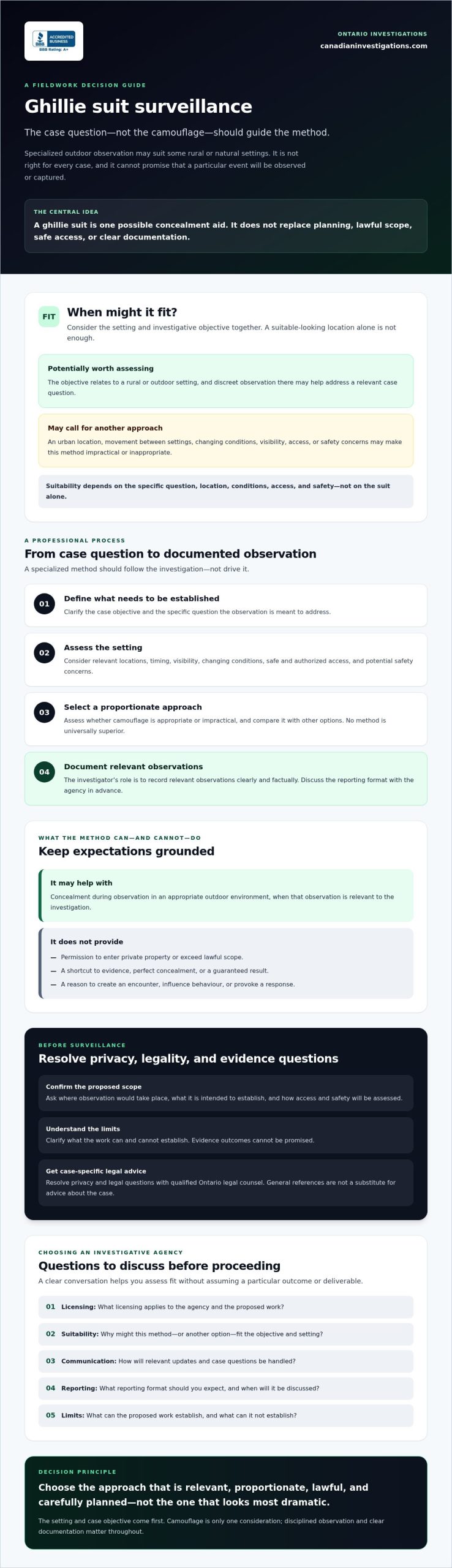
Privacy, legality, and evidence: questions to resolve before surveillance
Before authorizing ghillie suit surveillance services, clarify the purpose and boundaries of the proposed work. Applicable privacy and legal requirements can depend on the facts, location, purpose and how information is collected. A method that seems appropriate in one situation may raise different considerations in another. This section offers general points to discuss, not legal advice.
What should clients ask about privacy and lawful scope?
Ask the agency to define the agreed investigative objective and explain how the proposed work will stay within its scope. Clarify how lawful access boundaries and applicable privacy considerations will be addressed. Also discuss who may receive information about the case and how confidential communications and records are handled. Avoid assuming that a particular observation or recording is permitted simply because it takes place outdoors.
Use this checklist before fieldwork:
- Authority: What is the basis and purpose for the requested investigation?
- Scope: Which locations and activities are relevant, and what boundaries apply?
- Documentation: How will observations be recorded, and what reporting should you expect? Confirm the format with the agency.
- Privacy: Who can access case information, and how will communications and records be handled?
These questions help establish clear expectations without asking a client to direct field conduct. If your matter involves legal proceedings, raise the proposed scope with your lawyer before work begins.
Does surveillance evidence automatically become admissible?
No outcome should be assumed. Whether information can be used, and whether evidence is admissible, depends on the case and the relevant legal processes. An investigator can explain the proposed work and how observations are documented, but shouldn’t promise court acceptance or a particular result. Discuss evidentiary questions with both the investigator and qualified Ontario legal counsel. The lawyer can advise on how those questions apply to your circumstances.
This content is general information, not legal advice. To discuss investigative objectives and the proposed scope, contact Canadian Special Investigations.
Choosing ghillie suit surveillance services in Ontario
Selecting an agency starts with the case, not the equipment. A useful consultation should clarify whether ghillie suit surveillance services fit the setting and the question you need answered. Canadian Special Investigations is a fully licensed private investigation agency based in Toronto and serves clients across Ontario, but the suitability of a particular method still depends on the details of your matter.
What should you ask an investigative agency?
Use these questions to assess the proposed work before authorizing fieldwork:
- Licensing: Can the agency confirm its current licensing and explain who would conduct the investigation?
- Objective: How will the agreed investigative question guide the work, and what can the observations realistically establish?
- Method suitability: Why might a ghillie suit fit this setting? What limitations or alternative approaches should you consider?
- Scope and safety: What boundaries will apply to the work, and how will changes in conditions or safety concerns be addressed?
- Communication and reporting: Who will be your point of contact, how will updates be handled, and how will observations be documented?
Look for clear answers, not guarantees. Ask the investigator to distinguish what the method may help document from what it cannot establish. Confirm the proposed scope and communication expectations before proceeding, and raise legal questions with qualified Ontario counsel where appropriate.
How do you take the next step?
Prepare a concise summary before speaking with an agency. Include the concern prompting the investigation, relevant locations, useful background and the specific question you need answered. Share what you know without directing unsafe conduct or assuming that a particular method is necessary. This gives the investigator a basis to assess the case and explain whether the approach merits consideration.
Canadian Special Investigations offers ghillie suit surveillance among its investigative services and serves clients across Ontario, including Toronto. Field surveillance fees are based on the duration of physical surveillance, so ask how the proposed scope and anticipated fieldwork relate to the fees before proceeding. Request a confidential discussion about your case context, method suitability and what the service can and cannot establish.
Discuss ghillie suit surveillance suitability with Canadian Special Investigations.
Make a considered next move
Ghillie suit surveillance services are a specialized option, not a fit for every investigation. Their potential value depends on the setting, the question to be answered and whether the proposed work can be conducted within appropriate boundaries. A clear discussion of objectives, limitations, alternatives and documentation can help you decide whether this method merits consideration.
Canadian Special Investigations is a Toronto-based, fully licensed investigative agency serving clients across Ontario. An initial case discussion can help clarify the investigative objective and assess whether ghillie suit surveillance or another available approach may be suitable. No method can guarantee a particular observation or outcome.
If you’re ready to discuss your situation, discuss your surveillance requirements confidentially. Bring the relevant context and the question you need answered. A measured, informed conversation is a practical first step toward choosing an approach that fits your needs.
Frequently Asked Questions
What are ghillie suit surveillance services?
Ghillie suit surveillance services are specialized field observation using camouflage in suitable outdoor settings. An investigator may consider this approach when the environment and case objective make discreet observation relevant. The aim is to document observable activity, not to provoke behaviour or create an encounter. Camouflage doesn’t ensure that an activity will be seen or recorded, and it doesn’t replace planning, lawful access or clear documentation.
When might a private investigator use a ghillie suit?
A private investigator might consider a ghillie suit for an investigation involving a rural or natural outdoor setting where the surroundings may support camouflage. Suitability depends on the objective, visibility, access and safety, among other case-specific factors. Urban locations, changing conditions or limited sightlines may make another method more appropriate. The investigator should assess the circumstances rather than assume the suit is useful simply because the work is outdoors.
Is ghillie suit surveillance legal in Ontario?
It can be considered only within the applicable legal and privacy boundaries; the answer depends on the facts, location, purpose and how information is collected. Wearing camouflage doesn’t grant an investigator permission to enter private property or restricted areas. Before work begins, ask the agency to explain the proposed scope and how it will respect lawful access boundaries. For advice about your circumstances, consult qualified Ontario legal counsel.
Can ghillie suit surveillance evidence be used in court?
It may be relevant to a legal matter, but whether information can be used or admitted as evidence depends on the case and applicable legal processes. No investigator can responsibly guarantee court acceptance or a particular outcome. Discuss the objective and evidentiary questions with your lawyer and the investigator before surveillance begins. The investigator can explain how observations are documented, while your lawyer can advise on legal implications.
How do I know whether ghillie suit surveillance is right for my case?
Start with the question you need answered and the setting where relevant activity may occur. Ask an investigative agency to assess whether camouflage is suitable, what the method may establish, its limitations and what alternatives could fit. Consider feasibility, safety, lawful scope and expected documentation. Ghillie suit surveillance services are a specialized option, not a default solution, so a case discussion can help you make an informed choice.
Do ghillie suit surveillance services guarantee results?
No. Ghillie suit surveillance services can’t guarantee that an investigator will observe a particular activity, obtain useful documentation or achieve a specific case outcome. Visibility, conditions, access and the subject’s activity can all affect what is observed. Ask the agency to explain realistic objectives, possible limitations and how observations would be documented. A professional assessment should set clear expectations without promising a result.
What should I prepare before contacting an Ontario investigation agency?
Prepare a concise summary of your concern, the question you need answered, relevant locations and any useful background. Note whether the matter relates to Toronto, Oakville, Burlington, Brampton, Mississauga, Hamilton, Ancaster, Niagara Falls, Kitchener, Waterloo, Scarborough, North York, Richmond Hill, Barrie, Milton, Etobicoke or Guelph. Canadian Special Investigations serves clients across Ontario. Ask about licensing, method suitability, communication, scope and reporting during your discussion.

