A GPS trail can look precise and still tell an incomplete story. In gps tracking for investigations, location records can help establish where a vehicle travelled and when, but they don’t automatically prove who was driving or why it stopped. That distinction matters when privacy, consent and the reliability of evidence are at stake.
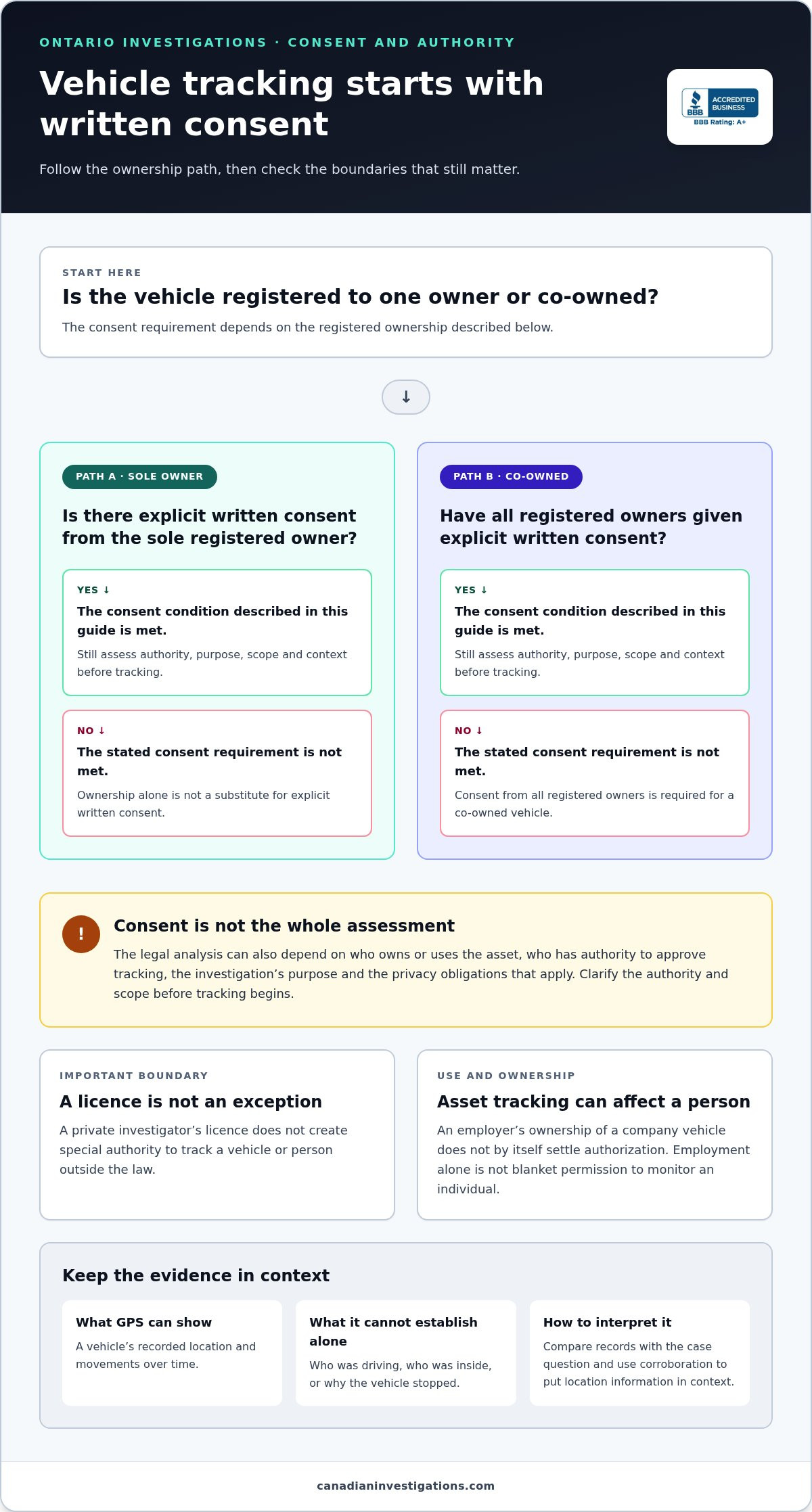
Whether monitoring an asset crosses into tracking a person depends on authority, scope and context. In Ontario, vehicle tracking requires the explicit written consent of the sole registered owner. For a co-owned vehicle, all owners must consent. A private investigator’s licence doesn’t create an exception.
This guide explains how GPS location data is generated and interpreted, what it may establish and where its limits lie. It also covers why clear authorization, careful documentation and corroboration matter, and how GPS tracking can work alongside surveillance and other evidence-gathering methods. Canadian Special Investigations provides GPS tracking and investigative services throughout Ontario, with a focus on methodical planning and evidence in context.
Key Takeaways
- gps tracking for investigations can help map a vehicle’s movements over time, but location records alone don’t identify the driver or explain the purpose of a stop.
- Assess lawful authority, the asset, purpose and scope before tracking begins. Ownership alone may not settle whether tracking is authorized.
- Understand how a GPS system generates, records and transmits location data, and account for configuration limits when interpreting results.
- Start with a clear investigative question, then review the data and decide whether further steps are warranted.
- Use GPS as one part of an evidence plan, with corroboration to put location information in context.
GPS tracking for investigations: what it can, and cannot, show
GPS tracking for investigations collects location data about a vehicle or other monitored asset over time. By itself, it doesn’t prove what a particular person did. A record may indicate that a vehicle was at a location at a particular time, but it doesn’t establish who was driving, who was inside or why the vehicle stopped.
Investigative tracking differs from consumer navigation and routine fleet management. A navigation app helps a user choose a route, while fleet tools may support operational needs such as coordinating vehicles. In an investigation, the question is whether location information can help examine a specific matter. Consider purpose, authority and scope, not just the technology.
A GPS tracking unit uses positioning technology to generate location information. Depending on its configuration, records may be stored or transmitted. A location record, however, isn’t a complete account of events. GPS data can inform an inquiry, but it doesn’t automatically prove conduct, motive or intent.
What location data can reveal during an investigation
Time-stamped records may help map a vehicle’s route, identify recorded stops and examine movement patterns. They’re most useful when considered against a specific case question, such as whether a vehicle’s recorded movements align with a reported timeline. A pattern can point to a need for further inquiry, but it shouldn’t be treated as an explanation on its own. Records may have gaps, and a location point doesn’t show what happened at that place.
Tracking an asset is not the same as tracking a person
Ownership, possession, use and authority to track are separate considerations. For example, an employer may own a company vehicle that an employee or another person uses. Registered ownership doesn’t, by itself, resolve whether tracking is authorized or what privacy considerations apply. Employment alone shouldn’t be treated as blanket permission to monitor an individual.
Interpret location data in context. Other evidence may help establish who had access to the vehicle, who was present or what a stop meant. Without corroboration, GPS can show a vehicle’s recorded movements, but it can’t reliably attribute them to a person. This distinction helps keep an asset-focused record from being overstated as proof of someone’s actions.
How GPS tracking works: signals, records, and practical limits
A GPS receiver estimates its position by interpreting signals from satellites in the Global Positioning System. A tracking device may then record that estimate, attach a timestamp and, depending on its configuration, transmit the information to a platform. These are separate steps: satellite signals help calculate location, while a network connection may send the record.
GPS records show estimated device locations, not independently verified identity. A mapped point can indicate where a device was estimated to be at a particular time. It doesn’t confirm who carried or used the device, who was in a vehicle or what happened at the location.
From satellite signals to a time-stamped location record
The receiver uses satellite signals to estimate a position. Depending on the system’s design and settings, the tracking system may save that position locally or transmit it. Network connectivity doesn’t determine the GPS position, but it can affect whether or when information reaches a remote platform. A record may appear as a time-stamped point or as a series of points on a map. Neither format explains the surrounding events.
For gps tracking for investigations, read the records against the case question. A sequence of mapped points, for instance, may help assess whether a vehicle’s recorded movements align with a reported timeline. Timestamps, reporting settings and gaps all matter to that assessment.
Why GPS records can contain gaps or uncertainty
Conditions can affect the location estimate or the availability of a transmitted record. Buildings, enclosed parking areas and terrain may obstruct or weaken satellite signals. Weak network connectivity may delay or interrupt transmission, even if the device has estimated a position. Power loss can also stop a device from recording or reporting.
Setup matters as well. Reporting intervals affect how frequently points are available, while device configuration influences what gets recorded and how it is displayed. A route drawn between two points may look continuous even when the system didn’t record every movement in between. A precise-looking map pin isn’t a guarantee of equal accuracy in every setting. Don’t assume a universal accuracy figure without verified information about the device and conditions.
Ontario investigators must consider professional conduct alongside technical limits. The Ontario private investigator code of conduct is a government reference for standards governing investigative work. Careful interpretation means distinguishing a device’s recorded location from a conclusion about a person. For case-specific GPS tracking and evidence planning, professional GPS tracking services can place location records within a broader investigative approach.
Is GPS tracking legal in Ontario investigations?
There isn’t a single answer for every situation. The legal analysis can depend on the asset, who owns or uses it, who has authority to approve tracking, the investigation’s purpose and the privacy obligations that apply. A private investigator’s licence doesn’t provide special authority to track a vehicle or person outside the law.
Assess lawful authority and privacy implications before tracking begins. Ownership is relevant, but it shouldn’t be treated as universal permission to monitor every use of a vehicle or everyone who may travel in it. Ontario’s guidance for private investigators identifies the vehicle owner’s permission as necessary for GPS tracking. Where ownership is shared or authority is unclear, don’t assume one person can authorize tracking on everyone’s behalf.
Authority, privacy, and purpose must be assessed together
Consider the relationship between the person authorizing tracking, the vehicle, its users and the investigation. A company’s ownership of a vehicle, for example, doesn’t by itself answer every privacy question about monitoring an employee’s movements. Purpose and scope matter, too. Limiting collection to information relevant to a defined investigative question is a sound planning principle, not a guarantee of legality.
Ontario and federal privacy requirements may also be relevant, depending on the parties and circumstances. If authority, consent or privacy obligations are uncertain, obtain advice from qualified legal counsel before proceeding. Professional status doesn’t replace that assessment. Pursuit Magazine discusses the potential legal consequences for both the client and investigator when GPS tracking is undertaken without proper authority.
What Ontario clients should understand about evidence
Lawful collection and admissibility are related, but they’re separate questions. Evidence isn’t automatically admissible because it came from a GPS device. Admissibility depends on the circumstances and the decision-maker. Records may need to be authenticated and explained, including how they were generated, what device they relate to and whether gaps or other limitations affect their interpretation.
Context matters. Corroborating evidence may help connect a location record to the issue under investigation, while the location data alone may not establish who was present or what occurred. The article on admissible evidence for Ontario courts provides further context on how evidence may be assessed. For gps tracking for investigations, careful authorization and documentation should come before any assumption about what records can prove.
How investigators plan GPS tracking for an investigation
A sound plan starts with the case, not the equipment. Before considering GPS tracking, define the uncertainty to address and assess whether location data is relevant, properly authorized and proportionate to that purpose. A focused plan helps prevent an asset inquiry from expanding into unnecessary monitoring of people.
Set the investigative question and define appropriate scope
The initial assessment should identify the relevant asset, the issue under investigation, the proposed time period and the basis for authority. Include privacy considerations in that review. If authority is unclear, resolve that question before proceeding. Set boundaries tied to the case objective, and don’t broaden them without a specific investigative reason.
A practical planning sequence for gps tracking for investigations may include:
- Define the objective. State what uncertainty location records are intended to clarify.
- Assess authority and relevance. Identify the asset and basis for tracking, and consider applicable privacy obligations.
- Set a focused scope. Establish the relevant period and limits connected to the investigative question.
- Review the records. Compare available location points and timestamps with known events, noting gaps and technical limitations.
- Plan the next step. Decide whether the records answer the question, need further context or point to another lawful investigative method.
Review records, document context, and determine next steps
Interpret the data against the objective rather than treating a map as a complete account. Compare timestamps with known events and note apparent interruptions or missing points. Document limitations identified during the review, including where the data doesn’t support a conclusion. A recorded location isn’t, by itself, proof of who was present or what they did.
If the inquiry requires confirmation of activity at a location, field surveillance may provide observations to compare with GPS records. The choice depends on the case question, authority and circumstances. GPS should inform a broader plan, not dictate conclusions. An Ontario guide to specialized surveillance offers further reading on complementary methods.
Canadian Special Investigations plans GPS tracking as part of investigative work, with attention to scope and evidence context. The GPS tracking service information explains how location information can fit within a focused evidence-gathering plan.
When GPS tracking fits professional investigations in Ontario
GPS tracking may assist an asset-focused inquiry when the proposed monitoring is lawful, relevant to a defined question and appropriately scoped. It can help examine movement patterns involving a vehicle or other asset, but it isn’t a complete account of what happened. Location records alone may not identify occupants, explain why a vehicle stopped or establish anyone’s intent.
Cases where location information may support fact-finding
In a corporate inquiry, authorized location information about a company vehicle may help assess whether its recorded movements align with a reported schedule or business activity. In an insurance matter, relevant vehicle movement may add context to a claim-related timeline. Each use depends on the facts, lawful authority, privacy considerations and a scope tied to the investigation.
For claims-related questions, an Ontario guide to insurance fraud surveillance explains how surveillance may contribute to fact-finding. GPS records should still be weighed against their limitations and the available corroborating evidence. A mapped route doesn’t, on its own, establish who was in the vehicle or what occurred during a stop.
GPS can also be used alongside professional field surveillance or other evidence-gathering methods. If direct observation is relevant, specialized surveillance, including drone surveillance where appropriate, may form part of the broader plan. An Ontario guide to drone surveillance provides further context on that method. The right approach depends on the case, authority and applicable requirements, not simply on which technology is available.
How Canadian Special Investigations can assess the investigative fit
Canadian Special Investigations is a licensed private investigation agency based in Toronto and serving clients throughout Ontario. Its investigative work includes GPS tracking, surveillance and evidence gathering. The agency assesses whether location information is relevant to the stated objective and how it may fit within a broader evidence-gathering plan.
This assessment focuses on what the records can reasonably contribute, where they may fall short and whether another method could provide useful context. No single data source should be treated as a guaranteed answer. Discretion, careful planning and sound interpretation remain central.
If you’re weighing GPS tracking for an investigation, a confidential discussion with Canadian Special Investigations can help clarify how asset-focused tracking may fit your circumstances and objectives.
Make your next investigative step a considered one
GPS tracking can provide useful location records, but those records have limits. They may help map an asset’s movements, but they don’t independently establish who was present, what happened or why. Their value depends on lawful authority, a defined scope and careful interpretation alongside relevant evidence.
For gps tracking for investigations in Ontario, begin with the case objective, assess privacy and authority before tracking, then consider whether surveillance or other evidence-gathering methods can add context. Treat location data as one part of an investigative plan, not a complete answer.
Canadian Special Investigations is a fully licensed private investigation agency based in Toronto, serving clients throughout Ontario with GPS tracking, surveillance and evidence-gathering services. Each inquiry calls for a measured approach shaped by its facts and objectives.
For a confidential discussion about your circumstances and possible investigative next steps, contact Canadian Special Investigations or call 905-332-4807.
Frequently Asked Questions
Is GPS tracking legal for private investigations in Ontario?
It may be lawful when the required authority and consent are in place, but a private investigator’s licence doesn’t grant special permission to track a vehicle. Ontario guidance requires explicit written consent from the sole registered owner. If the vehicle is co-owned, all registered owners must consent. The investigation’s purpose, scope and applicable privacy requirements also matter. If authority is uncertain, seek qualified legal advice before tracking begins.
Can GPS tracking prove who was driving a vehicle?
No. GPS records show the estimated location of a device, not the identity of the driver or occupants. For example, a record showing a vehicle at a workplace at a particular time doesn’t establish which employee drove it or who was inside. Investigators assess location data alongside relevant records, observations and case context. Any conclusion about a person requires supporting evidence, not location points alone.
How does GPS tracking work in an investigation?
In gps tracking for investigations, a receiver uses satellite signals to estimate the device’s location. Depending on its configuration, a tracking system may save time-stamped location records or transmit them over a network. Satellite signals determine the estimated position; network connectivity may affect when records are sent. Investigators review available points against the case question, noting reporting intervals, interruptions and other limitations before drawing conclusions.
Can GPS tracking evidence be used in an Ontario court?
GPS records may be presented for consideration, but their use isn’t automatic and no outcome can be guaranteed. The decision-maker may need to assess how the records were generated, whether they can be authenticated and what the data establishes in context. Lawful collection and admissibility are related but separate issues. Gaps, device limitations and the absence of evidence identifying occupants may affect how much weight the records carry.
What are the limitations of GPS tracking for investigations?
GPS data can contain gaps or uncertainty. Buildings, enclosed parking, terrain, device power, reporting settings and network interruptions may affect available records or their transmission. A mapped point may show an estimated device location, but it doesn’t independently identify who was present, explain a stop or establish intent. In gps tracking for investigations, careful interpretation and corroboration help keep conclusions within what the records can support.
Can GPS tracking be used for a company vehicle investigation?
It may be considered when tracking is properly authorized, relevant to the inquiry and appropriately scoped. Company ownership alone shouldn’t be treated as automatic permission to monitor every user or trip. In Ontario, employers with 25 or more employees must have a written electronic monitoring policy disclosing how and why employees are monitored, including GPS tracking of company vehicles. That policy doesn’t remove the need to assess authority and privacy obligations for the specific case.
When should GPS tracking be combined with surveillance?
Consider combining methods when location records help identify a relevant time or place but don’t show who was present or what occurred. Professional surveillance may provide observations that add context or corroborate a timeline, depending on the case and lawful authority. Canadian Special Investigations provides GPS tracking, surveillance and evidence gathering throughout Ontario, including Toronto, Oakville, Burlington, Brampton, Mississauga, Hamilton, Ancaster, Niagara Falls, Kitchener, Waterloo, Scarborough, North York, Richmond Hill, Barrie, Milton, Etobicoke and Guelph.

