In the Ontario judicial system, the difference between a painful suspicion and a successful legal filing isn’t the truth of the affair; it’s the tactical admissibility of your evidence. While Canada operates under a no-fault divorce framework, establishing adultery remains a specific legal pathway that requires more than just gut feelings or circumstantial clues. You’re likely feeling the weight of uncertainty, wondering if your efforts to uncover the truth might actually jeopardize your legal standing or violate privacy laws. Understanding how to prove infidelity in Ontario requires a methodical approach that prioritizes legal compliance over emotional impulse.
This guide provides the strategic clarity you need to gather proof that holds up under the scrutiny of a judge. You’ll learn exactly which methods of evidence collection are recognized by the Ontario Superior Court of Justice and how to avoid the common pitfalls of DIY surveillance that can lead to legal blowback. We’ll examine the specific types of documentation required, the role of professionalized surveillance in securing admissible facts, and how to build a case that provides the peace of mind you deserve through factual certainty.
Key Takeaways
- Define the legal role of adultery under the federal Divorce Act to ensure your case is built on a solid judicial foundation.
- Identify the specific types of circumstantial evidence that meet the “balance of probabilities” standard required in Ontario courts.
- Learn the tactical methods for how to prove infidelity ontario while maintaining strict compliance with provincial privacy laws.
- Eliminate the legal risks of harassment or stalking charges by transitioning from DIY efforts to professionalized, methodical surveillance.
- Discover how advanced tools like Ghillie suits and UAV technology provide high-quality proof in rural or difficult-to-monitor locations.
Understanding Adultery and the Divorce Act in Ontario
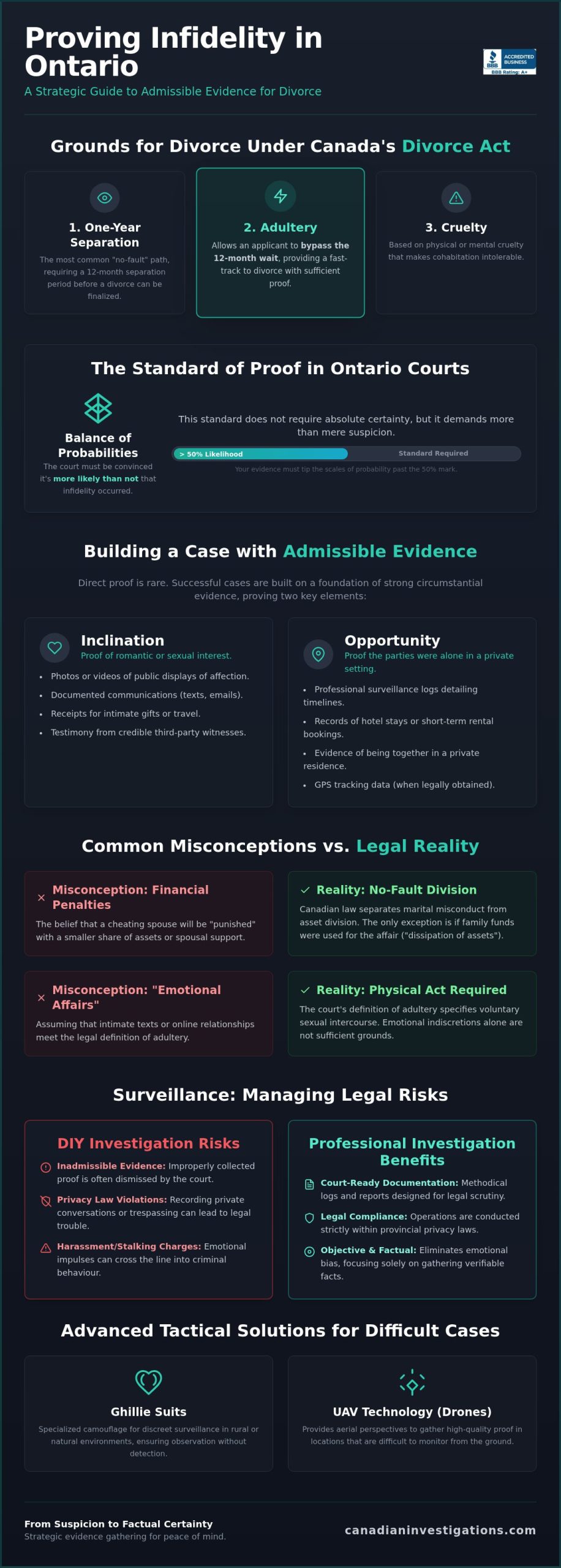
Canada’s Divorce Act governs the dissolution of marriage across all provinces. In Ontario, the system is fundamentally “no-fault,” meaning the court generally doesn’t seek to assign blame for the marriage’s end. Blame doesn’t drive the division of assets. Fault-based grounds still exist within the federal framework. To understand how to prove infidelity in Ontario, you must first recognize that Adultery is one of the three legal reasons a court will grant a divorce decree. The other two are physical or mental cruelty and a one-year separation period. While most residents opt for the separation path, proving infidelity offers a specific tactical advantage for those who require an immediate resolution to their marital status.
The Legal Utility of Proving Infidelity
Proving adultery allows an applicant to bypass the mandatory 12-month waiting period required for a “no-fault” filing. Choosing this fast-track option is crucial when a spouse needs to finalize legal proceedings quickly to move forward with their life or secure their personal situation. Beyond the timeline, obtaining factual certainty provides a necessary sense of closure. For the Ontario Superior Court of Justice, adultery is defined as a spouse having voluntary sexual intercourse with a person other than their partner. Suspicion alone isn’t sufficient for a judge. The court requires admissible proof that the act occurred or that the opportunity and inclination were undeniably present. Adopting this tactical approach turns a messy emotional situation into a clear-cut legal application.
Common Misconceptions About Ontario Divorce Law
A frequent error among clients is the belief that a cheating spouse will face financial penalties during the settlement. Canadian law doesn’t support “punishing” an unfaithful partner through asset division or spousal support. The court views the equitable distribution of property as a separate matter from marital misconduct. However, there is a specific exception. If a spouse has used family funds to support an affair, such as purchasing expensive gifts or paying for travel, this could be considered a “dissipation of assets.” In these instances, the court may adjust the financial outcome to compensate the slighted party.
The law also distinguishes between emotional indiscretions and physical acts. An “emotional affair” via text or social media, while devastating, doesn’t meet the legal threshold for adultery in a divorce application. That’s why professional evidence gathering for divorce is essential. It moves the case from hearsay to a documented reality that a lawyer can present with confidence. Learning how to prove infidelity in Ontario involves shifting your focus from moral outrage to the collection of hard, verifiable data that satisfies judicial standards. You need results, not just suspicions.
Admissible Evidence: What Counts in an Ontario Court?
In family law proceedings, the court doesn’t require absolute certainty to establish adultery. Instead, judges rely on the “balance of probabilities” standard. This means you must prove that it’s more likely than not that the infidelity occurred. While the Divorce Act lists adultery as a ground for divorce, the burden of proof rests entirely on the applicant. Understanding how to prove infidelity in Ontario involves moving beyond emotional narratives and focusing on verifiable, tactical facts that a judge can objectively evaluate.
Direct evidence, such as a signed confession or explicit video footage, is rare and often difficult to obtain without violating strict privacy laws. Most successful cases rely on circumstantial evidence. Third-party testimony from witnesses can add weight, but “he-said, she-said” arguments usually fail in a judicial setting. Without corroborating documentation or professional surveillance logs, oral testimony is easily dismissed as biased or unreliable. The court requires a cohesive story built on documented events rather than personal grievances.
Circumstantial Evidence: Inclination and Opportunity
To secure a finding of adultery, courts look for two specific pillars: inclination and opportunity. Inclination refers to proving the parties had a romantic or sexual interest in each other. This is often established through photos of public displays of affection, intimate gift exchanges, or documented communications. Opportunity involves proving the parties were alone in a private setting for a sufficient duration to commit the act. Surveillance logs are critical here. They create a meticulous timeline that places the subjects together in a private location, such as a hotel or residence, during hours that suggest more than a platonic meeting. When these two pillars are combined, they create a compelling legal argument that satisfies the balance of probabilities. The same evidentiary standards that apply to adultery cases also govern related matters such as proof of cohabitation in Ontario, where establishing a shared residence requires equally meticulous documentation of daily patterns and living arrangements.
Digital Evidence and Privacy Constraints
Digital footprints are powerful tools, but they come with significant legal risks. Text messages, emails, and social media posts can serve as admissible evidence for Ontario court, provided they were accessed legally. Hacking into a spouse’s password-protected accounts or installing unauthorized “spyware” is a violation of privacy that can lead to criminal charges. Evidence obtained through illegal means is likely to be thrown out, rendering your efforts useless and potentially damaging your reputation in the eyes of the court. Professional domestic investigations ensure that every piece of data is secured within the bounds of the law, protecting your case from being compromised by procedural errors or privacy violations. We prioritize the tactical acquisition of data while maintaining full legal compliance.
DIY vs. Professional Surveillance: Managing Legal Risks
Attempting to uncover the truth personally often leads to catastrophic legal consequences. In Ontario, the line between gathering evidence and criminal harassment is dangerously thin. If you follow a spouse or monitor their movements yourself, you risk being charged under provincial stalking laws. The court recognizes a reasonable “Expectation of Privacy,” even within a marriage. Violating this expectation through invasive DIY methods doesn’t just damage your credibility; it can destroy your entire legal case. When you’re determining how to prove infidelity in Ontario, you must prioritize legal compliance to ensure your findings are actually usable in court.
The Dangers of Illegal Tracking
Many people mistakenly believe they can use modern technology to simplify the evidence-gathering process. However, the legal reality of GPS trackers in Ontario is strict. Deploying a tracker on a vehicle you don’t solely own or have specific legal access to can constitute a criminal offence. Judges are increasingly sensitive to “technological stalking,” and unauthorized tracking often results in the evidence being thrown out immediately.
Section 184 of the Criminal Code of Canada presents another significant hurdle. It’s illegal to record a private conversation that you aren’t part of. If you hide a recording device in a room or car to capture your spouse’s calls, you’ve committed a crime. This data is considered “fruit of the poisonous tree.” Because the source is illegal, the evidence is ignored by the Ontario Superior Court of Justice. You’re then left with no admissible proof and a potential criminal record that could haunt your divorce settlement or parenting applications.
The Tactical Advantage of a Licensed Investigator
A licensed Private Investigator serves as an objective, third-party witness whose testimony carries significant weight in a courtroom setting. Unlike a slighted spouse, a professional investigator has no emotional stake in the outcome, making their evidence far more credible to a judge. Professional reports are structured meticulously to meet the specific requirements of Ontario family law lawyers, providing a clear, chronological timeline of events supported by high-quality imagery.
By utilizing matrimonial surveillance services in Ontario, investigators employ tactical discipline to remain completely undetected. This prevents the subject from “going underground” or altering their patterns. Our role as a “silent professional” ensures that the evidence is gathered discreetly and legally. We provide the factual certainty your legal team needs while protecting you from the blowback of privacy law violations. This methodical approach turns a volatile situation into a controlled, evidence-driven process.
The Tactical Evidence-Gathering Process
Securing admissible proof requires a disciplined, multi-phase operation. It isn’t a matter of luck; it’s a matter of methodology. When clients ask how to prove infidelity in Ontario, they’re often surprised by the depth of preparation required before a single investigator enters the field. We follow a rigorous five-step process to ensure every detail is captured with judicial precision.
- Initial Consultation: We establish clear legal objectives and define what constitutes a successful outcome for your lawyer.
- Intelligence Gathering: Our team analyzes known patterns to identify “zones of interest” and high-probability windows for surveillance.
- Field Execution: Tactical teams deploy specialized equipment to document the subject’s actions in real-time.
- Reporting: We compile a meticulous, chronological report supported by time-stamped visual evidence.
- Legal Integration: You take the completed evidence package to your family law professional for a final review.
Phase 1: Intelligence and Pattern Recognition
Before physical surveillance begins, we conduct thorough background research to establish an operational perimeter. This involves documenting anomalies such as sudden changes in work schedules, unexplained financial transactions, or suspicious travel patterns. Learning how to prove infidelity in Ontario effectively starts with identifying the “co-respondent” or third party involved to build a complete narrative. In high-density areas like Mississauga or Hamilton, we look for the “who, where, and when” to ensure our field teams are positioned for maximum effectiveness. This intelligence-led approach minimizes wasted hours and maximizes the probability of capturing critical interactions.
Phase 2: Field Operations and Visual Capture
Field execution relies on high-grade technology and tactical discipline. Our investigators use long-range optics to document meetings in public spaces from a safe, undetectable distance. This ensures the subject remains unaware while we secure the visual proof your case requires. We maintain a strict chain of custody for all digital files and photographs, ensuring they remain untampered and admissible in court. Time-stamped video serves as the gold standard for proving opportunity because it provides an irrefutable, continuous record of the subject entering or exiting a private location with the third party. If you need a professional domestic investigation to secure these facts, we are ready to deploy immediately.
CSI Tactical Solutions: Beyond Standard Surveillance
Canadian Special Investigations (CSI) operates as a sophisticated ally for those facing the complexities of marital breakdown. We don’t just provide a service; we deliver a strategic advantage through decades of industry experience across the Greater Toronto Area. Our approach to domestic investigations is rooted in tactical discipline and the use of advanced technology that sets us apart from generalized agencies. When you’re identifying how to prove infidelity in Ontario, you need a partner who understands that standard surveillance often falls short in high-stakes or non-traditional environments. We operate as silent professionals, ensuring that your sensitive issues are handled with absolute precision and discretion.
Advanced Surveillance Technology
Traditional ground surveillance has limitations, particularly when subjects move into rural areas or gated estates. To counter these challenges, we utilize specialized Camo Ghillie Suit Surveillance Services. This technique allows our investigators to maintain static, long-term observation in outdoor settings without being detected, providing a level of concealment that a standard vehicle or pedestrian approach cannot offer. By blending into the environment, we secure high-quality visual proof from positions that would otherwise be impossible to hold.
Our aerial capabilities further enhance our evidence-gathering toolkit. Through U.A.V. (Quadcopter / Drones) Surveillance, we monitor subjects in non-traditional settings such as remote cabins, large rural properties, or public parks where ground-based teams might be easily spotted. This aerial perspective provides an irrefutable record of meetings and interactions that occur away from the city centre. Every high-tech method we employ is carefully executed to remain within the bounds of Ontario law, ensuring that the data we capture is both accurate and admissible. We prioritize your security and legal standing while providing the factual certainty required for your case.
Next Steps: Securing Your Future
Securing the truth is the first step toward reclaiming your peace of mind. Once the evidence is gathered, it becomes a powerful component of your broader legal strategy. Many clients find that our findings are equally critical for other family law matters, such as establishing patterns of behaviour for child custody surveillance Ontario. We work closely with your legal team to ensure our reports are integrated seamlessly into your filings, providing the objective documentation needed to support your position.
Discretion is our hallmark. We understand the emotional weight of these situations and maintain absolute confidentiality throughout every phase of the investigation. If you’re ready to move from suspicion to factual certainty, our Toronto-based team is prepared to act immediately. You don’t have to navigate this uncertainty alone. Consult with a tactical infidelity investigator today to discuss your specific requirements and develop a methodical plan for your protection.
Establishing Factual Certainty in Your Legal Strategy
Transitioning from emotional suspicion to a successful legal filing requires a methodical, evidence-driven approach. You now understand that meeting the “balance of probabilities” standard in court depends on admissible proof that establishes both inclination and opportunity. By choosing professionalized surveillance over risky DIY methods, you ensure that every piece of data remains untainted by privacy law violations. Navigating how to prove infidelity in Ontario is ultimately about securing a tactical advantage that provides the clarity your legal team requires to move forward.
Canadian Special Investigations offers the specialized resources needed for these sensitive domestic cases. As a firm licensed by the Ministry of the Solicitor General, we utilize high-tech surveillance and tactical concealment to capture irrefutable proof. We serve clients across Toronto, Oakville, Burlington, and the entire GTA with absolute discretion and precision. Don’t leave your future to chance or uncorroborated claims. Secure the tactical evidence you need—Contact Canadian Special Investigations for a confidential consultation today. You deserve the peace of mind that only factual certainty can provide.
Frequently Asked Questions
Is adultery a crime in Ontario?
Adultery is not a criminal offence in Ontario or anywhere else in Canada. While it serves as one of the legal grounds for divorce under the federal Divorce Act, it’s strictly a civil matter handled within the family court system. You won’t face police intervention or criminal charges for infidelity. However, the tactical evidence gathered during a domestic investigation is used to satisfy judicial requirements for a fault-based divorce decree rather than criminal prosecution.
Can I use a GPS tracker on my spouse’s car in Ontario?
Using a GPS tracker on a spouse’s vehicle without their knowledge is legally complex and often prohibited. In Ontario, deploying tracking technology on a vehicle you don’t solely own can lead to criminal harassment or privacy violation charges. Licensed investigators follow strict provincial regulations when utilizing GPS tracking as part of a professional operation. Unauthorized DIY tracking typically results in the evidence being ruled inadmissible in an Ontario Superior Court of Justice hearing.
Do I need to name the “other person” in my divorce application?
Yes, if you are filing for divorce specifically on the grounds of adultery, you must generally name the third party as a co-respondent in your application. This individual is legally entitled to be served with the documents and may choose to defend the allegation. This requirement is one reason many residents in Toronto and Oakville choose the one-year separation path instead. Identifying the co-respondent is a formal step in establishing the legal basis for the claim.
Will proving infidelity help me get more spousal support?
Proving infidelity rarely impacts the amount of spousal support awarded in Ontario. Because Canada follows a no-fault divorce system, the court focuses on financial need and the ability to pay rather than marital misconduct. An exception exists only if the unfaithful spouse significantly depleted family assets to fund the affair. In most cases, the evidence is used to bypass the one-year waiting period rather than to influence the final financial settlement or asset division.
Can text messages be used as proof of adultery in court?
Text messages can be used as evidence, but they must be obtained through legal means to remain admissible. Messages that were volunteered or found on a shared family device are generally acceptable. However, hacking into a password-protected account or using spyware to intercept private communications is illegal under the Criminal Code. When determining how to prove infidelity in Ontario, professional investigators focus on gathering external, tactical proof that doesn’t rely on potentially compromised digital data.
What happens if I catch my spouse cheating through an illegal recording?
Evidence obtained through illegal recording is almost always excluded from Ontario court proceedings. Section 184 of the Criminal Code prohibits intercepting private communications you aren’t part of. If you use a hidden microphone to record your spouse, you risk facing criminal charges yourself. Judges apply the “fruit of the poisonous tree” doctrine, meaning the evidence is ignored regardless of what it proves. This makes professional, legal surveillance the only viable path for securing admissible proof.
How long does an infidelity investigation typically take?
The duration of an infidelity investigation depends on the subject’s specific patterns and the frequency of their meetings. Most operations in the GTA require several days of targeted surveillance to document a consistent timeline of inclination and opportunity. We begin with intelligence gathering to identify high-probability windows, which minimizes the time spent in the field. A typical case might conclude within one to two weeks once irrefutable visual proof is secured and processed.
Is a private investigator’s report admissible in an Ontario divorce hearing?
A report from a licensed private investigator is fully admissible in an Ontario divorce hearing. Because investigators are considered objective third parties, their documentation carries significantly more weight than the testimony of a slighted spouse. Our reports are meticulously structured with time-stamped visual evidence and chronological logs to meet judicial standards. This professional documentation provides the factual certainty needed for your lawyer in Toronto or Mississauga to present a compelling case. Cases involving separation and shared living arrangements may also require investigators to gather proof of cohabitation in Ontario to verify whether a common-law relationship exists, which can directly affect spousal support calculations.

