Paperwork is easily forged, but a person’s daily patterns are impossible to hide from a professional lens. Whether you are dealing with a partner hiding their true residence or trying to secure proof of cohabitation ontario authorities require for the CRA’s twelve-month rule, the stakes are too high to rely on flimsy documentation. You likely feel the weight of the “one-year” versus “three-year” confusion, worrying that your current evidence won’t survive a courtroom challenge. It’s a common anxiety, especially when your financial security or immigration status depends on a verified result.
This 2026 evidence guide ensures you master the legal requirements and tactical methods needed to establish a common-law relationship. We provide a clear checklist of admissible evidence, from joint utility bills to professional surveillance logs. You’ll learn how to leverage technical expertise to document the lived reality of a shared residency. This article outlines exactly how to build a case that is both methodical and indisputable, giving you the strategic advantage required to secure a favourable outcome in any legal or domestic dispute.
Key Takeaways
- Differentiate between the three-year provincial rule for spousal support and the one-year federal rule to ensure your documentation meets the correct legal threshold.
- Master the 7-point framework used by Ontario judges to evaluate shared residency, focusing on shelter, household chores, and social representation.
- Combine traditional paper trails with physical surveillance to build an unshakeable body of proof of cohabitation ontario courts will find admissible and persuasive.
- Discover how documenting “patterns of life” provides a strategic advantage when dealing with deceptive subjects who attempt to hide their true residency.
- Learn how advanced technology like UAV drone surveillance offers a professional, unobtrusive method for verifying residency in complex domestic or legal cases.
Understanding Cohabitation and Common-Law Status in Ontario
Ontario law doesn’t view cohabitation as a simple shared lease. It requires a “conjugal relationship,” a legal standard that separates romantic partners from mere roommates. Establishing proof of cohabitation ontario courts will accept involves more than showing a shared address; it requires demonstrating a combined life. In 2026, the distinction between various legal thresholds is sharper than ever. You must understand which rule applies to your specific situation before gathering evidence, as the requirements for spousal support differ significantly from tax or immigration mandates.
The Legal Definition of Co-habiting
The Family Law Act defines cohabitation as living together in a conjugal relationship, whether within or outside marriage. This distinction is vital. A roommate situation lacks the financial, social, and sexual interdependence that characterizes a common-law union. Judges look at the “lived reality” of the couple rather than just names on a document. Common-law relationships in Canada are governed by both provincial and federal statutes, making the specific context of your residency critical. If one party claims they were merely a guest or a tenant, the burden of proof shifts to documenting daily interactions and shared responsibilities. Evidence must show that the parties have merged their lives in a way that suggests a permanent union.
Why Proving Residency is Critical in 2026
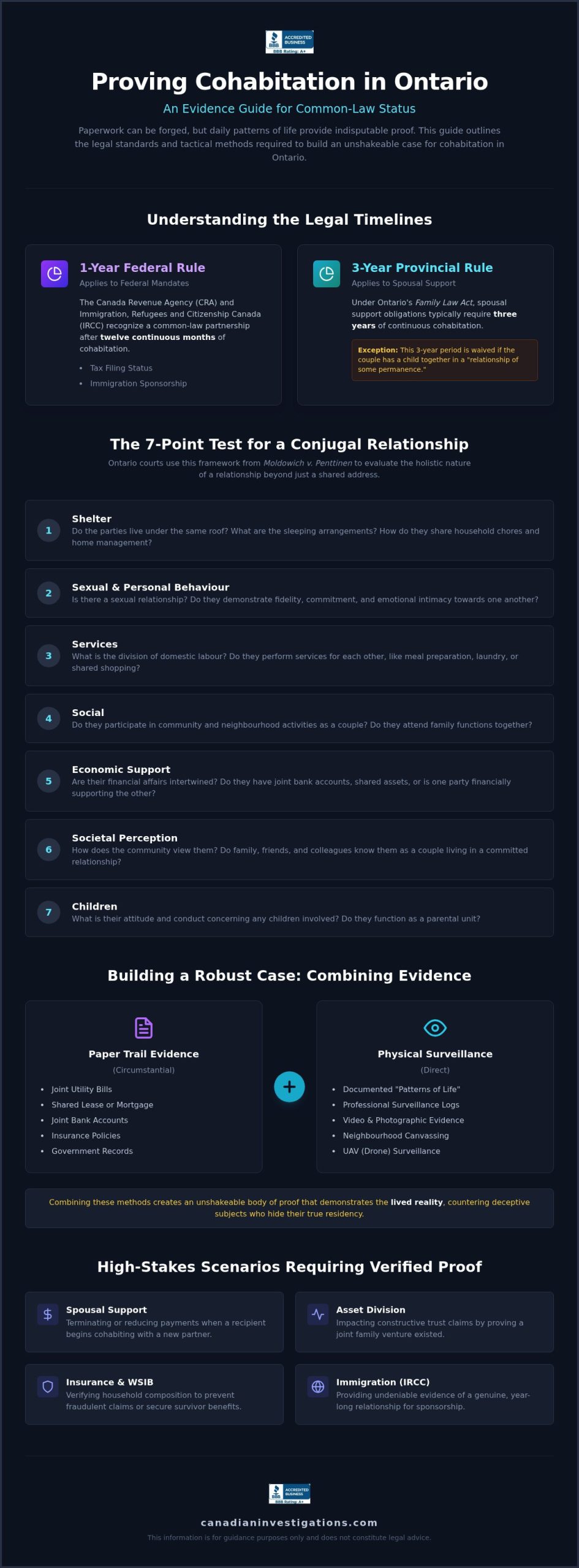
The timeline for legal recognition depends entirely on the purpose of the claim. For spousal support under provincial law, Ontario requires three years of continuous cohabitation. However, if the couple has a child together, this three-year requirement is waived in favour of a “relationship of some permanence.” Contrast this with federal mandates; the Canada Revenue Agency (CRA) and Immigration, Refugees and Citizenship Canada (IRCC) typically recognize a common-law partnership after only twelve continuous months. Accuracy is paramount here, as misrepresenting these timelines can lead to allegations of fraud or the dismissal of a legitimate claim.
High-stakes scenarios often involve deceptive subjects attempting to avoid financial obligations. Common triggers for needing verified evidence include:
- Spousal Support: Terminating or reducing payments when a recipient begins cohabiting with a new partner.
- Asset Division: While common-law partners don’t have automatic property rights in Ontario, proving a joint venture can impact constructive trust claims.
- Insurance and WSIB: Verifying household composition to prevent fraudulent claims or to secure survivor benefits.
- Immigration: Providing IRCC with undeniable evidence of a genuine, year-long relationship for sponsorship.
Intent matters as much as the physical address. A subject might maintain a separate “paper address” while physically residing elsewhere to manipulate these legal thresholds. Identifying the discrepancy between their stated residence and their actual pattern of life is where tactical evidence gathering becomes essential. You need to prove not just where they receive mail, but where they actually sleep, eat, and spend their domestic life.
The 7-Point Test: How Ontario Courts Define Living Together
Ontario courts don’t rely on a single document to determine common-law status. Instead, they apply a rigorous seven-point framework derived from the landmark case Moldowich v. Penttinen. This test examines the holistic nature of the relationship to determine if it truly meets the definition of “conjugal.” When gathering proof of cohabitation ontario judges will find credible, you must address these specific categories: shelter, sexual and personal behaviour, services, social activities, economic support, societal perception, and children.
Shelter involves more than just a shared roof. It looks at the division of household chores and the daily management of the home. Sexual and personal behaviour focuses on the commitment between parties, including fidelity and the level of emotional intimacy shared. Services refer to the domestic tasks performed for one another, such as meal preparation or shared shopping. Socially, the court evaluates whether the couple attends community or family events as a unit. Understanding the legal rights for common-law partners requires a deep dive into how these factors overlap in your specific case. If you suspect a subject is misrepresenting these factors, professional legal investigations can provide the clarity needed for court.
Economic Support and Financial Integration
Financial interdependence is a heavyweight factor in Ontario courtrooms. Judges analyze joint bank accounts and shared credit cards to see if the couple functions as a single economic unit. Beneficiary designations on life insurance policies or RRSPs serve as potent evidence of a long-term commitment. Small details matter too; regular shared expenses for groceries or utility bills help build a persuasive narrative of financial integration. Courts look for a pattern where one partner supports the other or where both pool resources to maintain their lifestyle.
Societal Perception and Children
Societal perception serves as a key judicial pillar, measuring how the community recognizes the couple’s status as a single unit. This category examines how family, friends, and neighbours view the relationship. Do they see two individuals or a committed couple? The presence of a child significantly alters the cohabitation timeline. As established in previous sections, having a child together can waive the standard three-year cohabitation requirement for spousal support, provided the relationship has “some permanence.” Evidence of joint parenting, such as school records or medical documents listing both parties, provides undeniable proof of cohabitation ontario authorities respect.
Direct vs. Circumstantial Evidence: Building a Robust Case
Static documents often provide the foundation for a legal claim, but physical evidence builds the walls of a courtroom case. While a signed lease or a joint utility bill serves as direct proof of cohabitation ontario judges recognize, these records are easily manipulated. Deceptive subjects frequently maintain a “paper” address at a relative’s home to avoid financial obligations or to preserve support payments. In contested cases, circumstantial evidence becomes the more persuasive force. This involves documenting the observed reality of where a person actually sleeps, eats, and parks their vehicle over an extended period.
Ontario judges prioritize a hierarchy of evidence that values consistency and verifiable patterns. Professional surveillance logs often carry more weight than a simple statutory declaration because they capture a continuous “pattern of life” rather than a single, self-reported moment. When a subject’s documented residence contradicts their physical presence, the court looks for a preponderance of evidence to establish the truth. For those dealing with broader domestic disputes where residency is just one piece of the puzzle, our Proving Infidelity in Ontario: Tactical Evidence Guide provides deeper insight into gathering high-stakes evidence that withstands scrutiny.
The Paper Trail: Essential Documents
Building a robust file starts with the paper trail. This includes driver’s licences, tax returns, and employment records that all point to a single shared residence. However, you must be wary of the distinction between a mailing address and a residential address. A subject might receive bank statements at one location while physically living at another. Verification requires a deep dive into emergency contact listings, insurance beneficiaries, and even medical records. When proving a common-law relationship for legal or immigration purposes, any discrepancy in these documents can trigger an investigation or lead to a dismissed claim.
The Digital Footprint
Modern cohabitation is often documented through a digital footprint. Social media posts, check-ins, and tagged photos create a chronological narrative of a shared life that is difficult to refute in cross-examination. Even shared streaming service accounts like Netflix or Spotify can serve as modern proof, as they track usage locations and shared billing details. To ensure this digital data is admissible, it must be meticulously time-stamped and preserved to prevent allegations of tampering. This digital layer, when combined with professional physical verification, creates an unshakeable body of evidence that clearly defines the domestic reality of the subjects.
Tactical Methods for Gathering Admissible Evidence
Legal disclosure is a slow, often fruitless process when dealing with a deceptive subject. While competitors might suggest waiting for a lawyer to request documents, this often results in sanitized or incomplete data. Establishing proof of cohabitation ontario courts will find undeniable requires independent, proactive verification. You must document the subject’s physical presence through a method known as “Patterns of Life” analysis. This involves verifying when they leave, when they return, and, most importantly, where they spend their nights. By following the Ontario Rules of Civil Procedure, you ensure that every piece of evidence gathered is ready for the courtroom.
Third-party witnesses often provide the final layer of a robust case. Neighbours and delivery personnel observe daily interactions that a subject might try to hide from a spouse or the court. These individuals can testify to the frequency of a subject’s presence or the shared use of common areas. To build an unshakeable case, contact our team for legal investigations that provide the clarity and precision required for high-stakes domestic disputes.
Documenting Daily Routines
Precision matters when tracking residency. A 14-day surveillance window is the industry standard for establishing a consistent pattern of life. This timeframe allows for the documentation of vehicle movements, showing that a subject’s car is parked at the target residence every night. Beyond vehicle tracking, we observe the performance of “household chores,” such as taking out the trash or performing lawn care. These actions are strong indicators of a conjugal relationship under the 7-point test. We also note the presence of personal belongings, like patio furniture or groceries, being moved into shared spaces. These small, daily details create a preponderance of evidence that outweighs any falsified mailing address.
The Importance of Admissibility
Self-help surveillance is a significant legal liability. If you attempt to gather evidence yourself without proper licensing, you risk having that evidence tossed out of court or even facing charges of harassment. Ontario judges require a professional, unbiased account of the facts. A licensed investigator’s log serves as a chronological, time-stamped record that carries significant weight in cross-examination. Our investigators are trained to provide testimony that bridges the gap between observation and legal proof. For a deeper understanding of technical rules, refer to our Admissible Evidence for Ontario Court: A Guide. Professionalism ensures your evidence is an asset, not a liability, during your proceedings. Clients navigating complex marital disputes can also benefit from understanding how matrimonial surveillance services operate within Ontario’s legal framework to produce court-ready findings.
Professional Surveillance: Verifying Cohabitation with CSI
Suspicion does not win cases in the Ontario Superior Court of Justice; verifiable evidence does. When a subject is intentionally deceptive, traditional documentation often fails to provide the necessary proof of cohabitation ontario authorities require. Canadian Special Investigations (CSI) provides the tactical advantage needed to bridge this gap. We move beyond static records by documenting the lived reality of a subject’s residency through disciplined, professional observation. Our approach transforms your initial concerns into a comprehensive, court-ready report that stands up to aggressive cross-examination.
In the Greater Toronto Area, urban density creates unique challenges for residency verification. We utilize U.A.V. (Quadcopter / Drones) Surveillance to provide unobtrusive monitoring in complex environments where a stationary vehicle would be immediately compromised. For rural Ontario properties with long driveways or open sightlines, we deploy Camo Ghillie Suit Surveillance Services. This specialized field craft allows our investigators to maintain a persistent presence without alerting the subject, capturing high-definition video evidence that confirms overnight stays and shared domestic activities.
Advanced Surveillance Technology
Precision is our baseline. We utilize high-definition video and drone-assisted monitoring to capture clear, time-stamped visual evidence of a subject’s daily routines. This technology allows us to document the subtle indicators of cohabitation, such as the use of specific entry points or the presence of personal property in shared outdoor spaces. When combined with our GPS Tracking capabilities, we can verify consistent overnight stays over a 14-day window, creating a data-driven narrative of residency. For clients dealing with overlapping family law disputes, our guide on Child Custody Surveillance Ontario details how these field methods apply to high-stakes litigation.
Why Professionals Succeed Where Individuals Fail
Attempting DIY surveillance is a strategic mistake that often leads to evidence being tossed out of court. Unlicensed individuals frequently face allegations of stalking or harassment, which can permanently damage a legal claim. As a fully licensed agency, CSI operates within the legal boundaries established by the Ontario Rules of Civil Procedure. Our investigators serve as expert witnesses, providing a level of credibility that a self-represented party or an unlicensed observer cannot match. We deliver a methodical log of activities that judges trust because it is objective, professional, and legally compliant. To secure the evidence you need with absolute discretion, contact CSI at 905-332-4807 for a confidential consultation.
Securing Your Strategic Advantage in Ontario Family Law
Establishing an unshakeable case requires moving beyond easily falsified paperwork. You now understand that Ontario courts prioritize the lived reality of a relationship, applying the 7-point test to determine if a residency is truly conjugal. Relying on static documents like mailing addresses is a risk you can’t afford when spousal support or legal status is on the line. By integrating professional surveillance with traditional evidence, you create a comprehensive narrative that deceptive subjects cannot refute.
Canadian Special Investigations (CSI) provides the tactical expertise necessary to secure proof of cohabitation ontario judges find admissible. As a fully licensed agency, we utilize specialized drone and ghillie suit technology to gather evidence with absolute discretion. Our professional reporting ensures your findings are court-ready, giving you the clarity needed to proceed with confidence. Don’t leave your financial future to chance. Secure Tactical Proof of Cohabitation: Contact CSI Today at 905-332-4807. You have the tools to verify the truth and protect your interests.
Frequently Asked Questions
How long do you have to live together to be common-law in Ontario?
You must cohabit continuously for at least three years to be considered common-law for spousal support under the Ontario Family Law Act. This period is waived if you have a child together and a relationship of some permanence. For federal matters like income tax or immigration sponsorship, the threshold is only twelve continuous months. Understanding these different timelines is essential when gathering proof of cohabitation ontario courts or government agencies will accept.
Can I prove cohabitation if we do not have a joint lease or mortgage?
Yes, you can establish residency without a joint lease by documenting the lived reality of your domestic life. Ontario courts use a 7-point test that looks at factors like shared household chores, financial interdependence, and societal perception. Evidence such as driver’s licences, bank statements, and witness testimony from neighbours in cities like Mississauga or Brampton can fill the gap left by missing formal property documents or shared titles.
Is surveillance evidence admissible in Ontario family court?
Professional surveillance evidence is fully admissible in Ontario family court provided a licensed private investigator gathers it. Judges often find time-stamped video and detailed logs more persuasive than self-reported claims or forged documents. Licensed firms like Canadian Special Investigations ensure all evidence follows the Ontario Rules of Civil Procedure. This professional oversight prevents the evidence from being dismissed as hearsay or resulting from harassment, which is a common risk with DIY attempts.
What happens if my partner denies we are living together to avoid support?
If a partner denies cohabitation to avoid financial obligations, the burden of proof rests on demonstrating their actual residency patterns. This is where professional field investigations become critical. We document “patterns of life,” such as where they sleep and park their vehicle in Hamilton or Oakville over a 14-day period. This physical evidence often overrides their verbal denials or a secondary “paper” address they might be using to deceive the court or insurance providers.
Do social media posts count as proof of cohabitation in Ontario?
Social media posts and digital check-ins serve as valuable circumstantial evidence in Ontario residency disputes. Photos, tagged locations, and shared status updates create a chronological narrative of a couple’s shared life. While not definitive on their own, they support other proof of cohabitation ontario requirements by showing how the couple presents themselves to the community. Meticulous time-stamping and preservation are necessary to ensure these digital records meet strict court admissibility standards.
How much does a private investigator cost for residency verification in Toronto?
The cost of residency verification in Toronto depends on the complexity of the case and the duration of the surveillance required. Canadian Special Investigations utilize hourly rates for physical surveillance and field work, which may include specialized tech like drones or ghillie suits. Factors such as the subject’s level of deception and the location of the target property in the GTA will influence the total investigative hours needed to secure court-ready proof for your file.
Can I use GPS tracking to prove someone is living at a certain address?
GPS tracking is a highly effective tool for verifying consistent overnight stays and daily routines. By monitoring vehicle movements, investigators can establish a clear pattern of residency that is difficult to dispute in a legal setting. However, this technology must be used by licensed professionals to ensure legal compliance. In Ontario, unauthorized tracking can lead to serious legal repercussions, so it’s vital to use a firm that understands provincial privacy regulations and court requirements.
What is the difference between a roommate and a common-law partner for tax purposes?
The CRA distinguishes between roommates and common-law partners based on the nature of the relationship, not just the shared address. A common-law partnership requires a conjugal relationship and twelve months of continuous cohabitation. Roommates share expenses without the financial, social, or emotional interdependence found in a conjugal union. Proving this distinction often requires evidence of shared bank accounts, beneficiary designations, or joint insurance policies that reflect a merged domestic life rather than a simple shared tenancy.

