Serving a legal document isn’t just a delivery task; it’s a tactical operation where a single procedural error can derail a multi-million dollar litigation before it even reaches a courtroom. Mastering legal document serving ontario requires more than just showing up at a front door; it demands a deep understanding of the Ontario Superior Court of Justice rules and the persistence to outmanoeuvre those actively evading service.
You know that the integrity of your entire case rests on the validity of that first point of contact. It’s frustrating when recipients go to ground or when confusing timelines threaten your standing with a judge. This guide provides the tactical expertise needed to navigate the complexities of Ontario’s Rules of Civil Procedure, ensuring every document is served with precision and remains fully admissible. We’ll examine the latest 2026 regulatory updates, including the mandatory use of the revised Form 53 and new quotation accuracy certifications, while providing strategies for securing a bulletproof Affidavit of Service even in the most high-stakes scenarios.
Key Takeaways
- Understand why personal service remains the “gold standard” under Ontario’s Rules of Civil Procedure to protect your case from being dismissed due to improper notification.
- Master the strategic requirements of legal document serving ontario to ensure every filing meets the rigorous standards and updated 2026 mandates of the Superior Court of Justice.
- Deploy tactical surveillance and investigative methods to identify patterns of life and successfully serve individuals who are actively evading legal notice.
- Identify the essential components of a robust Affidavit of Service to provide the court with undeniable, sworn evidence of procedural compliance.
- Leverage professional legal support to navigate the geographic challenges of the GTA and maintain security during high-conflict domestic or corporate serves.
Understanding Legal Document Serving in Ontario
Legal service is the formal mechanism that triggers a court’s jurisdiction over a respondent. It’s not a mere administrative formality; it’s a constitutional safeguard. Understanding Service of Process is vital because it ensures that every individual has the right to be notified of legal claims against them. In this province, the Ontario Superior Court of Justice establishes the standards that dictate how, when, and where these notifications occur. Without proof of proper service, the judicial process cannot move forward.
Executing legal document serving ontario requires a clear distinction between document types. Originating processes, such as a Statement of Claim or a Notice of Application, usually require personal service to establish the court’s authority. Subsequent documents, like motion records or affidavits, often follow less stringent rules. However, the foundation of any successful litigation remains the same: if the initial service is flawed, the entire case is vulnerable to procedural strikes.
The Rules of Civil Procedure (Rule 16)
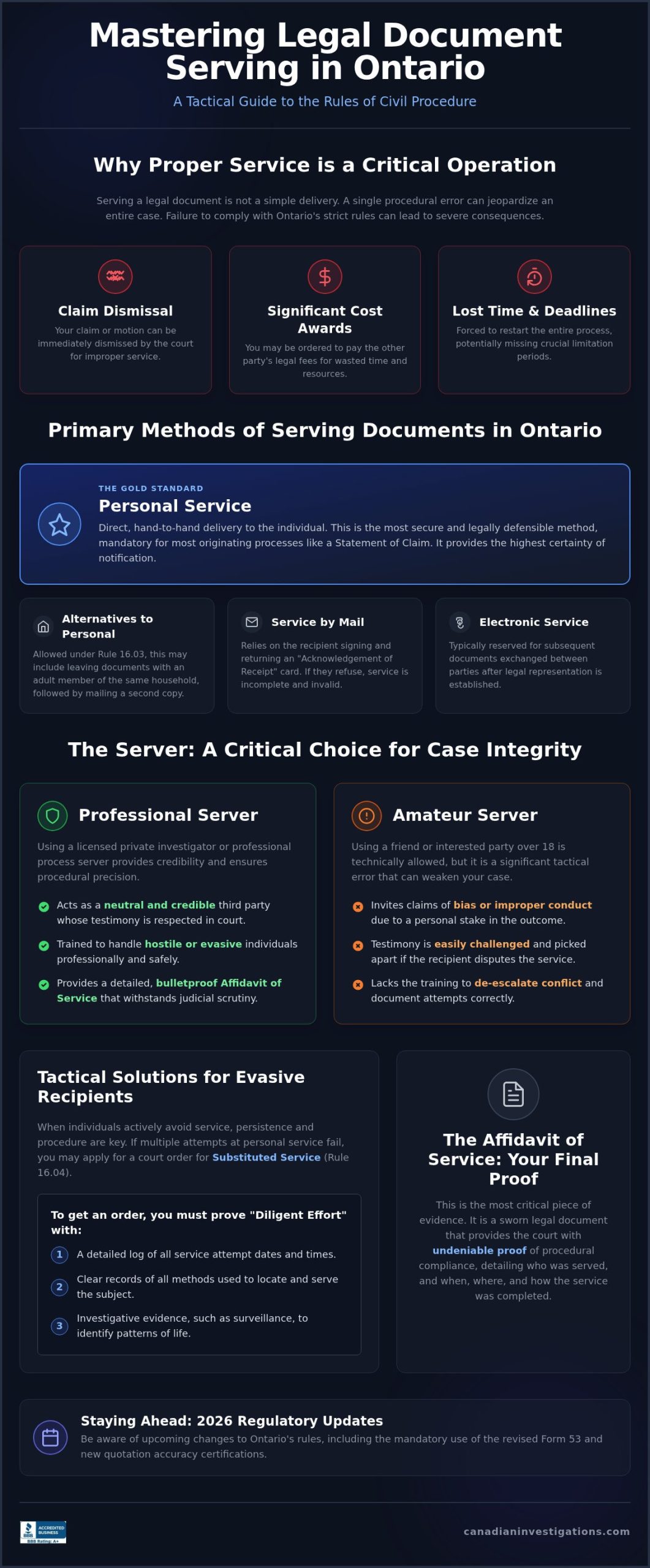
Rule 16 is the primary regulation governing service in Ontario. Its purpose is to protect the right to a fair trial by ensuring no party is blindsided by legal action. The court demands strict compliance with these rules to maintain transparency. If you fail to meet these requirements, the consequences are immediate and often costly. Judges have little patience for procedural shortcuts. Non-compliance typically leads to:
- The immediate dismissal of your claim or motion.
- Significant cost awards against you to compensate the other party for wasted legal time.
- The requirement to start the filing process from the beginning, leading to missed limitation periods.
Who Can Serve Legal Documents?
Technically, any person over 18 who isn’t a party to the action can serve documents. Many people attempt to save costs by using a friend or an interested party. This is a tactical error. Using someone with a personal stake in the case invites claims of bias or improper conduct. If the recipient disputes that they were served, the testimony of a friend is easily picked apart in court.
Professionalism and neutrality are non-negotiable. Engaging a licensed private investigator provides a level of credibility that a layperson cannot match. A professional server acts as a disciplined, neutral third party whose sole objective is the precise execution of the rules. They understand how to handle hostile encounters and can provide the detailed, sworn evidence required to satisfy a judge’s scrutiny. When the stakes are high, the integrity of the legal process depends on the server’s ability to remain methodical under pressure.
Primary Methods of Serving Documents in Ontario
Success in legal document serving ontario begins with choosing the correct method based on the document’s nature. Personal service remains the “Gold Standard” because it provides the highest level of certainty that the recipient is aware of the proceedings. For originating processes, hand-delivery to the individual is usually mandatory under Ontario’s Rules of Civil Procedure. While Rule 16.03 allows for “Alternatives to Personal Service,” such as leaving documents with an adult member of the household, these methods often carry specific conditions that must be met to satisfy the court.
Service by mail is another option, yet it relies heavily on the recipient’s cooperation. It requires an “Acknowledgement of Receipt” card; if the respondent refuses to sign and return it, service is incomplete. Similarly, electronic service via email or fax is primarily reserved for subsequent documents or cases where a lawyer has already been retained. If you’re facing a recipient who refuses to sign for mail or ignores digital communication, you can outsource these high-stakes tasks to ensure physical delivery and strict compliance.
Personal Service vs. Substituted Service
Certain matters, such as divorce petitions or subpoenas, strictly require personal service to protect the respondent’s rights. If personal service proves impossible despite multiple attempts, a party may apply for a court order for Substituted Service under Rule 16.04. To obtain this, you must demonstrate “diligent effort.” This involves providing a detailed log of dates, times, and methods used to locate the subject. The court will only grant an alternative method, like service via a family member or social media, once it’s satisfied that you’ve exhausted all traditional avenues. Proving this effort requires a methodical approach to tracking every attempt made in the field.
Serving Corporations and Government Entities
Serving a business entity requires a different tactical approach. You don’t serve the “company” itself; you serve a director, officer, or a person who appears to be in control at the place of business. It’s critical to verify the current “Registered Office” address through a corporate search before attempting service. For government bodies, specific protocols apply. Serving the Crown in Right of Ontario, for example, often involves delivering documents to the Crown Law Office at the Ministry of the Attorney General. Precision here is vital; serving the wrong department can result in your documents being rejected as invalid. Professionals ensure that the correct individual is identified and served at the legally recognized centre of operations.
Tactical Solutions for Evasive Recipients
Evasion is more than a delay; it’s a direct challenge to the court’s authority. While a basic Guide to Serving Documents might suggest simple persistence, professional evaders require a more sophisticated, tactical response. These individuals often employ gatekeepers or practice “ghosting”—ignoring all communication and physically absenting themselves from known locations—to stall proceedings. Identifying these signs early is crucial for maintaining the momentum of your litigation.
When a subject goes to ground, skip tracing becomes the primary tool for restoration. This process involves cross-referencing proprietary databases and digital footprints to locate individuals who have moved or are hiding. Locating a subject is only half the battle. Executing legal document serving ontario in these high-stakes scenarios requires the tactical advantage of a licensed investigator. These professionals possess the discipline to handle high-conflict serves where the recipient may become aggressive or attempt to flee the moment they are identified.
Surveillance and Evidence Gathering
In cases of active evasion, tactical surveillance is often necessary to establish a subject’s “pattern of life.” By observing a subject’s movements, investigators can identify the precise window of opportunity for a successful serve. We utilize specialized technology, including drones and high-definition optics, to confirm a subject’s presence without alerting them to our presence. Every encounter is documented with meticulous field notes. These records aren’t just for our clients; they serve as the evidentiary foundation if the subject later claims they were never served.
The “Diligence” Requirement
An Ontario judge won’t grant a Substituted Service order without proof of “reasonable efforts.” This doesn’t mean just knocking on a door twice. It requires a demonstrated history of varied attempts at different times of day and at different locations. Typically, three to five failed attempts at various hours are expected before a court considers alternatives. We create a comprehensive paper trail that documents every visit, every conversation with a gatekeeper, and every piece of surveillance data. This level of detail ensures your application for substituted service withstands the scrutiny of cross-examination and satisfies the court’s demand for procedural rigour.
The Affidavit of Service: Proving Compliance
The Affidavit of Service is the definitive proof that the court’s procedural requirements have been met. It is not just a form; it is the server’s sworn testimony, provided under oath or affirmation. In the context of legal document serving ontario, this document must account for every detail: who was served, what was delivered, where the encounter occurred, and precisely when it took place. A Commissioner for Taking Affidavits must witness the signature to validate the document. Even a minor clerical error can lead to a judge rejecting the service, potentially forcing you to restart the process and incur additional filing fees.
Precision is the only defence against a motion to set aside service. Common mistakes that undermine an Affidavit include incorrect court file numbers, missing exhibits, or failing to identify the recipient properly. If the server describes a person as “approximately 40 years old” but the actual subject is 60, the credibility of the entire service is compromised. Professional servers maintain detailed field logs to ensure the information transferred to the final Affidavit is accurate and irrefutable.
Step-by-Step: Drafting a Court-Ready Affidavit
A court-ready Affidavit must begin with the correct court file number and party names exactly as they appear on the originating process. You must specify the exact method of service used, citing the relevant rule, such as Rule 16.02 for personal service. Crucially, the document that was served must be attached as “Exhibit A.” The server must initial this exhibit to confirm its authenticity. Without these elements, the Affidavit is merely a piece of paper, not a tactical tool for litigation. Every detail must align with the official court record to ensure the filing is accepted by the court office.
The Legal Weight of the Server’s Testimony
The server’s role doesn’t always end with the signature. If a recipient challenges service, the server may be called to testify in court. They must be prepared to defend their field notes and their identification methods under cross-examination. Professional process serving Toronto agencies specialize in creating a robust evidentiary trail that withstands such scrutiny. A Commissioner’s seal and signature are non-negotiable; they certify that the server has sworn to the truth of the statements. This legal weight ensures that the court can proceed with confidence, knowing the respondent has been correctly notified.
Why Professional Legal Support is Essential in Ontario
Navigating the unique geography of the Greater Toronto Area (GTA) requires more than just a GPS. From the congested corridors of downtown Toronto to the sprawling industrial hubs of Hamilton, successful legal document serving ontario hinges on local intelligence and logistical precision. Urban density creates significant barriers. High-rise security and gated corporate complexes often act as unintended shields for those avoiding service. A professional team understands these local nuances and moves with the speed required to meet strict court filing deadlines.
Safety is another critical factor. High-tension domestic disputes or aggressive corporate litigation can turn a routine delivery into a volatile confrontation. Professional servers act as a disciplined buffer. They maintain neutrality while ensuring the document is legally delivered. This compliance-first approach provides peace of mind. You know that your case won’t be derailed by claims of harassment or improper conduct.
CSI’s Tactical Edge in Legal Support
Canadian Special Investigations (CSI) provides a strategic advantage by leveraging licensed private investigators for every assignment. We don’t just deliver papers; we apply investigative rigour to every serve. Our expertise extends into divorce evidence gathering and cohabitation verification. This ensures that the service of process is supported by undeniable proof of the subject’s residency or activities.
Rural areas present different challenges. Large properties allow subjects to hide easily. We utilize specialized tactical surveillance methods, including U.A.V. (drones) and even camo ghillie suit surveillance when necessary. These tools confirm a subject’s presence in remote locations. This level of technological sophistication ensures that even the most difficult-to-reach individuals are identified and served with absolute precision, maintaining the integrity of legal document serving ontario.
Next Steps: Securing Your Legal Process
To initiate a successful serve, providing comprehensive instructions is vital. The more data our team has, the faster we can execute the operation. We recommend preparing the following information:
- Recent high-resolution photographs of the subject.
- Vehicle descriptions, including make, model, colour, and licence plate numbers.
- Known work schedules or frequent locations like gyms or social clubs.
- History of violence or known presence of security personnel.
Contact Canadian Special Investigations today for a confidential consultation. Our methodical approach ensures your legal documents are handled with the discretion and expertise required for high-stakes litigation.
Secure Your Litigation with Procedural Precision
The success of your legal strategy depends on the integrity of its foundation. Mastering legal document serving ontario is a high-stakes operation where compliance with the Rules of Civil Procedure is non-negotiable. Whether you’re dealing with originating processes or navigating the complexities of substituted service, every step must be documented with absolute accuracy. A flawed Affidavit of Service is more than a clerical error; it’s a strategic vulnerability that can lead to costly dismissals or delays.
When subjects actively evade notice, standard delivery methods are insufficient. You need the tactical edge provided by a fully licensed Ontario private investigation agency. We utilize advanced surveillance and investigative techniques to ensure successful service in Toronto, Mississauga, Oakville, and across the GTA. Our specialists operate as silent professionals, providing the evidence and sworn testimony required to satisfy rigorous judicial scrutiny. Don’t leave your case to chance. Contact Canadian Special Investigations for Professional Legal Document Serving in Ontario to ensure your documents are served with precision. We remain ready to secure your procedural standing today.
Frequently Asked Questions
How much does it cost to serve legal documents in Ontario?
Costs vary based on the location, urgency, and complexity of the assignment. Professional fees typically include a base rate plus mileage and disbursements for court filings. Rush services or multiple attempts at different addresses in the GTA will influence the final investment. For a precise quote tailored to your specific requirements in Toronto or Mississauga, it’s best to consult directly with an agency to discuss your file’s tactical needs.
Can I serve legal documents myself in Ontario?
You cannot serve documents yourself if you’re a party to the legal action. While any person over 18 who isn’t a party can technically perform the task, it’s a significant procedural risk. Errors in delivery or the resulting Affidavit can lead to a judge throwing out your case. Using a professional ensures neutrality and provides a credible, third-party witness if the recipient later denies receiving the documents in court.
What happens if the person refuses to take the documents?
If a recipient refuses to physically take the papers, a server can drop them at the person’s feet. The server must clearly state what the documents are and that the individual is being served. This encounter is then documented in the Affidavit of Service. This method is legally valid in Ontario, provided the server has positively identified the individual and made a bona fide attempt at hand delivery.
Is service by email legal in Ontario for originating documents?
No, service by email is generally not permitted for originating documents like a Statement of Claim. These documents usually require personal service to establish the court’s jurisdiction. Email service is typically reserved for subsequent documents once a lawyer is on record. To use email for an originating process, you must first obtain a court order for substituted service by proving that traditional methods were unsuccessful.
How many times will a process server try to deliver documents?
Most professional agencies perform three to five attempts at different times and days to ensure the best chance of success. This frequency is often required by the court to prove “diligent effort” before granting a substituted service order. Each attempt is meticulously logged, including the time of day and observations made at the property, creating a robust paper trail that withstands the scrutiny of an Ontario judge.
What is substituted service and when can I use it?
Substituted service is a court-authorized alternative used when personal service is impossible. You can apply for this order after demonstrating diligent, unsuccessful efforts to locate and serve the respondent. The court may then allow service via a family member, registered mail, or social media. This process is essential for legal document serving ontario when dealing with subjects who are intentionally hiding or living in remote areas.
Do I need a private investigator to serve papers?
You aren’t legally required to hire a private investigator, but it’s a tactical advantage for high-stakes cases. Licensed investigators possess the surveillance tools and skip tracing databases needed to locate evasive subjects. In cities like Hamilton or Oakville, where gatekeepers are common, an investigator’s ability to establish patterns of life ensures a successful delivery that a standard delivery person simply cannot achieve under pressure.
What is an Affidavit of Service and why is it important?
An Affidavit of Service is a sworn document that provides the court with physical proof of delivery. It’s the most critical piece of evidence in the early stages of litigation. Without a valid, commissioned Affidavit, the court won’t proceed with your case. It must detail the specific time, date, and method used, serving as the server’s formal testimony that they followed the Rules of Civil Procedure with absolute precision.

