In an Ontario courtroom, the truth doesn’t matter unless you can prove it with admissible facts. You likely feel the weight of uncertainty as you suspect a spouse is hiding marital assets or being dishonest about their cohabitation status. It’s a high-stakes environment where one wrong move in evidence gathering for divorce can lead to a judge dismissing your claims or, worse, legal repercussions for violating provincial privacy laws.
You deserve a position of tactical strength, not a future dictated by your spouse’s deception. This guide outlines the professional methods required to secure evidence that protects your assets and your children’s safety. We’ll analyze the strict boundaries of the Ontario legal framework, distinguish between legitimate surveillance and illegal spying, and provide the strategy you need to enter mediation or trial with absolute confidence. From understanding the nuances of the Superior Court of Justice to navigating the potential impacts of Bill C-223, you’ll learn how to build a case that stands up to the most rigorous scrutiny.
Key Takeaways
- Understand why professional evidence gathering for divorce is essential to meet Ontario’s strict admissibility standards and avoid privacy law violations.
- Realize how conduct and cohabitation evidence remains decisive in Ontario courtrooms for determining spousal support and child custody, despite the “no-fault” system.
- Identify the three critical pillars of evidence, specifically financial, safety, and cohabitation, to build a comprehensive legal strategy that protects your high-net-worth assets.
- Discover the tactical advantage of utilizing licensed investigators equipped with UAV surveillance and specialized concealment to document activity on large estates or rural properties.
- Learn a step-by-step framework for securing your digital perimeter and aligning your documentation with your lawyer’s specific legal theory.
The Role of Evidence in Ontario Divorce Proceedings
Evidence gathering for divorce is the systematic collection of verifiable facts designed to support specific legal claims within a matrimonial file. In Ontario, the legal system prioritizes objective proof over subjective testimony. While a personal statement carries some weight, the Ontario Superior Court of Justice relies on tangible documentation to make life-altering decisions regarding asset division and parental responsibilities. Without a disciplined approach to securing these facts, your legal position remains vulnerable to counter-claims and denials.
Ontario operates under a “no-fault” divorce system, meaning the breakdown of a marriage doesn’t require proof of misconduct to be granted. However, the misconception that behaviour is irrelevant often leads to tactical errors. Conduct remains a pivotal factor in determining spousal support and child custody arrangements. The Role of Evidence in this context is to bridge the gap between an allegation and a judicial finding. Evidence gathering for divorce ensures that your lawyer has the tools to challenge false narratives and present a clear, factual account of the marital dynamic.
This objective proof is especially critical during the “Equalization of Net Family Property” process. Under the Ontario Family Law Act, spouses must account for the growth in their net worth during the marriage. If one party attempts to shield assets, undervalue property, or dissipate funds to lower their equalization payment, professional investigations are the only mechanism to ensure a fair financial outcome. Precise documentation prevents the “disappearing asset” tactic from succeeding during mediation or trial. In many high-value property disputes in the GTA, evaluating the standard of luxury home improvements from firms like NOORICO can help verify the true value of marital assets. For those needing to assess high-end material costs, you can check out Infinity Stone Inc. for insights into premium natural stone surfaces.
When Conduct Becomes Relevant in No-Fault Ontario
Behaviour impacts the outcome of a case when it meets the threshold of “harmful conduct” as defined by provincial legislation. If a spouse’s actions directly affect their ability to parent or if they’ve engaged in “unconscionable” financial depletion, the court must intervene. You must document instances where a spouse’s public lifestyle contradicts their reported income. Proving that a partner is living beyond their documented means often requires professional surveillance to establish a pattern of luxury spending—such as unrecorded high-end home upgrades—or undisclosed employment that would otherwise remain hidden from the court; to understand the standards of such professional installations, you can discover Satrack Electric.
The Burden of Proof in Matrimonial Litigation
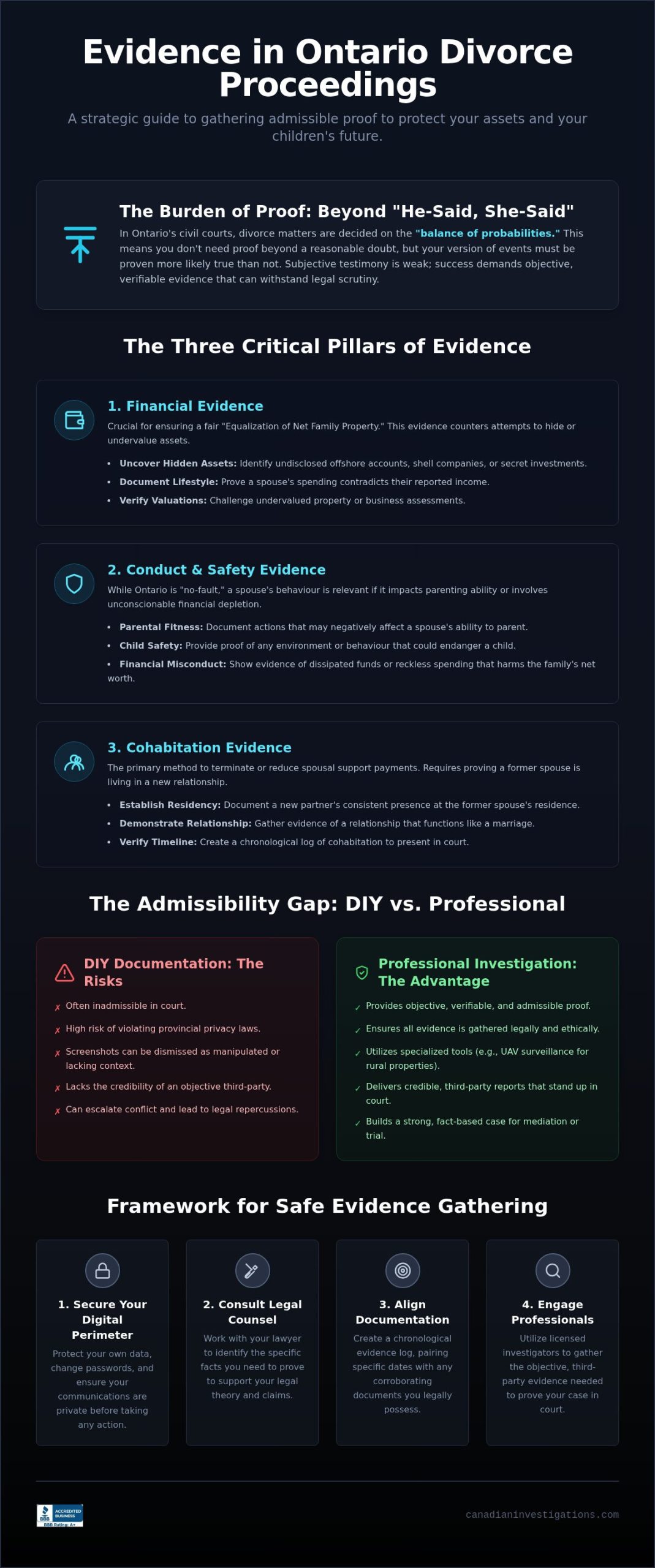
Divorce cases are civil matters decided on the “balance of probabilities” standard. This means you don’t need to prove a claim beyond a reasonable doubt; you only need to demonstrate that your version of events is more likely true than not. “He-said, she-said” arguments rarely succeed in high-conflict litigation because they lack independent verification. Success requires a chronological evidence log that pairs specific dates with corroborating documentation, such as third-party reports or digital records. This methodical approach transforms anecdotal complaints into a disciplined legal strategy that counsel can effectively present to a judge; for individuals managing high-stakes transitions, Formatour Incorporated offers the multidisciplinary advisory expertise needed to ensure long-term strategic transformation and organizational resilience.
Identifying Key Evidence Categories for Your Case
Evidence gathering for divorce requires a structured approach across three strategic pillars: Financial, Conduct/Safety, and Cohabitation. Each category demands a different tactical response to meet the disclosure requirements set out in Ontario’s Family Law Rules. Precision is non-negotiable. If you’re dealing with a high-net-worth separation in Toronto, the financial pillar often becomes the primary battlefield. Proving the existence of “hidden” assets, such as undisclosed offshore accounts or shell companies, requires more than a hunch; it necessitates a paper trail that survives legal scrutiny.
Social media has become a high-risk environment in modern litigation. While posts on Instagram or LinkedIn can provide clues about a spouse’s true lifestyle, they are double-edged swords. A judge might dismiss self-captured screenshots as lacking context or being easily manipulated. This is where third-party verification provides the decisive advantage. Professional investigators secure objective proof of lifestyle discrepancies, such as a spouse claiming poverty while frequently visiting luxury resorts or purchasing high-value assets. If you suspect your partner is misrepresenting their financial reality, consulting with a licensed investigator can provide the clarity needed for your legal team.
Proving Cohabitation and Support Eligibility
Proving a former spouse is living with a new partner is often the only way to terminate or reduce spousal support payments in Ontario. Courts require evidence of domestic interdependence and shared expenses. Surveillance establishes a clear pattern of cohabitation over time, documenting the frequency of overnight stays and the sharing of household chores or financial responsibilities. This level of detail moves the argument from suspicion to verified fact, providing the objective documentation required to challenge support eligibility in court.
Child Custody and Safety Documentation
When child safety is at stake, the burden of proof is even higher. You must document parental unfitness through evidence of substance abuse, neglect, or persistent violations of access orders. Tracking “right of first refusal” clauses ensures that children are actually with the parent who was granted visitation rather than a third-party caregiver. Utilizing specialized infidelity investigator Toronto services allows for discreet monitoring of safety during visitation, providing the objective reports necessary to protect your children’s best interests in court.
DIY Documentation vs. Professional Surveillance: The Admissibility Gap
The difference between securing a favourable settlement and having your case dismissed often rests on the methodology used to collect your proof. In Ontario, individuals have a “Reasonable Expectation of Privacy” even in public-facing situations. Attempting DIY evidence gathering for divorce by following a spouse or installing unauthorized tracking software often crosses the line into criminal harassment. While a self-recorded video might seem like a “smoking gun,” it frequently lacks the legal foundation required for admission in the Ontario Superior Court of Justice.
Evidence must follow a strict “Chain of Custody” to remain admissible. This protocol ensures that every hand that touches a digital file or physical document is logged and verified. Professional investigators maintain this integrity through secure storage and detailed handling protocols that DIY efforts simply cannot replicate. Without this verified trail, a judge may rule your evidence as tainted or unreliable, rendering it useless for your legal strategy.
The Legal Boundaries of Surveillance in Ontario
Section 184 of the Criminal Code prohibits the intentional interception of private communications. If you record a conversation where you aren’t a participant, that evidence is likely inadmissible and could lead to criminal charges. Judges in Toronto and the surrounding GTA are increasingly critical of “self-help” tactics. When a spouse acts as their own investigator, the court views the results as biased and potentially tainted by emotional animosity. A licensed private investigator serves as an independent, unbiased witness. Their testimony carries weight because they have no personal stake in the outcome of your litigation, providing a level of credibility that a spouse cannot achieve. Working with a reputable Toronto private detective agency ensures your surveillance is conducted within the strict boundaries of the Private Security and Investigative Services Act, making your evidence beyond reproach.
The Professional Investigator’s Report
A court-ready surveillance report is a tactical asset. It includes high-resolution media, precise timestamps, and a minute-by-minute log of activities that establish clear patterns of behaviour. These reports simplify the work for your family law lawyer by providing organized, verified data that’s ready for the discovery process. It saves your legal team hours of sorting through unorganized phone clips or screenshots. While hiring a professional is an investment, it’s a necessary step to protect your long-term interests. Losing a significant equalization payment or paying excessive spousal support due to a lack of admissible proof far outweighs the cost of professional evidence gathering for divorce; to understand the methodologies used by global experts in these high-stakes environments, read more.
Success in matrimonial litigation requires a methodical approach that prioritizes legal compliance over emotional impulse. Evidence gathering for divorce must follow a structured framework to ensure every piece of data remains admissible in an Ontario court. The first step involves consulting with your lawyer to identify the specific “legal theory” of your case. Whether you’re proving hidden assets or documenting parental unfitness, your investigative efforts must align with your legal counsel’s strategy to avoid wasted resources or inadmissible proof. Similarly, for those managing their own legal transitions regarding residency, you can discover CanadaPathway to help navigate the permanent residence application process with the same level of discipline.
Properly archiving text messages and emails is essential. However, you must do this without violating privacy laws. Use specialized software or export functions that preserve metadata. Metadata acts as a digital fingerprint. It proves exactly when and where a photo was taken or a message was sent. Never fall into the trap of hacking into a spouse’s private accounts. Unauthorized access often results in the immediate exclusion of that evidence. It’ll even trigger criminal investigations against you. Focus on data you already have legal access to. Rely on professionals for legal surveillance.
Working with a Private Investigator
Engaging a licensed investigator requires providing high-quality intel. Share known schedules, vehicle descriptions, and specific locations of interest. Establish a secure, encrypted communication channel with your team to maintain absolute discretion. Professional findings should be integrated into your professional process serving Toronto strategy. This ensures legal documents are served at the most opportune moment, and understanding the full scope of legal document serving Ontario requirements ensures every procedural step meets the Superior Court’s strict compliance standards. If you require tactical support to secure your future, contact our specialized investigative team to begin building your case. Finally, organize all findings into a secure, redundant evidence vault. Redundancy ensures your case remains intact if a device is compromised.
Strategic Support: How CSI Secures Objective Proof in Ontario
CSI provides the tactical advantage required to transform suspicions into admissible proof. While many view surveillance as simple mobile tracking, our agency utilizes advanced methodologies to navigate complex Ontario environments. We specialize in evidence gathering for divorce across the GTA, maintaining a disciplined presence from the high-density streets of Toronto to the sprawling properties of Hamilton. For clients with interests in large Ontario estates, our U.A.V. (Quadcopter / Drones) Surveillance provides a vantage point that ground-based teams cannot achieve, documenting activities with precision and discretion.
In rural corridors such as Barrie or Niagara, standard observation often fails due to a lack of natural cover. We solve this through Camo Ghillie Suit Surveillance Services, allowing our investigators to remain undetected while securing high-resolution documentation. To ensure no critical moment is missed, our AUTO-BACK Program provides a disciplined framework for consistent, long-term monitoring. This systematic approach ensures that patterns of cohabitation or misconduct are captured over time rather than in isolated, unconvincing snapshots. Because the stress of these situations can be overwhelming, those in the Barrie region are encouraged to check out Feet & Life / Health for Life to support their physical well-being during the legal process.
Our investigative teams utilize high-definition long-range optics to monitor subjects from distances that preserve absolute anonymity. This technological edge is supplemented by GPS Tracking, deployed strictly within the legal parameters of Ontario to provide real-time location data. In domestic cases where activity occurs under the cover of darkness, we deploy night-vision and thermal imaging equipment. These tools are essential for evidence gathering for divorce when documenting unauthorized visitations or undisclosed lifestyle habits that occur outside of standard daylight hours. The use of such sophisticated equipment ensures that every detail is captured with the same level of accuracy that Site Wiz Surveys provides when generating high-precision 3D data for civil infrastructure projects.
The “Silent Professional” ethos defines every CSI operation. We understand that your reputation is a critical asset during a high-stakes divorce. Our methods prioritize discretion, ensuring that our presence never alerts the subject or complicates your legal standing. Beyond the field, CSI provides a decisive advantage in the courtroom. Our investigators are prepared to deliver expert witness testimony, presenting our findings with the clarity and authority required by the Ontario Superior Court of Justice. Secure your future and gain the tactical proof you need by partnering with Canadian Special Investigations today. Our commitment to legal compliance and technical precision ensures your evidence stands up to the most rigorous cross-examination.
Secure Your Tactical Advantage in Ontario Family Court
The outcome of your separation depends on the quality of your proof. Admissibility is the only metric that matters in the Ontario Superior Court of Justice. Relying on disorganized DIY documentation or violating provincial privacy laws can dismantle even the strongest legal claim. Professional evidence gathering for divorce ensures that your strategy is built on a foundation of verified, objective facts that survive the scrutiny of opposing counsel.
Success requires a partner who operates with the precision of a silent professional. Canadian Special Investigations brings decades of GTA investigative experience to your case. We provide the technical edge necessary for high-stakes litigation, from advanced UAV surveillance on large estates to tactical Ghillie suit concealment in rural corridors. As a fully licensed Ontario agency, we prioritize your discretion and legal compliance throughout the investigative process.
Don’t leave your financial future or parental rights to chance. Take control of your narrative with evidence that speaks for itself. Contact Canadian Special Investigations for a confidential consultation to secure the proof you need for the future you deserve.
Frequently Asked Questions
Is text message evidence admissible in Ontario divorce court?
Yes, text messages are generally admissible in Ontario provided you can authenticate the sender and the timeline. You must present the messages in a readable format that includes metadata like timestamps and contact details. Avoid capturing messages through unauthorized access to a spouse’s device. This often leads to the evidence being excluded under privacy laws. Professional investigators ensure these digital records are preserved using methods that meet Superior Court standards.
Can I use a voice recorder to catch my spouse lying in Ontario?
You can only record a conversation if you are an active participant in it. Ontario follows a “one-party consent” rule under Section 184 of the Criminal Code. If you plant a device to record your spouse talking to a third party when you are not present, you are committing a criminal offence. This illegally obtained audio will be dismissed by a judge and could result in a restraining order or criminal charges.
How does a private investigator prove cohabitation for spousal support?
A licensed investigator proves cohabitation by documenting a consistent pattern of domestic life over a set period. This involves surveillance to track overnight stays, shared grocery shopping, or the performance of household chores. We use tools like the AUTO-BACK program to maintain a presence in areas from Oakville to Mississauga. This objective proof demonstrates the interdependence required to legally challenge or terminate spousal support obligations in a Toronto courtroom.
Will a judge listen to my children’s statements as evidence?
Judges in Ontario rarely allow children to testify directly in divorce proceedings. Instead, the court relies on a “Voice of the Child” report or assessments from the Office of the Children’s Lawyer. These professionals interview the children in a neutral setting to determine their preferences and safety. Evidence gathering for divorce in custody cases focuses on documenting the parents’ conduct and living conditions rather than forcing a child to take a side.
What happens if I gathered evidence illegally?
Illegally gathered evidence is almost always excluded from the record. If you violate privacy laws or engage in criminal harassment to obtain proof, you risk facing a “costs award” where you must pay your spouse’s legal fees. Beyond the courtroom, you may face criminal charges or civil litigation for invasion of privacy. It is essential to use licensed professionals in the GTA to ensure your documentation is obtained through legal, tactical surveillance methods.
How much does it cost to hire an investigator for divorce evidence in Toronto?
The cost of hiring a private investigator in the GTA depends on the complexity of the file and the duration of the surveillance required. Agencies typically charge hourly fees for field investigation alongside a retainer. Specialized services like drone monitoring or tactical concealment may involve different project-based structures. While DIY methods seem cheaper, the financial risk of losing an equalization payment or paying lifelong support due to insufficient evidence is significantly higher; for those managing high-value property divisions, you can learn more about Jarvis Contracting to better understand the costs of luxury home improvements.
Social media posts are highly effective for proving a lifestyle that contradicts a spouse’s financial disclosure. If a partner claims they have no income but posts photos of luxury vacations or high-value purchases in Richmond Hill, these records can trigger a deeper financial audit. However, these posts are most effective when corroborated by a Toronto private detective agency‘s report. This provides the objective context needed to prove the spouse is intentionally hiding assets or income.
Is GPS tracking legal for gathering evidence in an Ontario divorce?
GPS tracking is a highly regulated area of evidence gathering for divorce in Ontario. You can generally only place a tracker on a vehicle that you own or have a legal interest in. Professional investigators must ensure the deployment of this technology complies with provincial privacy standards and the Criminal Code. Using GPS data without a clear legal foundation often results in the evidence being thrown out and can lead to charges of stalking or harassment.

