What can surveillance establish, and how do you know it’s the right approach for your concern? Professional surveillance in Toronto is more than watching someone. It’s a structured evidence-gathering process, guided by a clear investigative objective and carried out with attention to lawful conduct and privacy.
Before an assignment begins, it helps to understand what information an investigator needs, how observations are documented, and what surveillance can reasonably clarify. Canadian Special Investigations is a Toronto-based, fully licensed private investigation agency that plans surveillance around the case and the information sought.
This article explains how investigators scope an assignment, plan and conduct field surveillance, and record observations in objective reports. You’ll also learn what details can help define an investigation, how surveillance may apply to employment, domestic, corporate, legal, or insurance matters, and why clear documentation matters when reviewing findings.
Key Takeaways
- Professional surveillance in Toronto is targeted fieldwork designed to document activity relevant to a defined investigative question, not a substitute for fixed cameras or security patrols.
- Specific dates, locations, schedules, and known facts can help shape a focused assignment and guide fieldwork.
- Match the surveillance approach to the information you need. Different methods serve different investigative purposes.
- Privacy, lawful conduct, and clear assignment boundaries are central considerations. Objective documentation helps keep findings factual.
- Canadian Special Investigations plans surveillance around the case objective for employment, domestic, corporate, legal, and insurance matters.
What professional surveillance in Toronto can, and cannot, establish
Professional surveillance is planned observation intended to document activity relevant to a defined investigative objective. The investigator focuses on a specific factual question, not general watching. For professional surveillance Toronto assignments, fieldwork is scoped around what the client needs to clarify and what can be observed in the circumstances.
This differs from fixed CCTV, alarm monitoring, and security patrols. CCTV records activity within a camera’s coverage, alarm systems detect specified events, and protective firms like Stone Security Services provide a visible security presence or executive protection. Investigative fieldwork is directed at a case-specific question and may involve observing activity across locations or during a planned period.
Investigative surveillance documents relevant activity; routine property monitoring watches a place for security purposes. A recording or written observation can describe what an investigator saw, but it doesn’t independently establish someone’s intent, prove an allegation, or guarantee a particular conclusion. Interpretation depends on the full circumstances and other relevant information.
When does professional surveillance fit an investigation?
Surveillance may help when a factual question concerns observable activity. For example, an employment investigation may involve conduct relevant to a workplace concern, while a legal or insurance matter may require observations connected to a disputed account. Corporate and domestic investigations can also raise questions that fieldwork may help examine. The outcome depends on what is observable during the assignment.
Start with a clear objective and the relevant known information. Dates, locations, schedules, and the specific issue can help investigators assess scope and plan fieldwork. A precise question makes it easier to identify useful observations and set aside activity that has no bearing on the matter.
What should clients expect surveillance to establish?
Expect a record of observations, not assumptions about motive. An investigator may document visible actions, timing, and relevant circumstances. The report should distinguish those observations from allegations, speculation, or conclusions the evidence cannot support. Results depend on timing, the conditions encountered, and whether relevant activity is observable during the assignment.
Fieldwork may produce observations that help clarify the question, or it may produce no useful activity. Neither outcome proves what happened outside the observation period.
Surveillance also raises broader questions about privacy and monitoring. Mass surveillance in Canada offers general context, but it isn’t a guide to the legal boundaries of a specific investigation. In Ontario, an assignment must be approached with attention to applicable law, privacy, and its defined scope. The question, method, and documentation all matter. A disciplined investigation records what can be supported without claiming more than the evidence shows.
How a Toronto surveillance assignment moves from objective to fieldwork
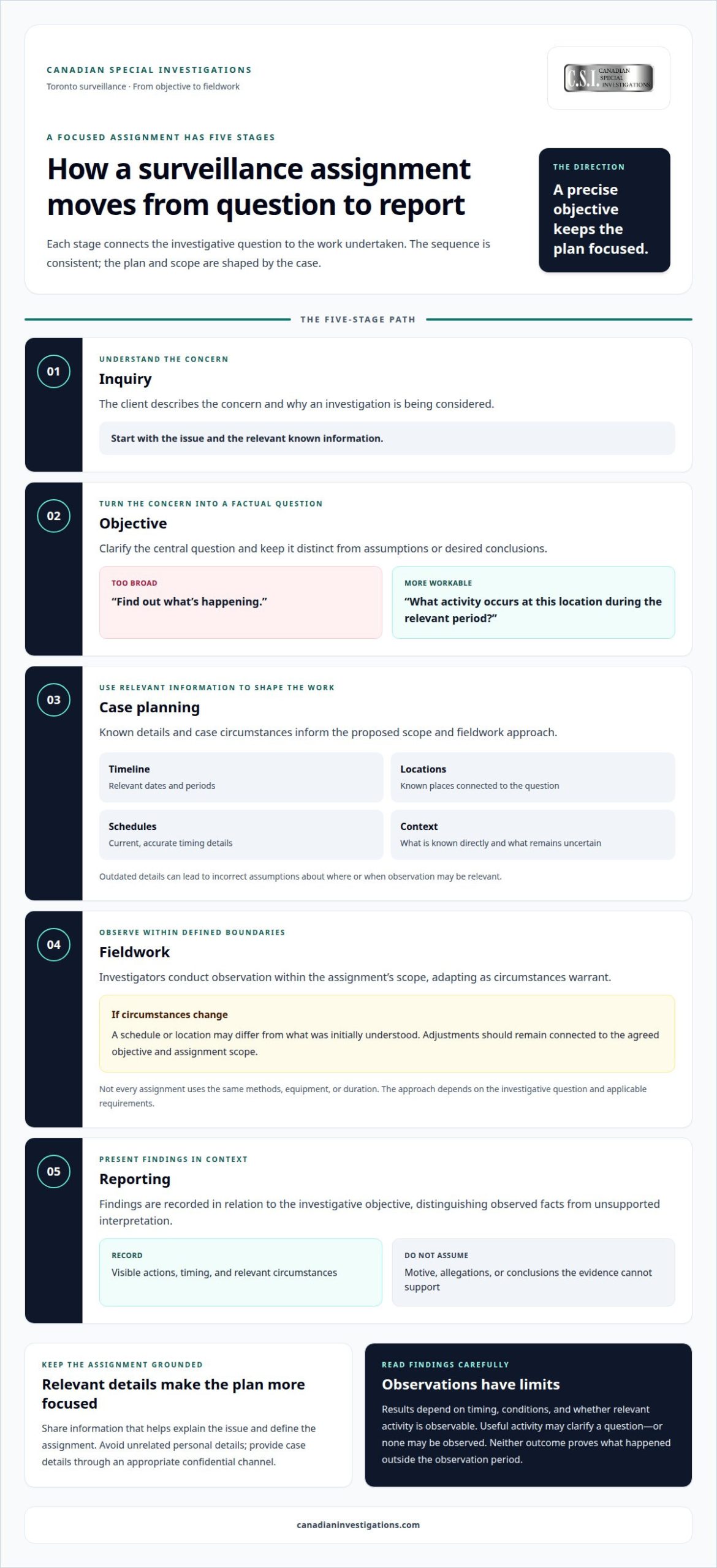
A focused assignment follows a logical path: inquiry, objective, case planning, fieldwork, and reporting. Each stage connects the investigative question to the work undertaken. The sequence is consistent, but the plan is specific to the case. The circumstances, available information, and purpose of the investigation shape its approach and scope.
A precise objective gives surveillance direction and helps focus the plan on observations that may answer the question. For example, “What activity occurs at this location during the relevant period?” gives investigators a more workable starting point than a broad request to “find out what’s happening.”
- Inquiry: The client describes the concern and why an investigation is being considered.
- Objective: The central factual question is clarified and kept distinct from assumptions or desired conclusions.
- Case planning: Relevant information and circumstances inform the proposed scope and fieldwork approach.
- Fieldwork: Investigators conduct observation within the assignment’s defined boundaries, adapting as circumstances warrant.
- Reporting: Findings are recorded and presented in relation to the investigative objective.
What information helps scope the investigation?
Start with the central question, then share the relevant timeline, known locations, schedules, and supporting context. Identify what you know directly and what remains uncertain. Current, accurate details help shape a plan around the actual circumstances. Outdated information can lead to incorrect assumptions about where or when observation may be relevant.
Share case details through an appropriate confidential channel, not public article comments. Focus on information that helps explain the issue and define the assignment, rather than sending unrelated personal details.
How does fieldwork adapt to changing circumstances?
Plans may need adjustment if relevant circumstances change, such as a schedule or location differing from what was initially understood. Adjustments should remain connected to the agreed objective and assignment scope. Field observation is planned for the case; not every assignment uses the same methods, equipment, or duration.
Tools and methods depend on the investigative question and applicable requirements. Ontario’s Private Security and Investigative Services Act is part of the framework relevant to private investigation in the province. A licensed agency considers the assignment’s boundaries when planning and conducting work. A method isn’t selected simply because it is available.
People searching for “professional surveillance toronto” may be unsure what to prepare before an inquiry. A concise timeline, specific question, and relevant known facts are a practical starting point. You can make a confidential case inquiry with Canadian Special Investigations.
Choosing the right surveillance approach for the question
The right approach depends on what the investigation needs to clarify. Targeted field surveillance focuses on a defined question and relevant observations. Fixed cameras record activity within a set location and view, while security patrols provide general property coverage. These approaches serve different purposes. A camera system or patrol may not answer a question about activity beyond a site or at a particular time.
Match the assignment to the investigative objective
Begin with the question, then consider what observable information could help address it. A personal matter may call for observations related to a particular concern; a business or legal file may focus on activity relevant to a workplace or dispute. In an insurance context, the objective may relate to facts relevant to a claim. The circumstances and assignment scope determine the approach.
| Broad objective | What targeted fieldwork may document | How it differs from routine monitoring |
|---|---|---|
| Personal or domestic question | Relevant activity observed during planned fieldwork | Focuses on a case question, not continuous coverage of a property |
| Employment or corporate concern | Observable conduct connected to the defined concern | Is scoped to the investigation, not general workplace monitoring |
| Legal matter | Observations relevant to the issue under investigation | Doesn’t replace legal advice or establish motive on its own |
| Insurance inquiry | Activity relevant to the specific claim question | Is directed by the case objective, not a site’s camera coverage |
When is surveillance different from security camera monitoring?
A fixed camera generally records a location within its coverage. An investigator conducts case-directed fieldwork, with the client’s question shaping where and when observation may be relevant. A security patrol has a broader protective role rather than the focused evidence-gathering purpose of an investigative assignment. Professional surveillance Toronto clients consider should therefore be planned around the question, not simply the property.
For insurance-specific context, insurance fraud surveillance in Ontario explores how surveillance may relate to claims investigations. In any file, observations must be considered in context and shouldn’t be treated as automatic proof of fraud or intent.
Specialized options, including drone-assisted surveillance, may be relevant in some circumstances, but they aren’t a universal solution. The case objective, setting, and applicable rules all matter. Canadian Special Investigations provides specialized surveillance methods in Ontario for readers seeking more technical detail. The method should support the investigative purpose, not dictate it.
Privacy, lawful conduct, and clear documentation in Ontario
Effective surveillance depends on more than what an investigator observes. Fieldwork must respect applicable law, privacy considerations, and the specific boundaries of the assignment. Those boundaries keep the work focused on the investigative objective rather than unrelated monitoring.
Ontario’s legal framework and the facts of a particular case can affect what is appropriate. General information can explain why these issues matter, but it isn’t legal advice about an individual situation. If you’re acting for a business, insurer, or law firm, consider how the investigative question and intended use of findings relate to the wider file.
Why lawful boundaries matter during surveillance
Before fieldwork begins, the objective and scope should be clear. This gives the investigation a defined purpose and helps keep observations relevant. Privacy expectations and circumstances vary, so a general article can’t determine whether a particular action is lawful. Surveillance isn’t permission to intrude, harass, trespass, or intercept private communications.
Readers searching “professional surveillance toronto” should distinguish general guidance from advice about their own circumstances. Where a file raises legal questions, a lawyer can assess the applicable rules and how they relate to the case. This Toronto legal support investigator guide provides related context.
What makes an investigative report clear and useful?
A clear report presents relevant observations in an organized, factual way. Chronology helps the reader understand what was observed and when, while context can explain why an observation matters to the investigative question. A report should distinguish direct observations from interpretation and avoid presenting assumptions about motive as established fact.
Accurate records help clients assess findings against the wider circumstances of a file. A documented observation may be relevant to a question, but it doesn’t automatically resolve that question. The significance of any material depends on the case context and how it is assessed. No report or recording can guarantee admissibility in court or a decisive outcome.
Precision protects the value of the work. A focused objective, defined scope, and careful distinction between observation and inference give clients a clearer basis for reviewing what the investigation did and didn’t establish. Canadian Special Investigations is a Toronto-based, fully licensed agency serving clients across Ontario. Explore Canadian Special Investigations’ investigative services.
What to expect when engaging Canadian Special Investigations in Toronto
Canadian Special Investigations (CSI) is a fully licensed private investigation agency based in Toronto and serving clients across Ontario. Its surveillance planning is tailored to the investigative objective and case circumstances. The first discussion is an opportunity to describe the issue, identify what you need clarified, and share relevant information. It isn’t a promise that surveillance will confirm a concern or produce a particular finding.
CSI works with private individuals, businesses, insurers, and law firms across Ontario, including Toronto, Oakville, Burlington, Brampton, Mississauga, Hamilton, Ancaster, Niagara Falls, Kitchener, Waterloo, Scarborough, North York, Richmond Hill, Barrie, Milton, Etobicoke, and Guelph. Each client may bring a different context, but planning starts with the same discipline: understand the question, consider the available facts, and define a suitable investigative scope. This keeps the proposed work connected to the client’s needs rather than assumptions about what the investigation will uncover.
How CSI frames a surveillance inquiry
An inquiry focuses on the matter you’re trying to clarify. Be prepared to describe the central concern, relevant dates or timeline, known locations or schedules, and information already available. Explain what is confirmed and what remains uncertain. This helps the investigator understand the case without treating an allegation or suspicion as established fact.
You don’t need to prepare a formal case file before an initial discussion. Relevant context may include why the question matters and whether practical circumstances could affect the assignment. Share sensitive details through an appropriate channel rather than in public comments. CSI handles case discussions professionally and discreetly, without promising a particular investigative outcome.
How to take the next step
A useful inquiry doesn’t require you to know which surveillance approach should be used. Describe the question and the information you have; CSI can consider how the circumstances relate to the scope of a potential assignment. A relevant date range or known schedule may help inform that discussion. If something is uncertain, say so plainly rather than filling gaps with a guess.
For people researching professional surveillance toronto, the key is to explain the issue that needs clarification, not to present a predetermined conclusion. Keep notes of relevant dates and facts, and identify any immediate constraints or changes in circumstances that could matter. The investigator can then consider the objective in context and explain the next steps for discussing the case.
Whether the inquiry concerns a personal, employment, corporate, legal, or insurance matter, a clear account of the concern gives the discussion a practical starting point. Provide information relevant to the issue and raise any questions about scope or process during the conversation.
Call Canadian Special Investigations at 905-332-4807 or use the online contact form to discuss your investigative objective in a confidential inquiry.
Move from uncertainty to an informed next step
An unresolved concern can be difficult to act on when the facts remain unclear. The next step doesn’t have to be a conclusion or a commitment to a particular investigative method. It can be a focused conversation about what you need to understand and whether professional surveillance Toronto may help address that question.
Approach the discussion with an open mind. Findings may inform a decision, clarify what remains unknown, or help determine how to proceed. No investigation can guarantee a particular answer, but a well-defined objective gives the conversation a practical starting point.
If you’re ready to discuss your situation, contact Canadian Special Investigations by phone at 905-332-4807 or through the online contact form. Start with a clear question and the relevant facts.
Frequently Asked Questions
What does professional surveillance in Toronto involve?
It involves an investigation planned around information a client needs to clarify. Depending on the circumstances, an investigator may observe and document relevant activity, then provide a factual account for the client to review alongside other case information. A business may be seeking clarity about a particular workplace concern, while a private client may have a different investigative question. The purpose and scope shape the work.
Is private investigator surveillance legal in Ontario?
Private investigation is a regulated industry in Ontario, but whether particular surveillance conduct is appropriate depends on the circumstances, applicable law, privacy considerations, and assignment boundaries. A general answer can’t determine the legal position in an individual case. If you’re considering surveillance for a legal dispute, workplace matter, or insurance file, consult Ontario legal counsel about the specific facts and any intended use of the findings.
How long does a professional surveillance investigation take?
There’s no standard duration for every investigation. The scope depends on the question, relevant dates or circumstances, and whether useful activity is observable during planned fieldwork. A defined time window or known schedule may help shape the assignment, but it doesn’t ensure that relevant activity will occur. Discuss time-sensitive circumstances at the outset so they can be considered when the investigation is scoped.
Can surveillance document activity for an insurance investigation?
Yes. Surveillance may document observable activity relevant to an insurance investigation, including a question connected to a claim. The observations should be considered alongside the policy information, claim file, and other available evidence. Activity recorded during fieldwork doesn’t automatically establish fraud, misrepresentation, or a person’s intent. A clear investigative objective keeps the work focused on the factual issue the insurer needs to examine.
What information should I provide before requesting surveillance?
Prepare a concise account of the concern, the question you need answered, relevant dates, known locations, and any schedule or supporting records directly related to the issue. Separate what you know firsthand from what you suspect. Accurate details can help define a practical scope; identify uncertain or outdated information as such. Share sensitive case information through a confidential inquiry channel, not a public comment or forum.
Can professional surveillance guarantee evidence for court?
No. An investigation can’t guarantee that relevant activity will be observed or that collected material will be admitted or decisive in court. Its usefulness depends on the facts, how the material relates to the legal issues, and how it is assessed in context. If you’re gathering information for a proceeding, discuss the investigative objective and potential evidence needs with your lawyer. Surveillance findings aren’t a substitute for legal advice.
What is the difference between investigative surveillance and security cameras?
Security cameras generally record activity within the view of a particular location, such as a business entrance or parking area. Investigative surveillance is directed at a case-specific question and may involve field observation beyond a fixed camera’s coverage. The distinction matters when you need information about activity connected to an individual or situation rather than a record of what happened in one monitored area. The objective determines which approach is relevant.

