What if the key to stronger legal investigation support isn’t a broader search, but a more precisely defined assignment? For law firms comparing legal support investigators toronto options, that distinction matters. The right service depends on the questions the file needs answered. Incomplete records, an unclear scope, or poor communication can make investigative material harder for counsel to assess.
You need more than a name on a shortlist. You need to know which investigative service fits the matter, what information to provide, and what reporting or other deliverables to discuss before work begins. This guide explains how investigators may support legal work in Toronto, what to assess when hiring, and how to brief an assignment with a clear purpose and boundaries.
It also covers practical checks around licensing, confidentiality, scope, and communication. Canadian Special Investigations is a Toronto-based agency serving clients across Ontario, with legal investigations and process serving among its listed services. Investigators can gather information and document their work, but they don’t provide legal advice or representation. Counsel remains responsible for deciding how investigative material fits the file.
Key Takeaways
- Match the investigative service to the specific factual question your file needs answered.
- When assessing legal support investigators toronto firms may engage, check licensing, relevant experience, proposed scope, and communication practices.
- Before assigning work, agree on the objective and ask which reports or other deliverables are within scope.
- Brief the investigator with relevant facts, timelines, instructions, and authorized materials, while limiting unnecessary sensitive information.
- Investigative material may help counsel assess a matter, but it doesn’t guarantee admissibility or a particular legal outcome.
How Legal Support Investigators in Toronto Help Law Firms
Legal investigative support is fact-gathering that may help counsel assess and work on a file. It is not legal advice, legal representation, or a substitute for counsel’s judgment. For law firms considering legal support investigators toronto, start with a specific factual question, not a broad request to “look into” a matter.
Legal investigation support for Toronto law firms is the scoped gathering and documentation of information that may assist counsel’s work, while legal analysis and decisions remain with counsel. A defined assignment clarifies what the investigator is being asked to establish, which steps are authorized, and what information should be reported back. For example, counsel may need a field inquiry into a particular circumstance or an attempt to serve documents. The appropriate task depends on the file, instructions, and counsel’s assessment. For an example of how dedicated trial attorneys leverage thorough factual investigations to pursue justice for individuals who have suffered harm, discover Cowper Law.
When a law firm may engage an investigator
Independent fact-finding may be useful when a file raises a question that requires information gathering outside the firm’s own work. This could involve locating relevant information, making field inquiries, or arranging process serving. These are different tasks, each requiring clear instructions about the objective, boundaries, and expected reporting. Counsel should determine whether investigative work is appropriate for the case facts and legal strategy.
Private investigators perform a range of information-gathering functions, though responsibilities and rules depend on jurisdiction. For broader background on the profession, see Private investigator. For a Toronto assignment, confirm the agency’s current licensing details and discuss the proposed scope before work begins.
What investigators do, and what remains counsel’s responsibility
An investigator carries out the agreed operational work and documents what was done and observed. Before assigning it, counsel can specify the factual question, relevant locations or people, known information, authorized materials, and any limits. The firm should also agree with the agency on the form and timing of updates or deliverables rather than assume what a report will contain.
The investigator does not provide legal opinions, choose litigation strategy, or control court decisions. Counsel remains responsible for assessing how gathered information relates to the file and whether or how to use it. No investigation can guarantee a particular finding, legal result, or that material will be admissible. Clear instructions help create a focused record for counsel’s review, but they don’t replace legal analysis.
This separation keeps the assignment focused: the investigator handles the defined fact-finding task, while counsel retains control of legal decisions. For legal support investigators toronto law firms engage, clarity at the outset helps align the work with the file and gives both sides a practical basis for communication.
Which Legal Investigation Services Fit Your Toronto Matter?
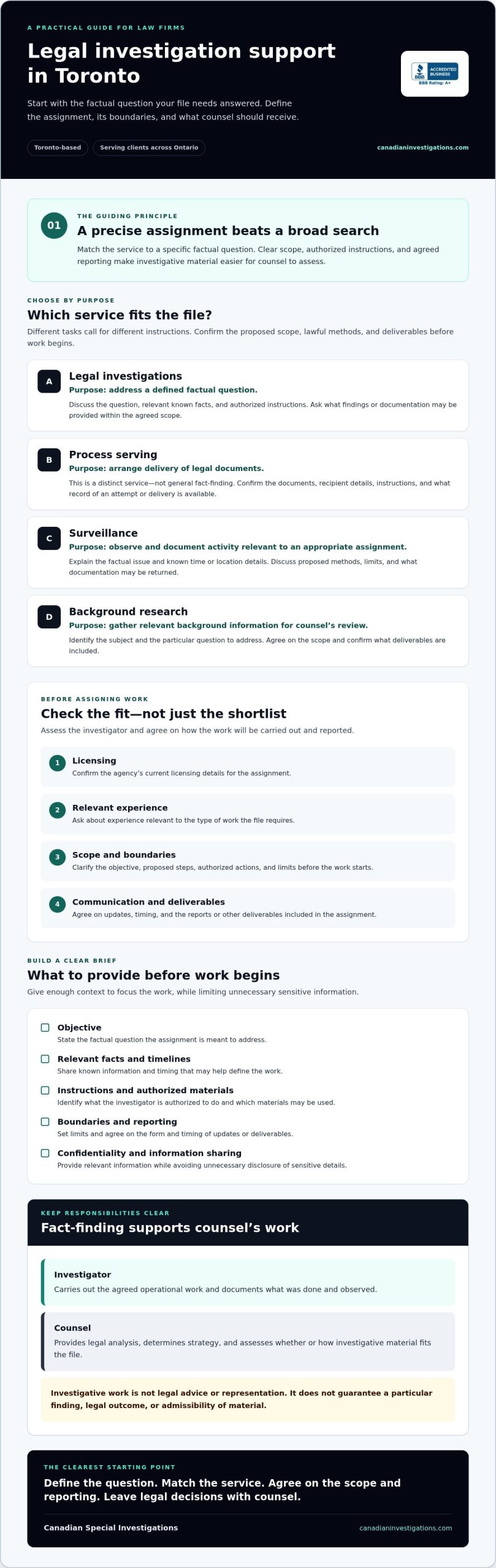
Start with the task the file requires. Legal investigations, process serving, surveillance, and background research address different needs, so choose a service based on the assignment’s purpose rather than a general request for investigative help. The comparison below is a starting point, not a recommendation for every case. Confirm the proposed scope, lawful methods, and deliverables with Canadian Special Investigations (CSI) before assigning work.
| Service | Potential assignment purpose | Information to discuss and deliverable to confirm |
|---|---|---|
| Legal investigations | Address a defined factual question through investigative work. | Share the question, relevant known facts, and authorized instructions. Ask what findings or documentation may be provided within the agreed scope. |
| Process serving | Arrange delivery of legal documents. This is a distinct service, not general fact-finding. | Confirm the documents, recipient details, instructions, and what record of the attempt or delivery is available. |
| Surveillance | Observe and document activity relevant to a specific, appropriate assignment. | Explain the factual issue and any known time or location details. Discuss proposed methods, limits, and what documentation may be returned. |
| Background research | Gather relevant background information for counsel’s review. | Identify the subject and the particular question to address. Confirm the research scope and how results will be reported. |
Legal investigations and field fact-finding
For legal investigations, counsel can frame the fieldwork around a narrow question, such as whether a specific reported circumstance can be independently checked. In areas like personal injury, employment disputes, or wrongful death claims, robust factual documentation is often essential when preparing a file; to explore how dedicated legal counsel handles these complex matters, click here. Provide relevant context without directing the investigator toward a preferred conclusion. Discuss the scope and lawful methods case by case, and agree in advance on the information or documentation the assignment may produce. Confirm the agency’s practices for the proposed work rather than assuming a particular format or level of detail. When an assignment involves difficult terrain, limited sightlines, or controlled access points, a specialized surveillance Ontario strategy that matches field methods and technology to the setting may be worth discussing with the agency.
Process serving and supporting research
Process serving focuses on delivery of legal documents, while investigation and research assignments focus on gathering information. Keep those instructions separate, even if both services relate to one matter. For practical considerations, review the Toronto process serving checklist and the Ontario legal document serving guide. For any service, confirm current licensing details. The Government of Ontario provides information on Ontario’s private security and investigative services.
Law firms comparing legal support investigators toronto can use a simple test: does the proposed service address the file’s specific need, and are the scope and deliverables clear? To discuss whether CSI’s listed legal investigation or process serving services fit an assignment, review Canadian Special Investigations’ services.
How to Assess a Toronto Investigator Before Assigning Legal Work
Choose an investigator by fit, not broad claims or a polished pitch. For law firms comparing legal support investigators toronto, due diligence should establish who will do the work, how the assignment will be managed, and what the firm can expect to receive. A careful intake conversation can reveal gaps before they affect the file.
Licensing, experience, and assignment fit
Ask the agency to confirm its current agency and investigator licensing details, then verify them through appropriate official Ontario sources. Match experience to the assignment: ask about comparable work, the proposed approach, and any limits the investigator sees. Confirm who will conduct the work, who your contact will be, and who can answer questions or provide updates. Canadian Special Investigations describes itself as a fully licensed Toronto-based agency; verify current details as part of your review.
Before authorizing work, put the assignment’s boundaries in writing. Specify the factual question, relevant background, permitted instructions or materials, and what would require further approval. Ask how the agency will communicate if circumstances change or the work cannot be completed as scoped.
Documentation, confidentiality, and evidence questions
Agree on documentation and reporting expectations before work begins. Ask how observations and information will be recorded, what the final report or other deliverable may include, how updates will be provided, and how the agency handles access, secure storage, retention, and confidentiality. Confirm the agency’s actual practices rather than assuming a particular format, level of detail, or retention period.
Gathered information does not guarantee admissibility, a legal result, or a particular finding. Counsel must assess how material relates to the file and whether it may be used. Legal and privacy questions can depend on the assignment’s facts and current Ontario requirements, so have counsel evaluate the proposed methods and handling practices. This checklist is a due-diligence aid, not legal advice. The Law Society of Ontario provides resources for Ontario legal professionals; counsel can consult those resources alongside file-specific judgment.
- Licensing: Can the agency confirm current licensing details for the agency and investigator?
- Assignment fit: Does the proposed experience and scope address the file’s specific factual question?
- Communication: Who handles instructions, progress updates, questions, and final delivery?
- Records and confidentiality: How will information be documented, protected, accessed, and retained?
- Limits: What can the assignment establish, and what remains for counsel to assess?
Clear answers help a firm assess whether an investigator’s process fits the matter before sharing sensitive instructions or authorizing work.
How to Brief and Coordinate an Investigation in Toronto
A focused brief gives an investigator a clear task and gives the law firm a defined basis for reviewing the work. For firms engaging legal support investigators toronto, coordinate the assignment before fieldwork starts: identify the factual question, share only relevant authorized information, and agree on communication and reporting. Counsel should clarify legal authority, privacy considerations, and boundaries for the specific matter.
Prepare a clear, proportionate assignment brief
Keep instructions factual and targeted. Include the objective, relevant people or locations, known dates, requested task, deadline, and practical constraints. Distinguish confirmed information from assumptions, and identify materials the investigator is authorized to use. Avoid sharing unrelated personal or file information. A brief should guide the inquiry, not prescribe a desired conclusion.
Before work begins, have counsel confirm that the requested task and materials are appropriate for the matter. Discuss any limits on contact, access, or investigative steps, and establish what requires further approval. These are case-specific considerations, not a substitute for legal advice or a complete statement of Ontario requirements. For surveillance assignments in particular, understanding how specialized surveillance Ontario methods address challenging environments, privacy requirements, and evidence considerations can help counsel frame appropriate instructions and boundaries.
- Define: State the factual question and the task you are requesting.
- Provide: Share relevant dates, known facts, and authorized materials only.
- Set boundaries: Identify deadlines, constraints, and actions that need approval.
Set expectations for updates and deliverables
Name one primary contact for instructions and questions. Agree on how the investigator should communicate material developments, what to do if the scope needs to change, and who can approve that change. Confirm the anticipated reporting format and contents with the agency in advance. Don’t assume a particular report structure, update schedule, or type of record is standard. Document revisions and approvals so the firm and investigator share the same instructions.
At completion, review the delivered material against the original objective. Note any unanswered questions, limitations, or departures from the agreed scope, then have counsel assess the information in the context of the file. This keeps operational reporting distinct from legal analysis.
For family-law matters, the Ontario divorce evidence guide offers additional context. If your firm is preparing a defined assignment, contact Canadian Special Investigations to discuss a legal investigation and confirm the proposed scope, communication process, and deliverables.
Choose Canadian Special Investigations for Legal Support in Toronto
For law firms looking for legal support investigators toronto, Canadian Special Investigations (CSI) offers a local point of contact for discussing investigative work. CSI is based in Toronto, describes itself as fully licensed, and serves clients across Ontario. Its listed services include legal investigations and process serving. These are investigative and document-delivery services, not legal advice or representation. Counsel continues to direct legal strategy and assess any information gathered.
Local coordination may be useful when an assignment involves Toronto or another Ontario community, but confirm that the agency’s current coverage and capacity match the matter’s location and requirements. CSI also provides a Toronto private investigation agency overview for more context about its services.
What to confirm with CSI before proceeding
Before authorizing an assignment, discuss the actual task rather than relying on a service label alone. Confirm current licensing details, who will handle the work, and whether the agency’s service and coverage fit the file. Then clarify the scope, communication arrangements, anticipated deliverables, and approval boundaries. Confirm specifics directly rather than assuming a particular reporting format, timeline, result, or legal status for material gathered.
This conversation can also help identify what information is appropriate to share at the outset. Prepare a short description of the factual question, the relevant location, any important timing considerations, and whether you’re considering legal investigation work or process serving. Keep sensitive details and supporting records limited to what is necessary for an initial discussion. Counsel can determine what further instructions or authorized materials are appropriate if the assignment proceeds.
Start a confidential case inquiry
A concise opening inquiry can establish whether the proposed work is worth discussing in more detail. Avoid sending extensive personal information or case documents before confirming how they should be shared and handled. Ask about the agency’s communication and information-handling practices directly, and provide additional instructions through the process agreed with CSI.
CSI accepts inquiries by phone or online. Before contacting the agency, note the question you need addressed, the location involved, relevant timing, and the service you’re considering. This gives the initial conversation a clear focus without presuming the outcome or scope. Verify current contact details and coverage directly with the agency.
To discuss a potential assignment, contact Canadian Special Investigations by phone or online with a concise outline of the matter and the investigative service under consideration.
Move Your Legal Investigation Forward with a Clear Brief
The strongest starting point is a precise factual question, matched to an appropriate service and a defined scope. Before assigning work, confirm licensing, communication arrangements, and expected deliverables. Counsel should assess how any information gathered relates to the file; investigative work doesn’t guarantee admissibility or a legal outcome.
Canadian Special Investigations is a Toronto-based agency that describes itself as fully licensed and serving clients across Ontario. The agency reports decades of industry experience, with legal investigations and process serving among its listed services. These services support fact-gathering or document delivery, not legal advice or representation.
Ready to discuss the requirements of your matter? Share a concise outline of the question, location, timing, and service under consideration. Discuss your legal investigation requirements with Canadian Special Investigations.
Frequently Asked Questions
What does a legal support investigator do in Toronto?
A legal support investigator gathers and documents information that may help counsel assess a file, but doesn’t provide legal advice or representation. Assignments can include legal investigations, field inquiries, or process serving, depending on the question and authorized scope. Canadian Special Investigations (CSI) is Toronto-based and identifies coverage in Toronto, Scarborough, North York, Etobicoke, Oakville, Burlington, Brampton, Mississauga, Hamilton, Ancaster, Niagara Falls, Kitchener, Waterloo, Richmond Hill, Barrie, Milton, and Guelph. Counsel directs strategy and evaluates any results.
Can a private investigator help a Toronto law firm gather evidence?
Yes. A private investigator may carry out a defined fact-gathering assignment and document the work for counsel’s review. For example, a firm might request a field inquiry to check a specific factual issue or ask an investigator to gather information within agreed boundaries. Counsel should set the objective, authorized instructions, and expected deliverables. Investigators don’t determine legal strategy, and gathered information doesn’t guarantee a particular finding or court outcome.
Is evidence collected by a private investigator automatically admissible in Ontario court?
No. Information gathered by a private investigator isn’t automatically admissible in an Ontario court. Its relevance, how it was obtained, and other case-specific considerations may matter. Counsel must assess the material and determine whether and how it may be used. Before an assignment begins, the law firm should clarify the factual objective, authorized methods, and reporting expectations with the investigator, while leaving legal analysis and decisions to counsel.
How do I choose a licensed investigator for a legal matter in Toronto?
Ask the agency to confirm its current licensing details and verify them through appropriate Ontario government resources. Then assess whether the investigator’s stated experience fits the assignment, who will perform the work, and who will communicate with your firm. Clarify scope, reporting expectations, confidentiality practices, and how changes will be approved. A Toronto agency’s broad experience alone isn’t enough; the proposed approach should address the file’s specific factual need.
Can investigators serve legal documents in Ontario?
Process serving is a distinct service involving delivery of legal documents. Canadian Special Investigations lists process serving among its services, but firms should confirm directly whether the agency’s current scope and coverage fit the particular assignment. Provide the documents and relevant instructions through the agreed process, and ask what record or reporting may be supplied. Process serving doesn’t replace counsel’s responsibility for legal advice or decisions about the matter.
What information should a law firm provide when hiring an investigator?
Start with the factual question, relevant known facts, people or locations involved, important dates, requested task, and any deadlines or practical limits. Identify which instructions and materials are authorized, and distinguish confirmed facts from assumptions. Agree on a point of contact, update process, expected deliverables, confidentiality practices, and approval boundaries before work begins. Share only information relevant to the assignment, and ask counsel to assess legal and privacy considerations.
How does a law firm contact Canadian Special Investigations about a case?
Law firms can contact Canadian Special Investigations by phone at 905-332-4807 or through its online contact form. For an initial confidential inquiry, prepare a concise outline of the factual question, location, timing, and service under consideration, such as legal investigations or process serving. Avoid sending unnecessary sensitive details or records before confirming how to share them. Confirm current contact details and service coverage directly with the agency.
To discuss a legal investigation or process serving assignment, contact Canadian Special Investigations with a concise outline of the factual question, location, and service you’re considering.

