A surveillance operation that burns its cover or breaches Ontario privacy statutes doesn’t just fail; it actively jeopardizes your legal standing before you ever step into a courtroom. When you need to hire private detective Hamilton operatives, the stakes are rarely low. You’re likely managing a high-stakes corporate dispute, a sensitive domestic proceeding, or suspected fraud, and you can’t afford an inexperienced operative who fumbles local logistics or compromises an entire investigation. You need absolute operational discretion, an ironclad chain of custody, and clear transparency regarding retainer structures before boots hit the ground.
This 2026 buying guide shows you how to vet, evaluate, and retain a licensed private investigator in Hamilton for court-admissible results that hold up under legal scrutiny. You’ll discover how to verify regulatory credentials under the Private Security and Investigative Services Act, evaluate specialized tactical capabilities across Hamilton’s distinct urban corridors and rural perimeters, and avoid ambiguous billing practices. Here is everything required to retain the right investigative team and secure decisive evidence with total peace of mind.
Key Takeaways
- Master Hamilton’s dual urban and rural geography by identifying surveillance teams equipped with specialized tactical assets, including aerial drone monitoring and concealed rural positioning.
- Apply a strict vetting standard to hire private detective Hamilton operatives who maintain active licensing and full regulatory compliance under the Private Security and Investigative Services Act.
- Map specific evidentiary targets to proven capabilities, ensuring domestic, corporate, and insurance files receive the appropriate investigative methodology.
- Safeguard your proceedings with uncompromising chain of custody protocols that guarantee photographic and video evidence remains admissible at the John Sopinka Courthouse.
- Establish structured retainer agreements and detailed intake briefs early to secure complete operational discretion and protect your strategic interests.
Why Hiring a Private Detective in Hamilton Requires Local Operational Mastery
Hamilton is not a generic secondary suburb of Toronto. It presents a complex operating theater defined by severe geographical divides, distinct municipal infrastructure, and divergent urban planning. Engaging a licensed private investigator who lacks localized operational experience frequently leads to burned surveillance, compromised files, and rejected evidence. Amateur efforts, such as following a spouse or attempting unauthorized GPS tracking, routinely breach the Criminal Code of Canada and ruin evidentiary admissibility. Professional field intelligence demands seasoned tactical specialists who understand provincial compliance while exploiting local terrain to capture indisputable proof.
When you prepare to hire private detective Hamilton professionals, evaluating geographic competence is just as vital as reviewing statutory credentials. Operatives must execute seamless transitions between high-density downtown blocks and isolated peripheral acreage without drawing scrutiny.
Navigating the Niagara Escarpment and Hamilton Urban Corridors
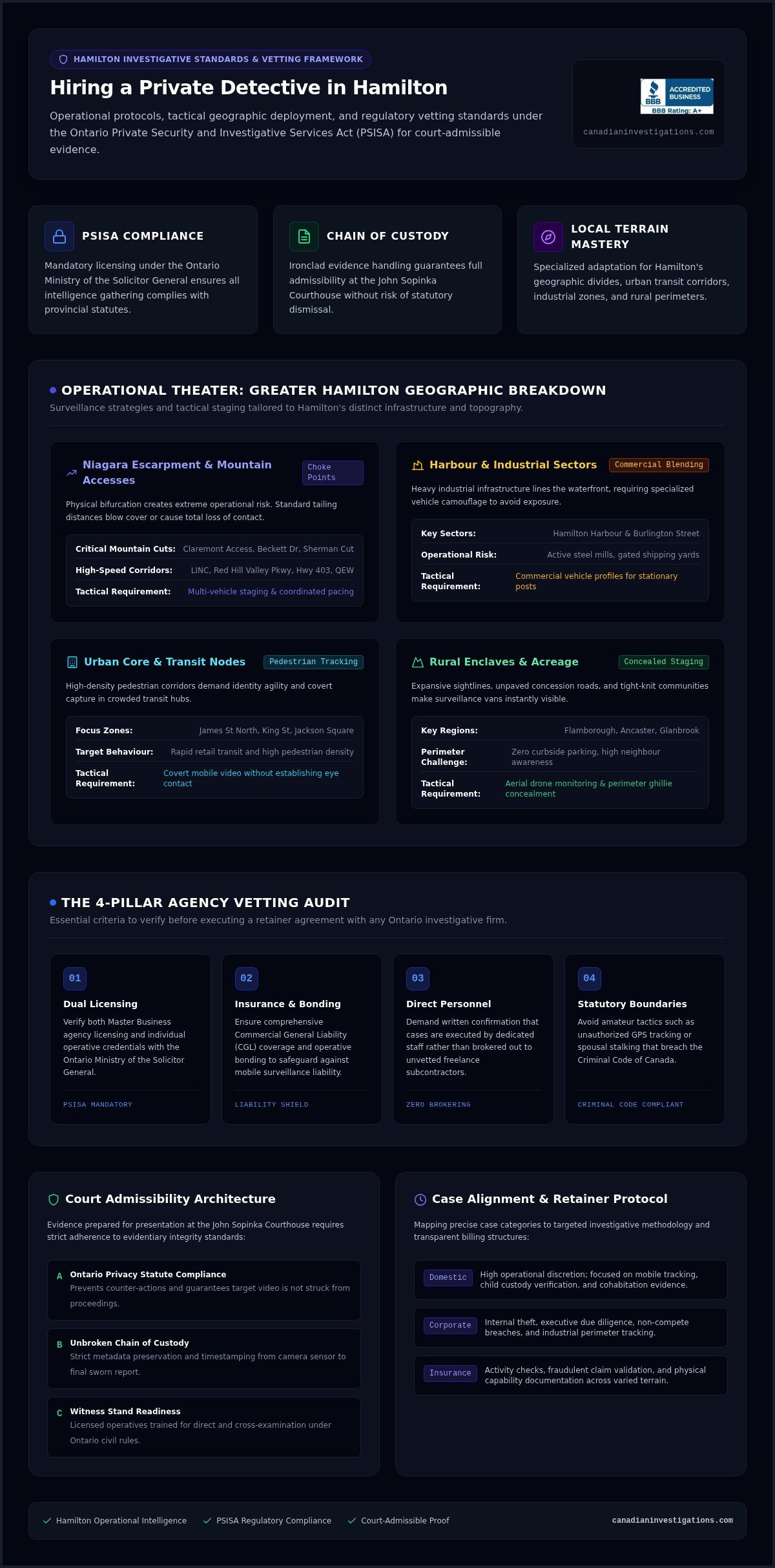
The Niagara Escarpment physically bifurcates the city, creating operational choke points at the mountain accesses. An operative trailing a target up the Claremont Access, Beckett Drive, or the Sherman Cut cannot rely on standard tailing distances without blowing their cover or losing visual contact entirely. High-speed pursuit across the Lincoln M. Alexander Parkway, the Red Hill Valley Parkway, Highway 403, and the QEW requires multi-vehicle staging and coordinated vehicle pacing. In the heavy industrial sectors lining Hamilton Harbour and Burlington Street, stationary surveillance demands commercial vehicle profiles to blend against shipping facilities and active steel operations.
Urban Density versus Rural Enclaves in Greater Hamilton
Operating realities shift radically across municipal boundaries:
- Urban Cores: Pedestrian tracking around James Street North, King Street, and Jackson Square requires operatives capable of shifting identities, entering crowded retail transit hubs, and executing mobile video capture without establishing eye contact.
- Rural Outskirts: Operations across Flamborough, Ancaster, and Glanbrook feature sparse traffic, expansive sightlines, and tight-knit agricultural communities. Standard surveillance vans stand out immediately on unpaved concession roads.
- Tactical Staging: Elite teams utilize specialized camo ghillie concealment along field perimeters and employ advanced aerial drone platforms to track subjects across open acreage where vehicle staging is impossible.
Securing actionable evidence across these disparate environments requires an adaptable agency that plans routes meticulously. Local operational mastery ensures your target remains unaware while operatives build an airtight factual record.
Vetting Checklist: How to Evaluate a Hamilton Private Investigation Agency
Retaining an investigative firm requires the same due diligence applied to corporate legal counsel or forensic auditors. Many online broker platforms rely on crowd-sourced star ratings that fail to evaluate actual operational competency, statutory standing, or court readiness. When you hire private detective Hamilton professionals, a systematic vetting audit protects you from legal liability, blown cover, and inadmissible evidence.
Before executing a retainer agreement, insist on direct answers to these foundational vetting criteria:
- Licensing Credentials: Confirm both individual operative and Master Business agency licensing under the Ontario Ministry of the Solicitor General.
- Insurance Coverage: Verify comprehensive commercial general liability insurance and operative bonding to safeguard your liability during mobile surveillance.
- Subcontractor Transparency: Demand written confirmation that your case will be executed by dedicated personnel rather than brokered out to unvetted freelancers.
Mandatory Licensing Under Ontario PSISA Standards
Every legitimate operative in Ontario must satisfy official licensing requirements governed by the Private Security and Investigative Services Act, 2005 (PSISA). Field agents are legally required to carry their physical provincial licence during assignments. Engaging unlicensed operatives risks severe provincial penalties and guarantees opposing counsel will seek an immediate motion to exclude your evidence at trial.
Technical Capabilities and Specialized Field Surveillance
Generalist agencies relying solely on dashboard cameras and handheld camcorders cannot handle complex cases. Advanced field intelligence demands specialized optical technology, including high-definition long-range lenses, ultra-low-light digital sensors, and covert micro-cameras. In expansive agricultural zones, tactical camo ghillie suit deployment provides undetectable stationary surveillance. For large rural acreage where vehicle perimeters fail, operatives must deploy Transport Canada-compliant U.A.V drone surveillance to maintain persistent visual contact.
Evidence Continuity and Chain-of-Custody Rigour
Raw footage is useless without strict evidentiary continuity. Professional investigators log contemporaneous field notes with synchronized, unedited digital time stamps matching court requirements. Digital files must be preserved in secure, encrypted repositories that prevent claims of metadata manipulation or spoliation. For complex business fraud, retaining specialized corporate investigator services ensures financial and operational evidence conforms to strict governance protocols. If you need immediate clarity on a high-stakes matter, consult canadianinvestigations.com to review tactical deployment options tailored to your specific legal objectives.
Matching Investigative Capabilities to Your Specific Case Requirements
Every legal dispute requires a distinct evidentiary strategy. When you hire private detective Hamilton specialists, aligning the firm’s tactical capabilities with your evidentiary burden is essential. Generalized investigative techniques often fail to produce decisive evidence. Professional bodies like the Council of Professional Investigators Ontario emphasize ethical standards, yet field execution hinges on tactical adaptability. Matching specific surveillance tools to distinct case parameters ensures your investment yields actionable, court-ready intelligence.
Domestic, Matrimonial, and Family Law Inquiries
Family law proceedings require zero margin for detection. In cohabitation and infidelity matters, operatives document pattern-of-life movements, overnight stays, and lifestyle discrepancies that clarify support obligations. Child custody disputes demand heightened precision, focusing on child safety, parental fitness, and compliance with court-ordered conditions. Review our tactical infidelity investigation guide to understand how domestic surveillance documents verifiable facts while protecting client discretion.
Corporate Asset Protection and Pre-Employment Due Diligence
Internal theft, non-compete violations, and unauthorized asset diversion threaten commercial stability. Detailed pre-employment vetting establishes candidate integrity through comprehensive public records, credential verification, and corporate history audits. For fleet oversight and commercial transport operations across Southern Ontario, specialized solutions like the AUTO-BACK program verify route compliance and detect off-site inventory diversion. These tactical checks safeguard company assets and mitigate executive risk.
Insurance Defence, WSIB Verification, and Fraud Mitigation
Exaggerated injury claims and questionable compensation filings generate massive financial exposure for employers and insurance carriers. Objective physical surveillance establishes a claimant’s true physical capabilities through clear, time-stamped video evidence. Operatives document subjects performing strenuous tasks, undocumented physical labour, or recreational activities that directly contradict filed restrictions. Examining insurance fraud surveillance in Ontario illustrates how disciplined field monitoring counters bad-faith claims and resolves disputed WSIB files.
Legal Boundaries, Ontario Court Admissibility, and Pricing Models
Evidentiary value collapses if investigative methods violate federal or provincial statutes. Surveillance operations in Hamilton must comply strictly with the Criminal Code of Canada and federal privacy frameworks like PIPEDA. Operating outside these boundaries exposes clients to civil liability and compromises their legal standing. When organizations and legal counsel prepare to hire private detective Hamilton operatives, understanding legal boundaries is the primary safeguard against wasted capital and tainted proceedings.
Evidentiary Admissibility in Ontario Civil and Family Courts
Judges presiding at the John Sopinka Courthouse demand evidence gathered without procedural violations. Private investigators cannot commit criminal trespass, intercept private oral communications without lawful consent, or install unauthorized tracking devices on vehicles without proper proprietary authority. Crossing these legal boundaries results in immediate evidence exclusion under Ontario civil procedure. Licensed operatives capture observations strictly from public vantage points where no reasonable expectation of privacy exists. When called to testify, they provide credible sworn affidavits and contemporaneous field logs that establish an unbroken chain of custody, converting raw field surveillance into decisive courtroom proof.
Understanding Professional Retainer and Billing Structures
Reputable investigative agencies operate with transparent, contractually defined retainer agreements rather than ambiguous estimates. The billing framework distinguishes dynamic field deployments from static record analysis:
- Dynamic Field Deployments: Surveillance operations bill against dedicated operative hours, vehicle staging, and active mobile monitoring across assigned jurisdictions.
- Operational Disbursements: Transparent case billings clearly itemize mileage, specialized deployment requirements, and evidentiary report preparation.
- Fixed-Scope Inquiries: Desktop background checks, pre-employment screening files, and legal process serving follow structured, predictable scopes.
A professional retainer contract explicitly establishes expenditure authorization limits, giving you absolute control over your operational budget. To secure legally compliant, court-admissible surveillance for your upcoming proceedings, retain an experienced tactical team at Canadian Special Investigations before critical legal deadlines pass.
Initiating an Investigation: What to Expect When Retaining an Operative
Retaining an investigative team follows a disciplined operational lifecycle. Moving from initial suspicion to courtroom-admissible evidence requires meticulous planning, operational discipline, and seamless collaboration between client and operative. When you decide to hire private detective Hamilton specialists, understanding what happens during case initiation ensures your objectives are met efficiently without alerting the target.
The Confidential Intake and Operational Planning Phase
The engagement begins with a secure intake conducted by phone or encrypted messaging to assess case objectives and legal standing. You will work directly with investigative managers to compile a comprehensive subject dossier. Providing sharp photographs, registered vehicle details, work shifts, daily routines, and known associate profiles enables the tactical team to plan effective operational parameters.
Communications security remains vital throughout this stage:
- Establish dedicated, non-compromised communication channels such as secure email accounts or direct phone contact away from shared family or workplace devices.
- Never alter your routine behaviour or confront the subject prior to surveillance deployment, as sudden behavioural shifts alert targets and compromise field positioning.
- Define clear operational triggers that authorize field deployment based on specific target schedules or anticipated movements.
Field Execution, Final Reporting, and Legal Support
Surveillance execution demands continuous coordination between active field operatives and senior case management. Operatives monitor targets using static perimeters or mobile pacing, adapting in real time to shifting routes and environments. Throughout the deployment, the team maintains secure, discreet progress updates so you remain informed without jeopardizing field operations.
Once surveillance concludes, the agency compiles an exhaustive evidentiary brief. This formal package includes contemporaneous field logs, chronological activity summaries, and synchronized, high-resolution digital video files ready for litigation. Decades of combined industry experience across Hamilton, Ancaster, and Stoney Creek ensure that Canadian Special Investigations delivers verifiable intelligence that stands up to strict judicial scrutiny. If you need decisive answers and discreet tactical execution, Contact Canadian Special Investigations to initiate your confidential Hamilton case assessment.
Securing Decisive Intelligence and Protecting Your Legal Strategy
Securing decisive, legally compliant intelligence requires tactical discipline and operational mastery over Hamilton’s unique terrain. When you hire private detective Hamilton specialists, verifying regulatory compliance under the Ontario Ministry of the Solicitor General and demanding strict chain of custody protocols protects your case against procedural failure. You don’t need to navigate sensitive domestic issues, corporate fraud, or disputed claims without factual clarity.
Backed by decades of combined field experience, Canadian Special Investigations provides the elite surveillance capabilities your file demands, from Transport Canada-compliant drone operations to tactical camo ghillie concealment across rural perimeters. You can approach your upcoming legal proceedings with unwavering confidence and verified proof. Contact Canadian Special Investigations to secure confidential, court-ready investigative evidence across Hamilton and Southern Ontario.
Frequently Asked Questions
Is hiring a private detective legal in Hamilton, Ontario?
Yes, retaining a private investigator is completely legal across Hamilton and throughout Ontario. The agency and its field operatives must hold active licences issued by the Ministry of the Solicitor General under the Private Security and Investigative Services Act, 2005. Both individuals and legal counsel retain licensed agencies regularly to obtain objective evidence for civil litigation, marital disputes, and workplace matters without violating provincial statutes.
Will surveillance evidence collected by a private investigator hold up in Ontario family court?
Surveillance evidence holds up in Ontario family court if operatives collect it lawfully from public vantage points. Video footage and photographic proof must preserve an unbroken chain of custody and avoid infringing reasonable expectations of privacy. When you hire private detective Hamilton professionals to document cohabitation or parental fitness, the investigator submits sworn affidavits and contemporaneous notes, providing credible witness testimony that judges routinely accept.
Can a private investigator track a vehicle using GPS in Ontario?
GPS tracking is legally permissible in Ontario only when deployed on a vehicle with the explicit consent of the registered vehicle owner. Investigators cannot attach tracking units to vehicles owned solely by third parties, as this breaches criminal harassment and privacy laws. In corporate fleet management or matrimonial files where a client owns or co-owns the automobile, GPS tracking can provide lawful intelligence before deploying mobile surveillance operatives.
How long does a typical private investigation surveillance assignment take in Hamilton?
Most surveillance assignments take between two to five operational shifts, depending on subject predictability and case complexity. Static files with established schedules, such as employment verification, might resolve in a single deployment. Dynamic domestic inquiries or evasive subjects navigating Escarpment corridors often require multiple observation blocks across varied days to establish consistent behavioural patterns and document conclusive evidence that satisfies legal standards.
What information do I need to provide before an investigation begins?
You must provide verified intelligence regarding the subject’s physical description, daily schedule, and primary locations. Critical details include recent photographs, workplace addresses, vehicle make and licence plate numbers, known associates, and routine departure times. Detailed intelligence minimizes unproductive field hours and prevents target detection. The more accurate information an agency receives during initial intake, the faster field operatives can establish effective perimeters.
Can private investigators tap phone lines or access private text messages legally?
No, private investigators cannot legally tap phone lines, hack mobile devices, or intercept private text communications. Section 184 of the Criminal Code of Canada strictly forbids the interception of private communications without judicial authorization or one-party consent. Legitimate agencies gather communications evidence through voluntary disclosure, public records, and direct physical observation. Any operative claiming access to locked text messages or private call logs is engaging in illegal activity that invalidates your evidence.
Why should I hire a licensed agency instead of attempting surveillance myself?
Attempting surveillance yourself frequently leads to criminal harassment charges, personal confrontation, and legally unusable proof. When you hire private detective Hamilton agencies, you retain trained specialists who operate with complete tactical detachment and provincial licensing. Professional investigators understand court-admissible standards, utilize specialized optics, and remain undetected. Their contemporaneous field logs and objective courtroom testimony provide impartial evidence that self-conducted surveillance simply cannot deliver.

