What if the next step in a finance file isn’t tracking an asset, but first establishing whether there’s anything to track? For finance companies searching “asset search investigator ontario,” the key questions are what investigative research can establish, who may control an asset, and whether further fieldwork is justified. A clear question helps you choose a proportionate next move.
Research and physical asset tracking answer different questions. Research can develop leads from appropriate sources; field investigation or tracking may help verify an asset’s location or movement when the scope and legal authority support it. This guide explains how to define an investigative scope for a finance-related matter, choose between methods, and account for legal and privacy boundaries.
Canadian Special Investigations is a fully licensed Ontario private investigation agency providing corporate and legal investigative services, GPS tracking, and the AUTO-BACK Program. Organized findings can help finance teams assess practical next steps, but a lead does not guarantee recovery or a particular legal outcome.
Key Takeaways
- Define the asset-related fact your finance team needs clarified before selecting an investigative approach.
- Before engaging an “asset search investigator ontario,” establish the question, scope, and intended use of findings.
- Compare property research, broader asset searches, field investigation, and tracking by the question each method can address.
- Ensure investigative methods and the use of findings account for applicable legal and privacy requirements.
- Use a proportionate sequence: define the question, select an appropriate method, then review organized findings to assess next steps.
What an asset search investigator in Ontario can establish for a finance company
Start by identifying the asset-related fact your finance team needs to clarify. The question might be whether an asset appears connected to a person or business, whether available information supports a reported connection, or whether further investigation is warranted. An asset search is focused research intended to identify or verify information relevant to that question.
An asset search provides information for decision-making, not recovery itself. Findings don’t seize, transfer, or value an asset, guarantee access to it, or determine whether a creditor can collect. They can help clarify what is known, identify gaps, and inform a proportionate next step. A private investigator conducts inquiries to establish facts, but the work and conclusions remain bounded by the assignment and the information that can be lawfully obtained.
Ontario context matters because the relevant sources, records, and procedures depend on the asset and circumstances. Some information may be available through appropriate public sources; other information may be private, unavailable, out of date, or insufficient to confirm control or ownership. Treat a record or lead in context, not as conclusive proof. A finance company searching for an asset search investigator ontario should begin with the decision it needs to make, rather than assume one search will answer every question.
Asset search versus asset tracking: what is the difference?
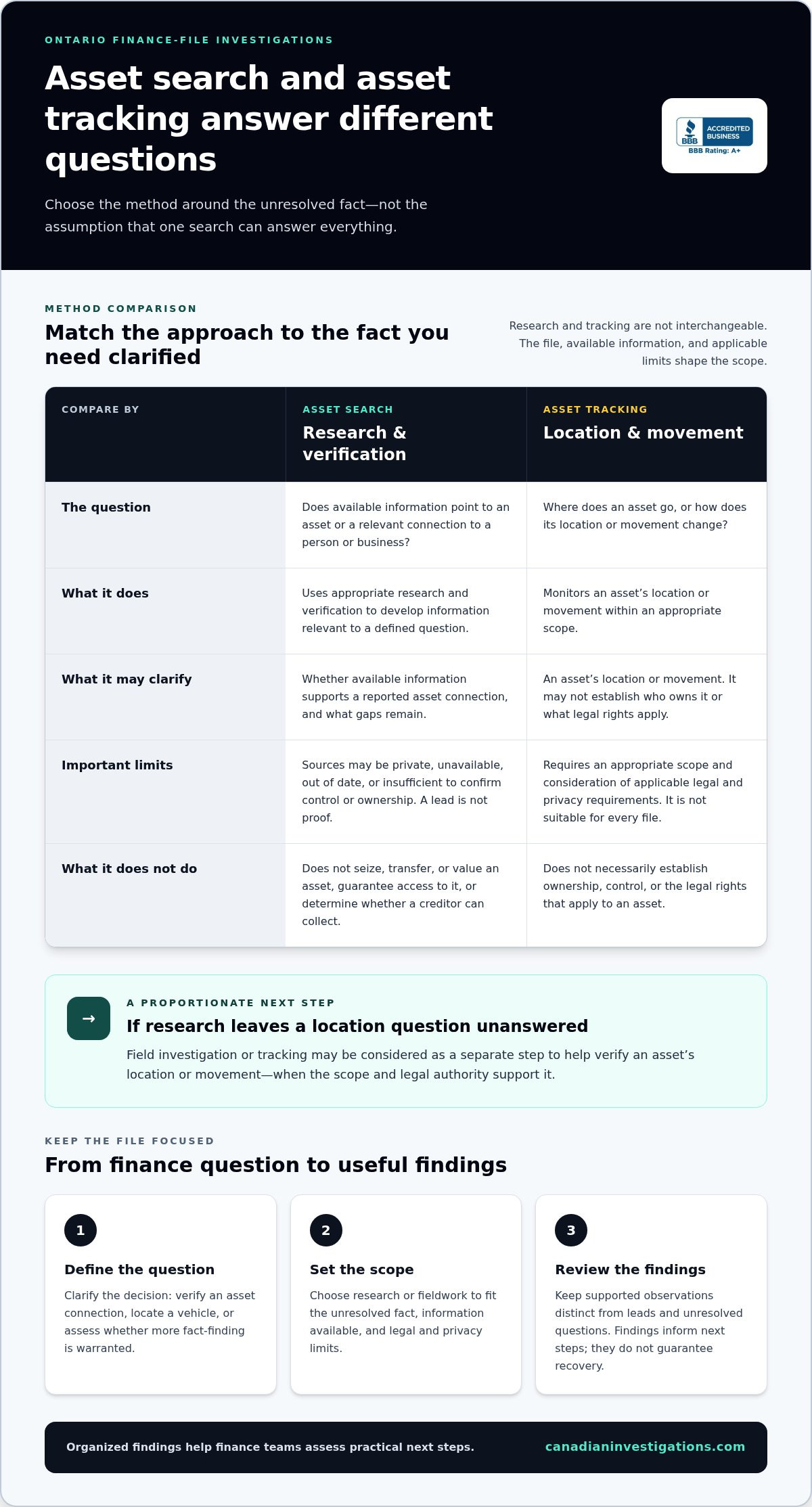
An asset search uses research and verification to address a defined question, such as whether available information points to an asset or a relevant connection. Tracking monitors an asset’s location or movement within an appropriate scope. It can address where an asset goes, but not necessarily who owns it or what legal rights apply. These methods aren’t interchangeable. Choose based on the unresolved fact, and assess tracking for legal and privacy considerations in the specific circumstances.
Which finance-company files may prompt an asset inquiry?
A lending file may raise questions about an asset identified in an application or related records. A recovery file may require clarification about a vehicle’s location or other relevant facts. In a due-diligence file, a company may need to examine information connected to a proposed transaction or business relationship. Tailor each inquiry to the file; none guarantees payment or recovery.
Corporate investigation experience supports disciplined fact-finding on business-related questions, with findings organized to help a finance team assess its options. Canadian Special Investigations is a Toronto-based, fully licensed private investigation agency serving clients across Ontario. Its corporate and legal investigative work, GPS tracking, and AUTO-BACK Program offer relevant capabilities for finance-related matters, with the scope shaped by the question and applicable limits.
How an Ontario asset investigation moves from question to findings
A finance-file investigation should follow a clear sequence: define the question, set the scope, conduct appropriate research or fieldwork, then report the findings. The method depends on the file, the information available, and the legal and privacy limits that apply. This sequence keeps the work focused on a decision the finance company needs to make.
Start with a defined finance-file question
Before choosing a method, identify the decision the organization is assessing. Is it trying to verify a reported connection to an asset, clarify a vehicle’s location, or determine whether more fact-finding is warranted? Relevant identifiers and file context can narrow the inquiry and reduce unnecessary work. Share information already held through appropriate channels; don’t try to obtain private records or access accounts without authority.
A defined question helps an asset search investigator in Ontario shape the research and distinguish confirmed information from matters that still need checking. A lead is an indication that may point towards a relevant fact; a verified finding is an observation supported by the work and sources available within the investigation’s scope. A lead can guide further inquiry, but shouldn’t be treated as proof.
Move from investigation to a clear report
A useful report organizes the result for review. Depending on the assignment, it may set out observations alongside relevant sources, dates, and limitations, making clear what was established and what remains unresolved. For example, research may identify a possible asset connection without establishing its current location or control. The report should preserve that distinction rather than overstate what the evidence shows.
If research leaves a specific location or movement question unanswered, field investigation or tracking may be considered as a separate next step. Tracking requires an appropriate scope and assessment of applicable legal and privacy requirements; it isn’t suitable for every file. For more on that distinction, see the GPS tracking guide for Ontario investigations.
Financial inquiries also sit within a broader Canadian context. The Financial Transactions and Reports Analysis Centre of Canada (FINTRAC) is Canada’s financial intelligence unit; its role is distinct from a private investigator’s casework. This distinction helps prevent assumptions about access to financial information or authority to obtain it.
For a finance-related matter, Canadian Special Investigations provides corporate and legal investigative support to help define a focused scope and organize findings for review. Learn more about investigative support for finance-related questions.
Asset search or asset tracking: compare the right method for your Ontario file
The right method depends on the fact the file needs to establish. A question about identity or a possible ownership connection calls for a different approach than a question about an asset’s current location or movement. An asset search investigator ontario can help match the investigative method to the finance file without treating any method as a universal solution.
| Question | Method | Potential output | Key limitation |
|---|---|---|---|
| Is there relevant property information to review? | Property-related research | Available property details or leads relevant to due diligence | A record may not establish current ownership, control, value, or recoverability. |
| What information may clarify an asset or identity connection? | Asset search | Organized research findings tied to a defined question | Results depend on available information and lawful access; private financial data isn’t automatically accessible. |
| Can a specific fact be assessed through observation? | Field investigation | Observations relevant to the assignment | Observations are limited by the scope and circumstances of the work. |
| Where is an asset, or how is it moving? | GPS tracking | Location or movement information within an appropriate scope | Suitability depends on legal authority, privacy considerations, and the specific circumstances. |
When research or property information may be relevant
Property information may help address a defined due-diligence question, such as whether a property record appears relevant to a person or business under review. GeoWarehouse is a third-party property-information platform, not an investigative service or product of Canadian Special Investigations. Information from a platform or record can provide a lead, but doesn’t establish every fact about ownership, control, current status, or whether an asset can be recovered.
Broader asset research may be appropriate when the file requires more than property details. Define the connection being examined and distinguish information that supports it from facts that remain unverified.
When field investigation or GPS tracking may be relevant
Field investigation can address a defined question through appropriate observation. Tracking, by contrast, concerns an asset’s location or movement and must be assessed for suitability and legal authority in the circumstances. It isn’t a substitute for research into identity or ownership. For further context, read the specialized surveillance guide for Ontario.
Finance companies may also have separate obligations under the Proceeds of Crime (Money Laundering) and Terrorist Financing Act, depending on their role and circumstances. Investigative work doesn’t replace legal or compliance review. Canadian Special Investigations provides corporate and legal investigative support across Ontario; explore finance-related investigative support to consider a focused scope.
Ontario safeguards finance companies should consider before an asset investigation
Set the boundaries before investigative work begins. A clear objective, defined permitted methods, and an agreed intended use help keep an inquiry proportionate to the finance file. Requirements can differ with the method and circumstances, particularly where personal information, observation, or tracking is involved. Have counsel review the specific legal and privacy requirements that apply before relying on a method or citing a statute.
Keep an internal record of the business question, instructions, and decision-makers who authorized the scope. This provides a reference point if the inquiry changes or findings inform a later decision. For financial institutions seeking broader guidance on regulatory compliance and risk management across consumer lending operations, versapien.com provides consulting focused on governance frameworks. A report can support an assessment, but it doesn’t guarantee that information will be admissible in court, sufficient for collection, or conclusive on its own.
Scope, privacy, and responsible use of findings
Information that is publicly accessible isn’t automatically appropriate to collect, combine, or use for every purpose. Consider why each detail is relevant, who needs to see the findings, and how they’ll be handled within the organization. Keep the assignment focused; don’t seek private financial information or use surveillance or tracking without an appropriate basis. An asset search investigator ontario should work within the agreed scope and applicable limits, while clearly distinguishing observations from unresolved leads.
A practical briefing checklist for finance teams
Before assigning work, organize the information the investigator needs to understand the file and the decision at hand:
- File objective: State the business decision the inquiry is meant to inform.
- Known identifiers: Provide relevant information already held through appropriate channels.
- Relevant dates: Identify the time period that matters to the question.
- Unresolved questions: Specify what needs clarification, without presuming what the investigation will establish.
- Recipients and use: Identify who will receive the findings and how the organization will assess them.
This briefing aligns the method with the question and helps prevent the assignment from expanding without a clear purpose. For guidance on business-focused investigative planning, read the corporate investigation guide for Toronto businesses.
Canadian Special Investigations provides corporate and legal investigative support for finance-related matters across Ontario. Discuss a focused investigative scope to clarify the question, boundaries, and intended use of findings.
Working with an Ontario asset search investigator: scope the next step
For finance teams searching for an “asset search investigator ontario,” the first step is defining the uncertainty the file needs to resolve, not selecting a tool. State the question, choose a proportionate method, then review the findings against the decision at hand. Research, field investigation, and tracking serve different purposes, so the scope should follow the facts needed rather than assume a method in advance.
What to prepare before requesting an investigation
A focused briefing establishes a clear starting point. Outline the file’s objective, relevant facts already known, and the specific question that remains unanswered. Include important timelines and explain how the organization expects to use the findings internally. This gives the investigator context to assess a suitable scope without presuming what the work will establish.
Share information through appropriate channels and limit it to what is relevant to the inquiry. Avoid sending unnecessary personal information before its relevance is clear. If the matter raises legal or privacy questions, identify them early so the proposed approach can be considered in context.
- Objective: What decision will the investigation inform?
- Known facts: What relevant information is already available?
- Uncertainty: What specific asset-related fact needs clarification?
- Timeline and use: What dates matter, and who will review the findings?
How CSI can support an Ontario finance inquiry
Canadian Special Investigations is a Toronto-based, fully licensed private investigation agency serving clients across Ontario. Its corporate and legal investigative capabilities support finance-related fact-finding. GPS tracking may be relevant when a properly scoped inquiry concerns an asset’s location or movement, while the AUTO-BACK Program is another capability connected to asset-related matters. Tracking isn’t a default; the method should match the question and be assessed against applicable legal and privacy considerations.
Clear instructions help keep the work focused. CSI’s corporate and legal investigative services can address the objective, relevant known facts, unresolved questions, intended use, and appropriate investigative scope with discretion. Findings can inform a finance team’s assessment of next steps, but they don’t guarantee asset recovery, collection, or a particular legal result.
To discuss a finance-related matter, Discuss your Ontario investigation confidentially. Share the file objective and the uncertainty you need addressed; provide only information relevant to defining the inquiry.
Make your next finance-file decision with greater clarity
A focused asset inquiry starts with a precise question. Research can help clarify identity or ownership connections, while field investigation or tracking may address different unresolved facts. Choose a proportionate method, set clear boundaries, and review findings in context. They can inform next steps, but don’t guarantee recovery or determine a legal outcome.
For finance companies considering an asset search investigator ontario, Canadian Special Investigations offers investigative support grounded in a defined scope. The fully licensed agency is based in Toronto and serves clients across Ontario, with corporate and legal investigations, GPS tracking, and the AUTO-BACK Program among its relevant capabilities.
Clarify the file objective, the facts already known, and the uncertainty that remains. Then discuss your Ontario investigation confidentially with Canadian Special Investigations. Share the question you need addressed to begin assessing an appropriate investigative approach.
Frequently Asked Questions
What does an asset search investigator in Ontario do?
An asset search investigator conducts focused research to clarify a defined question about relevant assets or related information. For a finance company, that may mean assessing a lead or supporting due diligence. An asset search investigator ontario works within the assignment’s scope, available information, and applicable legal limits. Findings can inform a decision, but don’t guarantee asset recovery, payment, or a particular legal outcome.
Is asset search the same as asset tracking?
No. An asset search researches or verifies information relevant to a defined question, such as whether available information suggests an asset connection. Tracking concerns monitoring an asset’s location or movement under an appropriate scope. First identify what the finance company needs to establish. Research and tracking address different questions, and neither should be treated as a substitute for the other.
Can an investigator track a vehicle in Ontario?
Vehicle tracking may be considered, but its suitability depends on the circumstances, method, authorization, and applicable legal and privacy requirements. A finance relationship alone shouldn’t be assumed to authorize tracking. A licensed investigator should assess the proposed scope before work proceeds, and finance companies should obtain legal advice where needed. Avoid unauthorized tracking or surveillance; the method must be appropriate to the specific inquiry.
What information should a finance company provide to an asset search investigator?
Start with the inquiry’s purpose and the specific fact the organization needs clarified. Relevant context may include known identifiers, important dates, and information already associated with the file. Share only information appropriate to the investigation. A focused briefing helps define the scope, assess suitable methods, and organize findings for review. Canadian Special Investigations is based in Toronto and serves clients in Oakville, Burlington, Brampton, Mississauga, Hamilton, Ancaster, Niagara Falls, Kitchener, Waterloo, Scarborough, North York, Richmond Hill, Barrie, Milton, Etobicoke, and Guelph.
Can an asset search investigator find property ownership information in Ontario?
Property-related information may help address a specific due-diligence question, but a search result isn’t a complete answer about ownership, value, control, or recoverability. Sources and access conditions vary, and information may require further verification. The investigator should explain the scope and limitations of findings. The finance company can then assess how they fit the file and consult legal counsel about appropriate use.
Are an investigator’s asset-search findings admissible in court?
No investigator can guarantee that findings will be admitted or accepted in a legal proceeding. Admissibility depends on the evidence, how it was obtained, the issues before the court, and applicable law. Preserve relevant records and consult legal counsel about intended use. Investigative findings can help inform a finance company’s assessment, but they aren’t a substitute for legal advice or a guarantee of a court outcome.
How should a finance company choose between an asset search and GPS tracking?
Begin with the fact the file needs to establish. If the question concerns relevant asset information or a possible connection, research may be suitable. If it concerns an asset’s location or movement, tracking may warrant assessment, subject to an appropriate scope and legal considerations. The right method depends on the facts and applicable limits. An investigator can discuss options without assuming one approach fits every case or promising a result.

