A stock count doesn’t reconcile. Cash is missing, or an asset can’t be accounted for. The pressure to act is immediate, but a discrepancy is not proof of theft. Employers searching for “employee theft investigation ontario” guidance need a clear process to separate verified facts from suspicion before making an employment decision.
It’s reasonable to want answers quickly. A careless inquiry, however, can alert a subject, compromise relevant evidence or disrupt operations. Start by defining the concern, preserving relevant records and limiting the investigation to what the facts support.
This guide explains how to respond to suspected employee theft in Ontario, what information to preserve and how to set an appropriate investigation scope. It also covers when discreet support from a licensed investigator can help with independent fact-finding, and why employment-law advice may be important before deciding what action to take. The goal is clarity: establish what the evidence shows, document the steps taken and make decisions on a sound, fair basis.
Key Takeaways
- In an employee theft investigation ontario employers can distinguish an isolated discrepancy from a meaningful pattern by comparing records, timing and independent corroboration.
- Set a narrow, impartial scope and preserve original records, documenting how evidence was collected and handled.
- Internal teams can review business records; independent investigators can provide discreet, scoped fact-finding when additional independence is needed.
- Use an ordered checklist to document the concern, preserve relevant information, assess findings and consult appropriate advisers before deciding next steps.
- Canadian Special Investigations is a Toronto-based, fully licensed agency serving businesses across Ontario with employment investigation, evidence-gathering and surveillance support.
Employee Theft Investigation in Ontario: Responding to Warning Signs
Unexplained losses put managers in a difficult position. They need to understand what happened, but a misplaced item, unusual adjustment or till discrepancy doesn’t establish who caused it, or whether theft occurred at all. Employers should first test whether the concern can be reproduced in the records and supported by independent information.
Separate what’s known from what’s inferred. A count may show that inventory is short, but it doesn’t explain why. Look for repetition across dates, locations, shifts or transaction types, and check whether the same pattern appears in more than one record. A documented red flag is a reason for further review, not proof of theft.
Which discrepancies may justify a closer review?
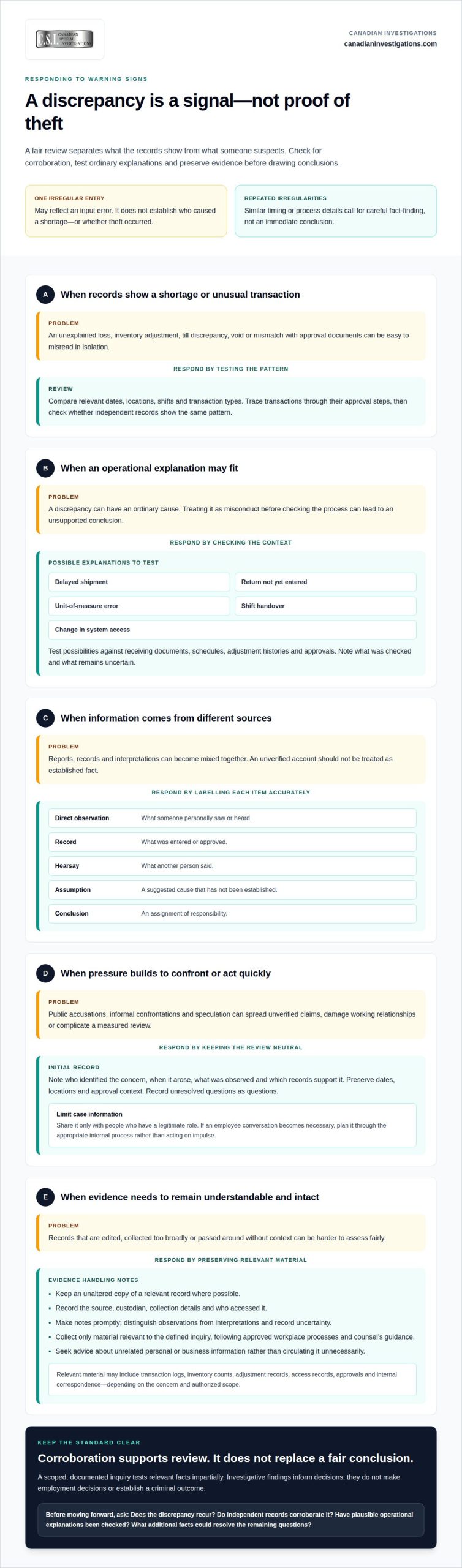
Recurring shortages in the same product, unexplained inventory adjustments, voids without clear supporting details or transaction records that don’t match approval documents may warrant closer review. Compare relevant dates and locations, then trace each transaction through its approval steps. A single irregular entry may reflect an input error. Repeated irregularities with similar timing or process details call for careful fact-finding, not an immediate conclusion.
Check ordinary operational explanations before assigning meaning to a discrepancy. A delayed shipment, a return not yet entered, a unit-of-measure error, a shift handover or a change in system access can affect records or counts. Note these possibilities and test them against receiving documents, schedules, adjustment histories and approvals. If the concern involves suspected misuse of entrusted property, Embezzlement provides background on how that form of theft is distinguished from other taking.
Keep evidence categories distinct. A direct observation describes what someone personally saw or heard. A record shows what was entered or approved. Hearsay reports what another person said; an assumption suggests a cause; a conclusion assigns responsibility. Label each accurately so an unverified account isn’t treated as established fact.
What should managers avoid doing at the outset?
Don’t accuse an employee publicly, confront them informally or speculate about the matter with staff. Premature discussion can damage working relationships, spread unverified claims and complicate a measured review. Limit case information to people with a legitimate role. If a conversation with an employee becomes necessary, plan it through the appropriate internal process rather than acting on impulse.
Create a neutral initial record while the details are fresh. Note who identified the concern, when it arose, what was observed and which records support it. Distinguish direct observations from reports or interpretations, and preserve the relevant dates, locations and approval context. Don’t edit records to fit a theory; record unresolved questions as questions.
A practical first review asks: Does the discrepancy recur? Do independent records corroborate it? Have plausible operational explanations been checked? Are there gaps that need clarification? If the available information points in different directions, record the uncertainty and define what additional facts could resolve it. This gives the next stage of an employee theft investigation ontario inquiry a clear, proportionate basis.
How an Ontario Employee Theft Investigation Protects Evidence and Fairness
A defensible inquiry is a scoped, documented effort to test relevant facts impartially, not a search for confirmation of a suspicion. Set out the issue to be examined, the records and people relevant to it, and the questions the inquiry must answer. Keep the scope proportionate, and document any changes and why they’re needed.
Evidence integrity means preserving information in its original form where possible and recording how it was obtained, stored and handled. Keep an unaltered copy of a relevant record, note its source and custodian, and document when it was collected and who accessed it. This history helps others understand what the record shows and whether it changed during the inquiry.
Contemporaneous records are more useful than reconstructed recollections because they capture details close to the time an event occurred. Make notes promptly, distinguish direct observations from interpretations, and record uncertainty rather than filling gaps with assumptions. Treat fact-finding as separate from legal advice, decisions about discipline and any criminal determination. Investigative findings inform decisions; they don’t make those decisions or establish a criminal outcome.
What records and observations can support fact-finding?
Depending on the concern and the authorized scope, relevant material may include transaction logs, inventory counts, adjustment records, access records, approvals and internal correspondence. For facilities protected by on-site guards, logs and entry reports from providers like Northwest Security Services can help substantiate physical access to sensitive stock areas. For each item, record its source, date, custodian and context, such as the location or process it relates to. A short collection log can show how records connect to the questions being examined.
Preserve only material relevant to the defined inquiry, following approved workplace processes and guidance from counsel. Avoid broad collection “just in case.” If a record contains unrelated personal or business information, seek advice on how to handle it rather than circulating it unnecessarily. The Government of Ontario’s Ontario Occupational Health and Safety Act guide describes employer duties in its health-and-safety context; it shouldn’t be treated as a blanket rule for every theft inquiry.
How do Ontario privacy and employment considerations affect scope?
Privacy and employment considerations depend on the workplace, the information involved and how it was obtained. Monitoring, reviewing access records or searching workplace areas can raise context-specific legal issues. Have Ontario employment counsel assess proposed steps, applicable privacy requirements and the Ontario Human Rights Code, including whether the scope could affect protected rights. Don’t assume that access to a record automatically makes every use of it appropriate.
Evidence handling may also matter if a workplace issue later enters a legal process. The guide to evidence for Ontario courts can provide related context, but counsel should assess legal questions in the circumstances. Canadian Special Investigations provides employment investigation support, with a scope tailored to the concern. A clear mandate keeps evidence gathering focused while management and its legal advisers retain responsibility for employment decisions.
Internal Review or Independent Investigation: Choosing the Right Approach
Internal and independent investigations can serve different purposes. An internal team may be best placed to reconcile records and explain workplace processes. An independent investigator can add neutral, scoped fact-finding when internal capacity or impartiality is limited. The right approach depends on the question, the records available and any potential conflict of interest. Outsourcing doesn’t automatically make evidence stronger or guarantee a particular finding.
Purpose
Internal review: Clarify a discrepancy using business knowledge and authorized records.
Independent investigation: Gather and document facts from a defined, impartial perspective.
Suitable tasks
Internal review: Reconcile inventory, check transaction entries and trace approval steps.
Independent investigation: Conduct scoped fact-finding, including field investigation where relevant.
Independence
Internal review: Efficient when staff are equipped to assess the issue without a conflict.
Independent investigation: Useful when the concern involves a decision-maker or the internal team lacks capacity.
Typical information sources
Internal review: Business records, inventory documentation, transaction histories and workplace procedures.
Independent investigation: Information identified in the mandate, relevant observations and authorized records.
When can an internal preliminary review be appropriate?
Begin internally when the question may be resolved through routine reconciliation. A manager or finance team can compare existing inventory and transaction records, check whether an adjustment followed the usual approval path, and identify any process change that explains the variance. When discrepancies involve inbound or outbound shipments, reviewing cargo transit documentation can also help rule out transport-related delays or logistical losses—learn more about how professional freight forwarding operates across North American supply chains. Keep the review narrow and use only systems and information the team is authorized to access.
Escalate if a pattern remains unresolved, allegations are sensitive or someone conducting the review has a personal or reporting-line conflict. A preliminary review should establish what is known and what remains unexplained, not decide responsibility prematurely.
When can independent investigative support add value?
Independent support can help when internal staff can’t reasonably perform the work or their involvement could undermine confidence in the process. A clear mandate should define the question, relevant timeframe and limits. Consider field investigation or surveillance only when relevant, appropriately scoped and assessed for the circumstances. An ACFE overview of fraud investigation best practices offers broader procedural context.
Keep roles distinct. Investigators gather and document facts; legal counsel assesses legal exposure and advises on employment implications. Management retains responsibility for workplace decisions. For wider business-investigation context, see this corporate investigator guide for Toronto businesses. Canadian Special Investigations provides employment investigation support, including impartial field fact-finding scoped to the concern. Learn more about Canadian Special Investigations’ employment investigation support.
Ontario Employer Checklist: Preparing an Employee Theft Investigation
A clear brief keeps an employee theft investigation ontario focused on the documented concern, not assumptions or unrelated workplace issues. Before work begins, identify who is responsible for directing the process, what questions need answers and how the inquiry can proceed with minimal disruption. Use this checklist to establish a controlled, proportionate plan.
- Document the concern. Describe the discrepancy or reported conduct in neutral language. Record when it came to light, who raised it and which records or observations prompted the review. Separate confirmed information from reports that still need verification.
- Set a narrow objective. Frame factual questions the inquiry can answer, such as whether specified inventory adjustments can be reconciled for a defined period. Don’t start with a conclusion about who is responsible or why a loss occurred.
- Map the known timeline and locations. Identify relevant dates, shifts, sites, transactions or processes. This focuses record collection and reduces unnecessary requests that could disrupt routine operations.
- Assign authorized roles. Name the person overseeing the inquiry, relevant record custodians and approved points of contact. Establish who can receive updates and how information should be shared to maintain appropriate confidentiality.
- Define the boundaries. State what is outside scope, including unrelated employee history, unverified allegations and records with no clear connection to the concern. If direct observation may help answer a specific question, assess whether it is appropriate before including it. Specialized surveillance in Ontario should be considered only when relevant to the brief and properly scoped.
- Plan for review and decisions. Decide how findings will be organized, who will review them and which advisers should be involved before any employment decision. Keep fact-gathering separate from decisions about discipline or other workplace action.
How should an employer prepare an investigation brief?
Make the brief useful to someone who wasn’t present when the concern arose. Summarize the issue, known timeline, relevant locations, available supporting records and unanswered factual questions. Identify authorized contacts and custodians, along with communication boundaries. State the limits of the inquiry explicitly. A brief should guide the work, not steer investigators towards a preferred conclusion.
Where independent fact-finding is appropriate, share only the information needed to carry out the defined scope. Clarify what the investigator is being asked to establish and how questions or scope changes will be handled. This helps contain disruption and prevents informal speculation from driving the inquiry.
What should happen after information is gathered?
Organize material by source and date. Separate verified facts from conflicting accounts, gaps and unresolved points; don’t treat an absence of information as proof of misconduct. Review the findings against the original questions and note whether each was answered, partly answered or remains open.
Before acting, review proposed employment decisions with qualified Ontario employment counsel where appropriate. Retain investigation records, restrict access and manage them according to workplace policies and legal advice. If a scoped, independent inquiry would help your team, engage Canadian Special Investigations for employment investigation support tailored to the documented concern.
Canadian Special Investigations: Discreet Employee Theft Support Across Ontario
When an internal review leaves important questions unanswered, independent fact-finding can help an employer assess what the information supports. Canadian Special Investigations (CSI) is a Toronto-based, fully licensed private investigation agency serving business clients across Ontario. Its employment investigations include evidence gathering and, where appropriate to the circumstances, surveillance and field investigation. CSI serves clients in Toronto, Oakville, Burlington, Brampton, Mississauga, Hamilton, Ancaster, Niagara Falls, Kitchener, Waterloo, Scarborough, North York, Richmond Hill, Barrie, Milton, Etobicoke and Guelph.
Support begins with the concern, not a predetermined conclusion. The purpose is to gather and document relevant facts within an agreed scope. No investigation can guarantee a particular finding, employment outcome, recovery or prosecution. Legal interpretation and employment decisions remain with the employer and its counsel.
What can a tailored investigative scope address?
A tailored scope connects investigative tasks to specific unanswered questions. For example, if records leave an unexplained gap around a particular location or period, the scope can identify relevant sources and factual questions to examine. This keeps the work focused and avoids collecting information unrelated to the concern.
Fieldwork and surveillance aren’t automatic steps. Their relevance depends on the circumstances, the question being examined and the agreed scope. Consider any proposed approach in context, including applicable legal and workplace considerations. CSI provides investigative support; it doesn’t replace employment counsel or decide what disciplinary action is appropriate.
The scope also informs the work and its fees. Surveillance and field investigation are charged hourly, while specified background and legal-support deliverables may use flat-rate fees. The applicable fee depends on the agreed work; every case doesn’t require the same investigative steps.
How can an Ontario business begin a confidential inquiry?
Prepare a concise summary before discussing the matter. Include the known timeline, records already identified and the main factual questions that remain. Note what is confirmed and what is still an allegation or uncertainty. This gives an initial discussion a practical focus without requiring extensive employee information at the outset.
Keep the initial material relevant. Avoid sending unrelated personnel records or broad document collections before a suitable scope is established. An initial discussion can identify the nature of the concern, the investigative questions and information needed to define next steps. Share sensitive details through appropriate channels and limit internal circulation to people with a legitimate role.
For employers considering an employee theft investigation ontario, a measured first discussion can help clarify the investigative questions, potential evidence sources and appropriate boundaries. CSI serves businesses throughout Ontario with employment investigation support tailored to the agreed work. If unresolved facts warrant independent attention, contact Canadian Special Investigations to discuss the concern discreetly and define practical next steps.
Choose a Measured Next Step
Pressure to act can make a workplace concern feel as though it demands an immediate answer. A more useful next step is to identify what remains unknown and what information could reasonably clarify it. That keeps an employee theft investigation ontario grounded in questions that can be examined, rather than a conclusion formed before the facts are complete.
Consider who should oversee the next phase, whether internal resources can do so impartially, and whether the inquiry needs independent fact-finding. If an external investigation is appropriate, a focused discussion can help establish its purpose, boundaries and practical next steps without treating suspicion as proof. Keep employment decisions with the employer and its legal counsel.
Canadian Special Investigations supports businesses with employment and corporate investigations, evidence gathering, surveillance and field investigation across Ontario. Discuss confidential investigative support with Canadian Special Investigations and identify a measured path forward. A careful decision now can help your organization proceed with greater clarity and confidence.
Frequently Asked Questions
Is suspected employee theft automatically grounds for dismissal in Ontario?
No. Suspicion alone shouldn’t determine dismissal. Employers should assess the evidence, the employee’s explanation, the seriousness and context of the conduct, and whether discipline is proportionate. Ontario’s Employment Standards Act sets a “wilful misconduct” standard for denying certain termination entitlements on a just-cause basis; that standard differs from common-law just cause. The legal and contractual implications can be complex, so seek Ontario employment counsel before deciding.
Can an Ontario employer search an employee’s personal phone or belongings during an investigation?
Not automatically. An employer shouldn’t assume that workplace authority permits searching a personal phone, bag or other belongings. The answer can depend on the circumstances, applicable policies, privacy expectations, how the item is used at work and the proposed search. Don’t demand access or inspect personal content based only on suspicion. Pause and obtain advice from Ontario employment counsel about lawful, proportionate alternatives for addressing the specific concern.
How long does an employee theft investigation take in Ontario?
There’s no standard timeline. A narrow review of a few existing records may take less time than an inquiry involving multiple locations, inconsistent records, interviews or fieldwork. Delays can also arise while relevant records are located or explanations are assessed. Set a realistic review schedule with whoever is conducting the inquiry, note any outstanding information and update the plan when scope changes. Don’t sacrifice fairness or accuracy to meet an arbitrary deadline.
How much does an employee theft investigation cost in Ontario?
There isn’t one fixed cost for every case. The fee depends on the agreed work: surveillance and field investigation are billed hourly, while certain specified background or legal-support deliverables may have flat-rate fees. Before work begins, establish the questions to be examined, expected tasks, reporting needs and how additional work will be approved. Canadian Special Investigations can discuss a tailored scope for business clients in Toronto and across Ontario.
Can an employee theft investigation lead to criminal charges?
It may identify information an employer considers relevant to a possible criminal complaint, but an investigation doesn’t itself lay charges or determine guilt. Employers can consult legal counsel about whether to report suspected conduct to police and how to handle records or other materials. Police and prosecutors make decisions within the criminal process. Keep employment fact-finding separate from criminal conclusions, and don’t describe an allegation as proven before it has been established.
What should a business do if an employee learns about the investigation?
Don’t react with threats, public accusations or sudden changes that imply guilt. Record how the employee learned of the inquiry and any immediate effect on records, operations or witness contact. Consult counsel and the person overseeing the investigation about appropriate next steps, including how to communicate fairly and protect relevant information. Avoid retaliation or restricting workplace access without a considered basis. Continue to assess evidence impartially, including information that may explain the concern.
Can an employer recover losses after suspected employee theft is established?
Possibly, but recovery isn’t automatic, even if an internal inquiry supports the allegation. The available route can depend on the evidence, the amount and nature of the loss, insurance terms, employment arrangements and legal considerations. Ask Ontario counsel to assess options before seeking repayment or making deductions from wages. Keep a clear record of the loss calculation and supporting documents, and don’t promise recovery or treat an allegation as a guaranteed claim.

