A WSIB fraud investigation in Hamilton does not automatically follow every report. The WSIB reviews reports of suspected fraud or non-compliance, then investigates some cases and handles others administratively. If a claim review suggests an offence, the Board conducts a preliminary inquiry. Evidence of wrongdoing may lead to a referral to Regulatory Services, which decides whether to investigate.
It is reasonable to want clarity about what happens after you report a concern, especially when a claim or workplace obligation is involved. This article explains who may come under scrutiny, which claim-related offences and warning signs can prompt attention, and who may initiate an investigation. It also outlines what the reporting process can lead to, so you can understand the steps without treating suspicion as proof of wrongdoing.
Key Takeaways
- Workers, employers and health-care providers may face scrutiny when concerns relate to a workplace claim or insurance obligations.
- False or misleading claim statements, unreported income and claim suppression are among the conduct addressed by Ontario law.
- Payroll inconsistencies or other warning signs may warrant attention, but an investigation requires grounds suggesting an offence.
- Anyone may report suspected wrongdoing, and an Insurance / WSIB investigation can help employers gather evidence about a claim-related concern.
Workers, employers, and health-care providers who may be investigated
A WSIB review may involve a worker receiving wage-loss or health-care benefits, an employer reporting a workplace accident, or a health-care provider whose information supports a claim. The focus is on possible false statements, concealed changes, or inaccurate records connected to benefits or workplace insurance. An investigation alone does not establish that anyone committed an offence.
For workers, scrutiny may follow concerns about whether an injury happened at work, the extent of a reported impairment, or income received while collecting benefits. For example, a report might allege that a worker returned to paid work without disclosing earnings. Health-care providers may also be examined when their assessments or records are part of a claim review. The key question is whether information was knowingly misrepresented, not simply whether opinions differ.
Employers may face scrutiny over accident reporting, claim suppression, payroll information, or statements affecting a worker’s entitlement. A Hamilton employer’s records could be compared with a reported incident or information in a claim. Ontario employers must register with the WSIB within 10 days of becoming a Schedule 1 employer. A concern about registration or reporting does not alone prove intentional wrongdoing.
For an individual convicted under Ontario’s Workplace Safety and Insurance Act, the maximum fine is C$25,000 for each offence, and the person may face up to six months in jail for each offence. Ontario courts may order restitution of the full amount of money received through an offence under the Workplace Safety and Insurance Act.
A useful WSIB fraud report identifies the people or business involved, the claim or incident, relevant dates, and the specific conduct causing concern. Include supporting records or messages, and avoid speculation. The WSIB’s reporting form is confidential, but information may be disclosed to the accused, their representatives, or law enforcement.
To reduce impersonation risk, don’t provide sensitive information or make a payment in response to an unexpected demand. Use an independently obtained WSIB contact channel to verify the request; the WSIB’s fraud action line is 1-888-745-3237. Information sent online is not secure while in transit.
Common claim-related fraud offences
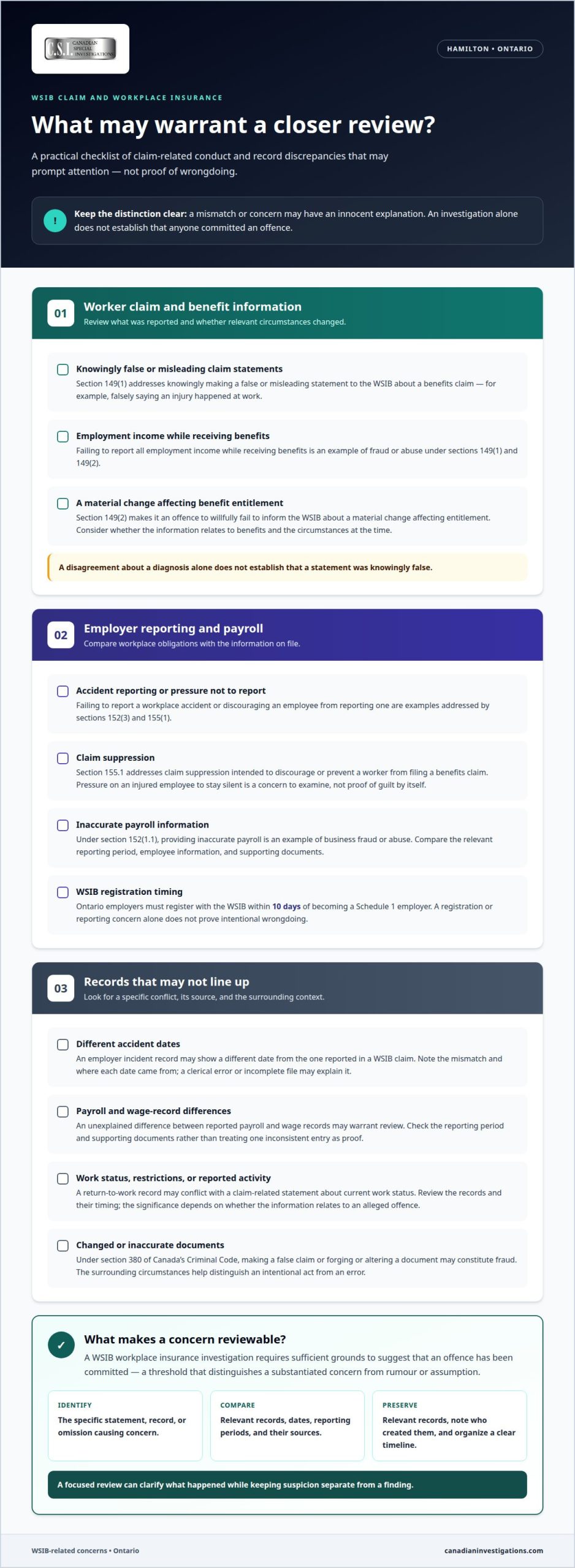
Ontario’s Workplace Safety and Insurance Act addresses false information connected to a claim. Under section 149(1), knowingly making a false or misleading statement to the WSIB about a benefits claim is an offence. Examples include falsely saying an injury happened at work or misrepresenting an injury or illness to obtain benefits. A disagreement about a diagnosis alone does not establish that a statement was knowingly false.
Income and changing circumstances can also matter. Under sections 149(1) and 149(2), failing to report all employment income while receiving benefits is an example of fraud or abuse. Section 149(2) makes it an offence to willfully fail to inform the WSIB about a material change affecting benefit entitlement. For instance, concealed earnings or a material change in circumstances may prompt questions about whether benefits remain payable.
Employer conduct is covered too. Under sections 152(3) and 155(1), failing to report a workplace accident or discouraging an employee from reporting one are examples of business fraud or abuse. Claim suppression intended to discourage or prevent a worker from filing a benefits claim is an offence under section 155.1. A supervisor pressuring an injured employee to stay silent is a concrete concern, not proof of guilt by itself.
Document-related conduct may raise separate concerns. According to the Department of Justice Canada, under section 380 of Canada’s Criminal Code, making a false claim or forging or altering a document may constitute fraud. In a WSIB fraud investigation in Hamilton, a changed record or inaccurate form may be relevant when it appears intended to mislead. The surrounding circumstances help distinguish an intentional act from an error.
For employers considering a Hamilton WSIB fraud investigation, the practical starting point is to identify the specific statement, record, omission, and surrounding circumstances. A focused review can help establish what happened and preserve relevant evidence without treating suspicion as a finding. Claim-related investigation support may help clarify disputed facts.
Red flags that may prompt an investigation
A discrepancy warrants closer review when claim details conflict with employment records, payroll, or incident documentation. For example, the accident date in an employer’s incident record may differ from the date reported in a WSIB claim. Note the specific mismatch and its source before drawing conclusions. A clerical error or incomplete file may explain a discrepancy, so context matters.
Payroll records are another important area. Under s. 152(1.1) of Ontario’s Workplace Safety and Insurance Act, providing inaccurate payroll is an example of business fraud or abuse. An unexplained difference between reported payroll and wage records may therefore warrant review. Compare the relevant reporting period, employee information, and supporting documents to determine what conflicts, rather than treating one inconsistent entry as proof.
Claim-related records may also raise questions when dates, work restrictions, or reported activities appear inconsistent. For instance, a return-to-work record may conflict with a claim-related statement about current work status. These differences call for careful review of the records and their timing. Their significance depends on whether the information relates to an alleged offence, not merely on differences in wording.
A WSIB workplace insurance investigation requires sufficient grounds to suggest that an offence has been committed. This threshold distinguishes a substantiated concern from rumour or assumption. Preserve relevant records, note who created them, and organize a clear timeline. A focused review can help determine whether an apparent red flag has a reasonable explanation or warrants further scrutiny. In Hamilton, employers should keep observations factual and distinguish documented discrepancies from conclusions about intent.
Who may initiate a workplace insurance investigation
A worker, employer, health-care provider, or other person can report suspected WSIB fraud in Ontario. Reports can be made anonymously by calling the WSIB action line at 1-888-745-3237. A report may prompt a review, but reporting a concern does not itself prove wrongdoing or guarantee a formal investigation.
For claims in Hamilton, the relevant body is the WSIB, which administers Ontario workplace compensation and insurance. Its process applies province-wide: the WSIB records suspected fraud or non-compliant behaviour, reviews reports, and investigates some matters. Others receive administrative follow-up. The WSIB begins a preliminary inquiry when a claim review raises suspicion of an offence under the Act.
After a preliminary inquiry, evidence of wrongdoing may lead to a referral to Regulatory Services, which decides whether to investigate. If the suspected offence is criminal, WSIB Regulatory Services refers the matter to police, who decide whether to lay Criminal Code charges. This sequence distinguishes the initial report from later decisions about investigation and possible charges.
A report is most useful when it identifies the claim or workplace, describes the suspected conduct, and provides relevant dates or records. Callers do not have to provide their name, address, or other identifying details. The WSIB’s reporting form is confidential, and the Board makes reasonable efforts to protect reporters’ identities. However, information supplied may be disclosed to the accused person or business, their employer or representatives, and law enforcement. Information may also be released under the Freedom of Information and Protection of Privacy Act and the Workplace Safety and Insurance Act.
Employers managing a claim-related concern can use Insurance / WSIB Investigations to gather relevant evidence and clarify disputed facts. This can support an informed response while the WSIB follows its own review and decision process.
Canadian Special Investigations: Insurance / WSIB Investigations
Canadian Special Investigations conducts Insurance / WSIB Investigations for employers facing claim-related concerns. Consider an investigation when records, reported activity, or other evidence raise questions that call for impartial fact-finding. The goal is to establish relevant information and provide a clearer basis for decisions, not to replace the WSIB’s review or determine guilt.
Employers can outline their concern and share relevant claim or workplace records. The investigation can then focus on the issue, such as a discrepancy connected to a claim or employment matter. If concerns extend beyond a single claim, Corporate Investigations may also be relevant. Each step should stay focused on the evidence and the question the employer needs answered.
For discreet, evidence-focused support with a workplace insurance concern, contact Canadian Special Investigations.
Set a clear direction for your next step
For employers considering a WSIB fraud investigation in Hamilton, start by defining the question that needs answering. Keep the concern focused, identify the records or events connected to it, and decide what information would help you respond responsibly. A disciplined process supports sound decisions and keeps attention on evidence rather than assumptions.
Canadian Special Investigations also conducts Employment Investigations, Domestic / Infidelity Investigations, and Corporate Investigations. These services may help when a workplace concern extends beyond a compensation claim or involves separate conduct that requires investigation.
Discuss your concerns and the investigative support you need with Canadian Special Investigations. A clear starting point can help you move forward with greater confidence.
Frequently Asked Questions
What happens after I report suspected fraud or abuse of the workplace compensation system?
The WSIB reviews the report and decides whether to investigate or provide administrative follow-up. If a claim review suggests an offence, the Board conducts a preliminary inquiry. Evidence of wrongdoing may be referred to Regulatory Services for an investigation decision. If the suspected conduct is criminal, the file may be referred to police, who decide whether to lay Criminal Code charges.
What is WSIB fraud and what counts as benefit fraud in Ontario?
WSIB fraud involves knowingly or willfully providing false information or withholding material information connected to workplace insurance or benefits. Examples include knowingly making a misleading statement about a claim, concealing employment income while receiving benefits, or failing to report a material change affecting entitlement. A reporting error or disagreement about a claim does not, by itself, establish fraud.
How can someone report suspected WSIB fraud in Hamilton?
Anyone can report suspected WSIB fraud in Hamilton by calling the WSIB action line at 1-888-745-3237. Explain what conduct raised concern and identify the people, business, claim, or incident involved, if known. Relevant dates and supporting records can help make the report specific. A caller can provide information without giving their name or address.
Can a WSIB fraud report be made anonymously, and how is it kept confidential?
Yes. Someone reporting suspected WSIB fraud can withhold their name, address, and other identifying information. The WSIB’s reporting form is confidential, and the Board makes reasonable efforts to protect the reporter’s identity. However, information in a report may be disclosed to the accused person or business, their employer or representatives, or law enforcement. It may also be released under applicable Ontario laws.
What happens to a worker or employer after WSIB investigates a fraud allegation?
An investigation may lead to administrative follow-up, referral to police, or prosecution if charges are laid and a court finds an offence. A court may order restitution for money received through an offence, and convictions can carry fines or imprisonment under Ontario law. An allegation alone is not a finding of guilt; the WSIB’s review and any court process determine what happens next.

