A rushed internal probe into missing inventory often costs an employer far more in bad-faith litigation than the stolen assets were ever worth. When unexplained shrinkage quietly erodes your operational margins, the urge to confront a suspect immediately is understandable. Yet, acting without verifiable proof exposes your enterprise to severe wrongful dismissal claims and substantial regulatory penalties under privacy legislation like PIPEDA. Executing a methodical workplace theft investigation is the only tactical way to neutralize an internal threat without transferring financial liability onto your corporate ledger.
You shouldn’t have to choose between absorbing ongoing losses and risking punitive court awards. In this guide, you’ll master the legal protocols, covert surveillance methods, and rigorous evidence standards required to investigate internal corporate theft across Ontario. We examine how to build an evidentiary chain admissible in Ontario courts, cleanly terminate culpable personnel for cause without severance liability, and execute asset recovery strategies that safeguard your bottom line.
Key Takeaways
- Identify distinct corporate theft typologies to establish actionable legal thresholds before initiating a workplace theft investigation.
- Align surveillance and monitoring practices with PIPEDA and Ontario employment standards to neutralize privacy claims and bad-faith litigation.
- Deploy tactical physical surveillance and strict chain-of-custody protocols to secure evidence that stands up in Ontario courts.
- Mitigate constructive dismissal exposure by understanding when internal HR inquiries introduce bias and require independent licensed investigators.
- Execute clean terminations for cause without severance liabilities while preparing documented findings for civil asset recovery.
Understanding Workplace Theft: Typologies, Impact, and Legal Thresholds
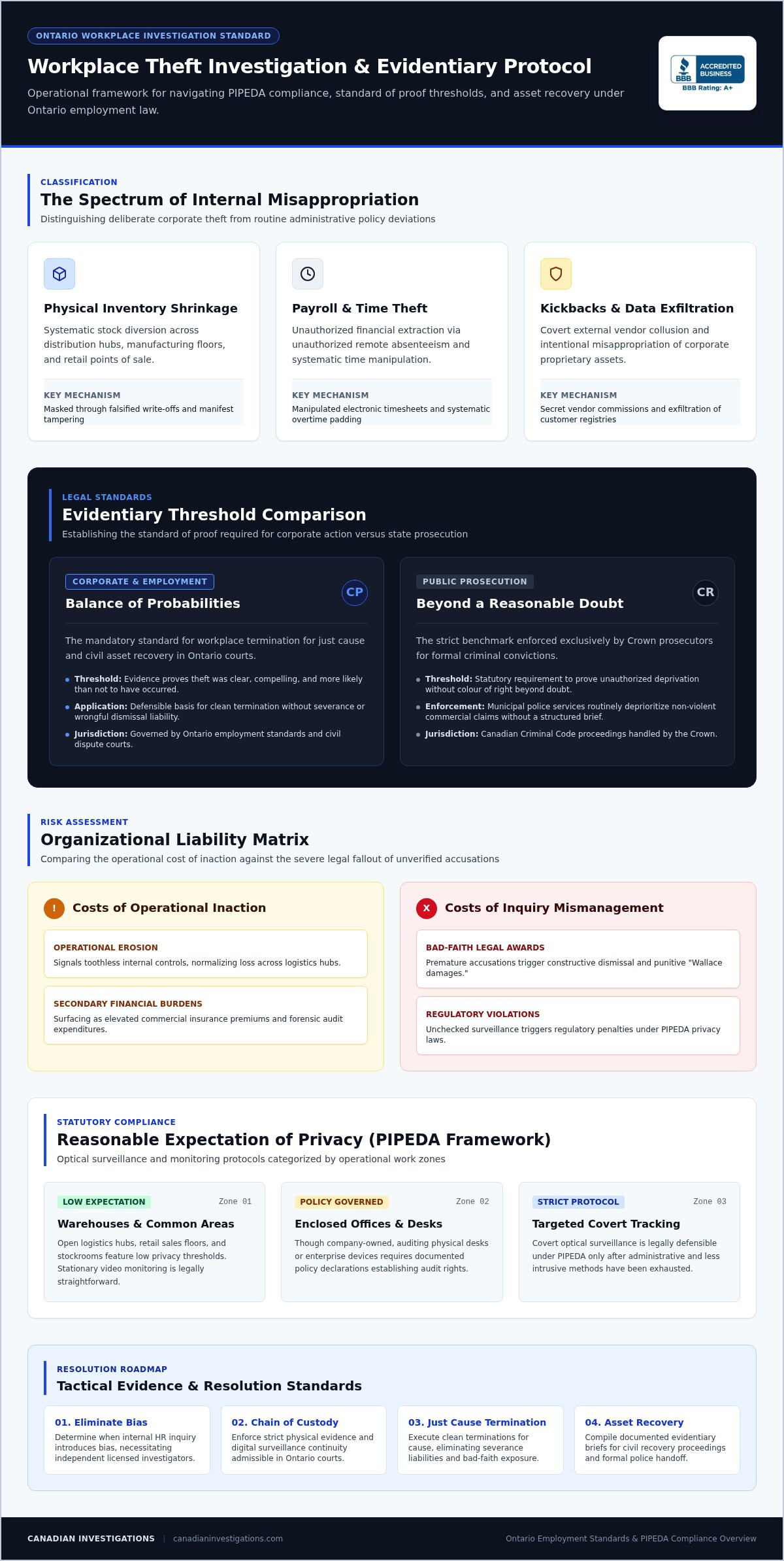
At its operational core, workplace theft is the unauthorized misappropriation of an organization’s physical assets, capital, time, or proprietary information for personal gain. While the statutory definition of theft centres on intentionally depriving an owner of their property without colour of right, corporate environments present distinct legal complexities. Distinguishing between procedural policy deviations and deliberate criminal behaviour is critical. An employee misplacing a shipping manifest is a performance issue; an employee systematically rerouting shipments to liquidate freight off-site represents intentional theft.
When leadership initiates a formal workplace theft investigation, establishing the correct evidentiary threshold dictates the entire strategy. Criminal proceedings demand proof beyond a reasonable doubt, a stringent benchmark enforced by Crown prosecutors. Conversely, employment termination for just cause and civil asset recovery rely on the civil standard: the balance of probabilities. Establishing that theft was clear, compelling, and more likely than not to have occurred provides employers with the defensible foundation needed to act decisively under Ontario law.
The Spectrum of Internal Misappropriation
Corporate loss manifests across several distinct operational verticals:
- Physical Inventory Shrinkage: Systematic stock diversion across distribution hubs, manufacturing floors, and retail points of sale, frequently masked through falsified write-offs.
- Payroll and Corporate Time Theft: Manipulated electronic timesheets, unauthorized remote work absenteeism, and systematic overtime padding.
- Commercial Kickbacks and Data Exfiltration: Covert vendor side-agreements, secret commissions, and the deliberate theft of proprietary intellectual property or customer registries.
The High Cost of Inaction and Mismanagement
Ignoring internal losses destroys organizational discipline, effectively signaling to staff that internal controls are toothless. The secondary costs quickly outpace the value of the missing merchandise, surfacing as elevated commercial insurance premiums, hefty forensic audit fees, and compromised operational margins.
Yet, mishandling an internal inquiry carries severe financial exposure. Accusing an employee without verified proof opens the door to aggressive constructive dismissal lawsuits and extraordinary bad-faith awards, known in Canadian employment law as Wallace damages. Relying prematurely on municipal police services rarely solves the problem. Constrained public resources mean police units routinely deprioritize non-violent commercial property complaints unless management presents a fully documented, legally structured brief of evidence.
The Legal Framework: Navigating PIPEDA and Ontario Employment Law
Operating a workplace theft investigation requires maintaining a precise balance between corporate asset recovery and statutory employee privacy protections. In Ontario, employers cannot unilaterally deploy unchecked surveillance without justifying its necessity. PIPEDA establishes clear boundaries around collecting personal data during internal inquiries. Covert optical surveillance or targeted asset tracking is legally viable only after exhausting less intrusive administrative methods; otherwise, organizations invite operational liability that eclipses the initial loss.
Every commercial inquiry demands compliance with statutory thresholds and common law doctrines. Understanding standard frameworks on how to conduct a workplace investigation helps HR teams structure preliminary records. However, Canadian jurisprudence places strict boundaries on admissibility, compelling management to align internal evidence collection with provincial employment standards.
Reasonable Expectation of Privacy in the Workplace
Workplace privacy boundaries depend heavily on operational context and location:
- Common Workspaces and Warehouses: Open logistics hubs, retail sales floors, and stockrooms feature low privacy expectations, making stationary video monitoring legally straightforward.
- Enclosed Offices and Desks: While company-owned, these zones require clear policy declarations establishing the employer’s absolute right to audit enterprise devices and physical spaces.
- Restricted Private Zones: Locker facilities, change areas, and washrooms carry absolute privacy protections; monitoring these zones triggers severe liability under the common law tort of intrusion upon seclusion.
Establishing Defensible Cause for Termination
Terminating a dishonest employee without triggering severance obligations requires meeting the rigorous threshold for just cause under the Ontario Employment Standards Act. Ontario judges consistently reject speculation. If an enterprise relies on circumstantial patterns, such as badge swipes that coincide with inventory shortages without direct visual corroboration, the court will likely rule the dismissal wrongful. An unproven allegation can trigger punitive aggravated damages against the organization.
Securing evidence capable of withstanding scrutiny in the Ontario Superior Court of Justice demands professional tactical execution. Engaging an experienced corporate investigator in Toronto ensures that digital timestamps, physical surveillance logs, and asset movements are captured lawfully, preserving complete evidentiary integrity.
When high-value assets or senior staff are implicated, partner with Canadian Special Investigations to execute a legally defensible corporate inquiry across Southern Ontario.
Tactical Evidence Gathering: How Professional Investigations Unfold
A rigorous workplace theft investigation relies on verifiable corroboration rather than speculation. Moving from initial suspicion to courtroom-ready evidence demands a disciplined, multi-phase operational strategy. Professional corporate investigators begin by analyzing transactional anomalies, access timestamps, and inventory ledgers to map loss vectors and establish clear physical or digital choke points before deploying field assets.
Discreet Surveillance and Intelligence Operations
Physical observation documents what digital logs cannot verify: the actual physical diversion of company property. Investigators deploy stationary vantage points and mobile vehicular tracking to monitor departing transport units, unauthorized offloading sites, and suspect off-duty movements. When managing complex supply chain networks, operatives employ field tradecraft aligned with insurance fraud surveillance in Ontario, ensuring that video recordings, photographic time-stamps, and activity logs remain objective, proportional, and legally defensible.
Forensic Documentation and Chain of Custody
Tangible evidence must survive intense defence scrutiny during civil or arbitral hearings. Establishing a strict chain of custody requires logging every item of physical merchandise, point-of-sale record, and badge-access export from seizure to court presentation. As industry literature on detecting and combating employee theft demonstrates, unassailable audit trails are non-negotiable. Meticulous chronological logs prevent accusations of digital tampering or spoliation, producing a forensic binder ready for immediate review by commercial litigation counsel.
The Investigative Interview Protocol
Investigative interviews represent the operational culmination of an inquiry. Coercive or hostile interrogation tactics quickly backfire, invalidating confessions and exposing the company to bad-faith litigation. Investigators execute structured, non-accusatory interviews designed to protect procedural fairness. By introducing irrefutable physical surveillance and forensic data sequentially, the interviewer systematically closes avenues of denial. Securing signed factual declarations and video-recorded admissions provides corporate counsel with the unyielding documentation required to withstand union grievances and wrongful dismissal challenges.
Internal HR Inquiries vs. Independent Licensed Investigators
Internal human resources departments excel at resolving interpersonal conflicts and standard policy grievances. However, treating a workplace theft investigation as an internal administrative exercise often compromises the entire case. Attempting to conduct covert operations internally introduces severe procedural vulnerabilities, creates irreparable evidentiary conflicts, and exposes leadership to protracted civil liabilities.
The Hidden Risks of Internal Management Probes
Under the Private Security and Investigative Services Act of Ontario, conducting private surveillance or covert operational tracking without a provincial licence is unlawful. When untrained managers follow employees off-site or plant unapproved recording gear, they violate regulatory standards and render resulting materials legally toxic.
Internal probes also invite immediate allegations of managerial bias, constructive dismissal, and poisoned work environments. If an employee claims an HR inquiry was a pretextual witch hunt, the employer faces significant pushback at union arbitration or in civil court. Premature internal interviews often tip off the perpetrator, leading to deleted ledger entries, destroyed physical assets, and coached accomplice testimonies.
The Strategic Advantage of Independent Retainers
Independent licensed investigators deliver objective, untainted findings that internal personnel cannot provide. Corporate boards, commercial insurers, and municipal police services require impartial, forensic documentation before authorizing substantial claims, insurance payouts, or criminal charges. Utilizing an external team also maintains internal operational stability, insulating executive management from retaliatory harassment claims while protecting workplace morale.
Crucially, retaining an outside agency through external legal counsel allows organizations to shield preliminary reports, witness summaries, and investigative strategy behind litigation privilege. This tactical separation ensures that findings remain confidential while corporate counsel structures an asset recovery or termination plan.
If your organization faces inventory shrinkage or executive asset diversion, retain the licensed corporate investigators at Canadian Special Investigations to secure impartial evidence across Toronto and Southern Ontario.
Post-Investigation Resolution: Recovery, Prosecution, and Prevention
Compiling verified evidence is only half the battle; how leadership handles the aftermath dictates whether losses are recouped or compounded. A methodically executed workplace theft investigation provides the legal leverage needed to remove culpable staff, initiate asset recovery, and seal organizational vulnerabilities against repeat occurrences. To reinforce physical premises and eliminate security blind spots, organizations can learn more about AlphaLVC and their tailored commercial protection systems.
Executing Clean and Defensible Terminations
Armed with an objective investigative dossier, management can execute a termination for just cause without triggering severance packages or common law notice payouts. Working alongside employment counsel, leadership should conduct the dismissal meeting with clinical professionalism. Presenting documented facts rather than speculative accusations immediately deflates bad-faith litigation attempts. The goal is simple: terminate the employment relationship decisively while shielding the business from costly retaliatory claims.
Asset Recovery and Law Enforcement Collaboration
Terminating a dishonest worker stops immediate losses, but recovering misappropriated capital requires strategic action. Depending on the scale of the theft, organizations have several paths for recovery:
- Commercial Crime Insurance: Filing comprehensive proof-of-loss claims supported by an independent investigation report significantly accelerates underwriter payouts.
- Civil Litigation and Asset Freezing: Commercial litigation counsel can leverage verified findings to obtain court orders, such as Mareva injunctions, to freeze suspect bank accounts and real property before assets are dissipated.
- Law Enforcement Hand-Off: Submitting a standardized, binder-ready evidentiary brief to regional police divisions throughout Ontario expedites criminal charges. Crown attorneys are far more likely to proceed with prosecution when the investigative legwork is already fully packaged.
Hardening Workplace Defences Against Future Loss
A vital component of safeguarding commercial premises against recurring internal theft is establishing reliable perimeter security and automated entry monitoring. Organizations looking to secure vulnerable operational areas can explore Installation and maintenance of physical security and access control systems to control facility ingress and eliminate security blind spots.
Every internal breach highlights systemic weaknesses in operational infrastructure. Following an investigation, management must audit its physical and procedural vulnerabilities. Tightening inventory dual-custody protocols, upgrading biometric or keycard access points, and conducting regular third-party audits eliminate the procedural blind spots that facilitate employee theft.
Preventative security begins before an applicant’s first shift. Establishing thorough pre-employment background screening across sensitive logistics, accounting, and managerial roles prevents high-risk candidates from accessing vital corporate assets. Proactive prevention consistently costs far less than reactive damage control. Schedule a confidential consultation with Canadian Special Investigations to secure your operations.
Protect Your Enterprise With Decisive Evidentiary Proof
Internal shrinkage and operational fraud demand immediate, disciplined action rather than managerial speculation. Executing a structured workplace theft investigation eliminates financial bleed while neutralizing the threat of bad-faith litigation or costly constructive dismissal liabilities under Ontario employment law. By adhering strictly to PIPEDA compliance, maintaining unbroken evidence chains, and relying on verified physical corroboration, corporate leadership can proceed with clean terminations for cause and initiate targeted asset recovery.
Don’t allow unaddressed internal theft to compromise workplace morale or erode your balance sheet. Licensed by the Ontario Ministry of the Solicitor General, the team at Canadian Special Investigations brings extensive experience in corporate asset protection, discreet tactical surveillance, and legally admissible evidence preparation for the Ontario Superior Court of Justice. Secure confidential corporate investigation services with Canadian Special Investigations to restore organizational accountability and protect your bottom line with complete confidence.
Frequently Asked Questions
Can an employer in Ontario monitor employee emails or phone calls during a theft investigation?
Yes, provided the employer establishes clear electronic monitoring policies and legitimate operational grounds under PIPEDA and Ontario employment legislation. Employers must notify staff of electronic monitoring practices through written workplace handbooks. While auditing corporate email accounts and business communications is lawful to investigate suspected theft, intercepting personal telephone calls or private accounts without consent risks severe civil privacy violations. Keep electronic oversight strictly proportional to the investigated loss.
What is the legal difference between an internal HR inquiry and a licensed private investigation?
The core legal distinction lies in statutory licensing under the Private Security and Investigative Services Act of Ontario and procedural objectivity. Internal HR personnel can examine administrative records and conduct internal interviews, but they cannot legally perform covert mobile surveillance or off-site tracking. Licensed corporate investigators operate under provincial legislative standards, securing unbiased, third-party physical evidence and maintaining strict chain-of-custody protocols that satisfy Ontario Superior Court scrutiny.
Can an employer terminate an employee for theft without police charges being filed?
Yes, an employer can terminate an employee for just cause based on theft without criminal charges or police intervention. Employment law relies on the civil standard of the balance of probabilities, which requires establishing that theft more likely than not occurred. If a methodical workplace theft investigation gathers clear, compelling physical documentation and verified audit trails, management can execute a clean termination for cause without awaiting municipal police action.
How do Ontario courts view covert video surveillance evidence in workplace investigations?
Ontario courts admit covert video surveillance only if the employer demonstrates the monitoring was necessary, proportional, and conducted after exhausting less intrusive options. Judges scrutinize whether an employee possessed a reasonable expectation of privacy in the targeted space. Covert cameras positioned across open warehouses, loading docks, or stockrooms are generally defensible. Conversely, installing surveillance in washrooms, changerooms, or dedicated break areas constitutes unlawful intrusion upon seclusion.
What immediate steps should an employer take upon discovering suspected inventory theft?
Secure transactional data, preserve existing facility recordings, and avoid premature confrontations that might alert suspects. Management should immediately isolate inventory records, badge logs, and shift schedules to identify pattern anomalies without tipping off internal staff. Engaging external professionals early ensures that the subsequent workplace theft investigation maintains an unbroken chain of custody. Premature accusations frequently cause suspects to destroy electronic records, coach accomplices, or file preemptive constructive dismissal claims.
Can an employer search employee lockers or personal belongings during an internal theft investigation?
Employers can only search lockers or personal items if explicit corporate policies establish company ownership and eliminate expectations of privacy. Without an express written policy stating lockers remain corporate property subject to unannounced inspection, arbitrary searches trigger privacy tort claims under Ontario common law. Even with clear policies, searching personal bags, purses, or vehicles without explicit employee consent or police involvement introduces extreme liability.
How does hiring an independent private investigator protect against wrongful dismissal claims?
Independent investigators eliminate allegations of managerial bias and provide verifiable, objective evidence that withstands courtroom scrutiny. When terminations for cause reach the Ontario Superior Court of Justice, judges closely examine the fairness and neutrality of the underlying probe. Independent licensed investigators establish an impartial factual record. Their standardized documentation, neutral witness interviews, and uncompromised evidentiary custody neutralize common defence arguments of bad-faith termination, pre-judgment, or employer retaliation.

