A sensitive workplace allegation calls for more than a quick internal conversation. Employers need to establish what happened without letting personal relationships, workplace pressures or competing accounts undermine confidence in the process. If you’re assessing workplace investigation services toronto, consider whether independent fact-finding can help clarify the facts fairly and discreetly.
Internal teams may understand the organization, but their involvement can create a perception of bias. Interviews and evidence gathering also need to be managed without unnecessarily disrupting operations. A focused external investigation can support an employer’s response, but it doesn’t replace the organization’s responsibility to assess the findings and decide what to do next.
This guide explains how Toronto employers can define an appropriate investigation scope, gather and assess relevant information, and use objective findings to support informed decisions. It also covers when external employment investigation support may be useful. Canadian Special Investigations is a Toronto-based private investigation agency providing employment investigations for organizations across Ontario.
Key Takeaways
- Workplace investigation services toronto can provide scoped fact-finding when misconduct allegations, policy concerns or conflicting accounts need careful examination.
- A structured process helps employers define the concern, gather relevant information and assess it without assuming wrongdoing.
- When comparing internal and external fact-finding, consider impartiality, perceived bias and the needs of the specific situation.
- Prepare a concise summary of the concern, key dates, available records, relevant contacts and questions to keep the investigation focused.
- Canadian Special Investigations provides employment investigation support for organizations across Ontario.
When Toronto Employers Need Workplace Investigation Services
Workplace investigation services provide structured fact-finding for concerns that arise at work. The purpose is to gather and assess relevant information, not to assume an allegation is true or decide in advance how the matter should end. For Toronto employers, workplace investigation services toronto can bring structure to a sensitive issue when accounts differ or the facts aren’t clear.
Potential triggers include allegations of misconduct, questions about whether workplace policies were followed, or conflicting accounts of an incident. A complaint may involve employees on the same team, a supervisor and a direct report, or several people describing an event differently. The concern calls for careful examination; it doesn’t establish that anyone acted improperly.
Which workplace concerns may call for external fact-finding?
External fact-finding may be useful when a matter is sensitive, disputed or difficult for the organization to examine impartially. Close working relationships can complicate internal inquiries. For example, an assigned manager may report to someone involved or have longstanding ties to a person whose account is central to the matter. Even without actual bias, those connections may affect how employees perceive the process.
Consider a Toronto employer reviewing a disagreement about a project handover. One employee says key information was withheld; another says it was shared in a meeting. Relevant emails, meeting records and individual accounts may help clarify what happened. A focused inquiry can examine the competing accounts without treating either version as established fact.
The appropriate scope depends on the concern and the organization’s context. A narrow question may call for limited fact-finding, while a matter involving several people or events may need a broader review. Defining the question helps keep the inquiry relevant and proportionate.
What does an external investigator contribute?
An external investigator can provide a defined, independent role in gathering and organizing relevant facts. Depending on the assignment, this may involve reviewing available records, seeking information from relevant people, or assessing whether sources support or contradict particular accounts. The methods should fit the question; no single approach suits every workplace concern.
A clearly scoped role can help separate evidence gathering from the organization’s response. The investigator does not provide employment-law advice, make HR decisions, determine discipline or guarantee a particular outcome. The employer considers the findings alongside its policies and other relevant factors, then decides what action, if any, is appropriate.
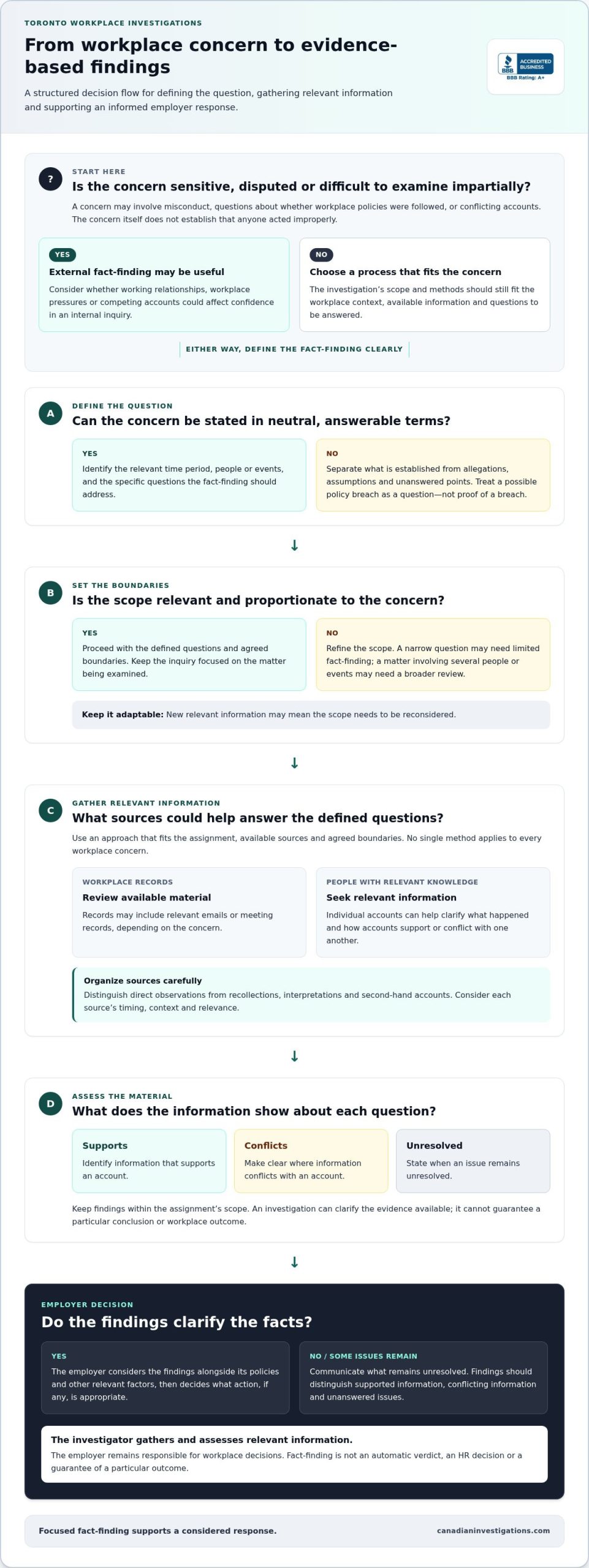
An investigator gathers and assesses relevant information; the employer remains responsible for workplace decisions. This distinction helps organizations use fact-finding to support a considered response rather than treat an investigation as an automatic verdict.
How Toronto Workplace Investigations Establish Facts
A disciplined investigation moves from a defined concern to an evidence-based account of the information available. The sequence can be adapted to the assignment, but each step should have a clear purpose: identify the issue, set boundaries, gather relevant material, assess it and communicate findings. Employers considering workplace investigation services toronto benefit from a process focused on the questions that need answering.
Start with a clear scope and investigation questions
Begin by stating the concern in neutral terms. Identify the relevant time period, people or events involved, and the specific questions the fact-finding is meant to address. Separate what’s established from allegations, assumptions and unanswered points. For example, a concern about a policy breach is a question to examine, not proof that a breach occurred.
Set the scope according to the workplace context and information available. A tightly defined question can prevent unrelated issues from taking over the inquiry, while new relevant information may mean the scope needs to be reconsidered. A clear scope keeps fact-finding proportionate, relevant and anchored to answerable questions.
Gather and organize relevant information
The investigator identifies and gathers information that may help address the defined questions. Depending on the assignment, this could include available workplace records or information from people with relevant knowledge. No single method applies to every matter. The approach should fit the concern, available sources and agreed boundaries.
Organized records make the material easier to assess. Accurate notes should distinguish direct observations from recollections, interpretations and second-hand accounts. Context can affect how a record or statement is understood, so consider each source’s timing and relevance. This helps prevent an unverified account from being treated as established fact.
Next, assess the gathered material against the investigation questions. The review may identify information that supports an account, conflicts with it or leaves an issue unresolved. Any findings should make those distinctions clear and stay within the assignment’s scope. An investigation can clarify the evidence available; it can’t guarantee a particular conclusion or workplace outcome.
A defined sequence helps employers follow the work and gives decision-makers a clearer basis for considering next steps. Canadian Special Investigations provides employment investigation support tailored to workplace concerns. More information about its confidential workplace investigation service is available online.
Impartiality, Evidence, and Employer Decisions in Toronto
Choosing who conducts fact-finding depends on the concern, the people involved and the organization’s capacity to manage the assignment. Internal handling can draw on knowledge of workplace practices and records. External investigative support can offer useful separation where relationships, reporting lines or prior involvement could affect confidence in the process. Neither approach guarantees impartiality or a particular finding. Consider workplace investigation services toronto in light of the specific assignment, rather than as a universal substitute for internal review.
Internal handling or external investigative support?
| Consideration | Internal fact-finding | External investigative support |
|---|---|---|
| Perceived neutrality | May be affected by reporting relationships or prior involvement. | Can provide distance from internal relationships, while impartiality still depends on how the work is conducted. |
| Internal knowledge | Familiarity with workplace structure, policies and records can help establish context. | May require organizational context to be explained and relevant records identified. |
| Scope | Can be managed within existing internal processes and responsibilities. | A defined assignment can focus independent fact-finding on specific questions. |
| Organizational resources | Uses available staff and internal capacity, which may be limited by other responsibilities. | Adds investigative capacity while requiring coordination with the employer. |
An employer may value an independent perspective when a senior leader is involved, an internal reviewer has a close working relationship with a participant, or the organization wants to separate fact-gathering from its own decision-making. These are considerations, not automatic reasons to outsource. A clear mandate, access to relevant information and careful handling of competing accounts matter whichever approach is used.
How findings should inform workplace action
Keep three categories distinct: information collected, observations made during the investigation, and conclusions drawn by the employer. A record may establish that a message was sent, for example, but its meaning and relevance may depend on context. An investigator’s observations can help explain the material, but evidence isn’t automatic proof of misconduct.
The employer remains responsible for assessing the findings and deciding on appropriate next steps. When those decisions lead to personnel changes, organizational restructuring or the need for temporary coverage, workforce management providers such as Human Bees can assist employers in navigating staffing transitions. If the matter raises questions about Ontario employment, human rights or workplace safety requirements, assess those legal issues with qualified legal advice. An investigation can inform a decision; it doesn’t decide liability or guarantee a disciplinary outcome.
When a workplace concern also points to broader organizational exposure, corporate investigations in Toronto may be relevant to the wider fact-finding needs.
Planning a Workplace Investigation Across Toronto and the GTA
Good preparation keeps workplace fact-finding focused. Before engaging workplace investigation services toronto, organize the information already available and identify what remains unclear. This gives the investigator a practical starting point without assuming every detail is settled or expanding the assignment beyond its purpose.
What should an employer prepare before work begins?
Assemble a concise briefing package. Include a neutral summary of the concern, a chronology of relevant dates, any policies connected to the issue and records already identified as potentially relevant. Note who may have direct knowledge and which questions the investigation should address. Distinguish confirmed information from allegations, assumptions and gaps.
- Concern summary: State what needs to be examined without presenting an allegation as a conclusion.
- Dates and chronology: Record when relevant events reportedly occurred and how the organization learned about them.
- Known records: Identify available documents or other information connected to the questions.
- Relevant contacts: List people who may have direct knowledge, without presuming what they will say.
- Assignment authority: Identify who can clarify the scope and approve changes if new information emerges.
Keep requests specific. A broad instruction to examine “everything” can make it harder to distinguish relevant information from unrelated material. Define the unresolved questions and why each matters. If the inquiry uncovers a new issue, assess whether it belongs within the original scope or requires a separate decision.
How location and workplace context shape the assignment
Local context can inform practical planning, especially when people, records or work sites are spread across the region. A Toronto-based agency serving organizations across Ontario can coordinate fact-finding involving workplaces in Toronto, Mississauga, Brampton or Hamilton. Not every assignment requires an on-site visit; the appropriate approach depends on the questions and information involved.
For example, an organization with a Toronto office and a Brampton work site may need to clarify which location holds relevant records or where key events took place. Understanding the operating context helps define useful lines of inquiry and avoid unnecessary disruption.
Plan confidentiality deliberately. Limit sensitive details to people who need them for the assignment, use appropriate channels to share records, and clarify who will receive updates. These steps support discretion, but they don’t guarantee that information will remain restricted in every circumstance.
If the workplace matter overlaps with a legal proceeding or another legal investigation, information about legal support investigators in Toronto may be relevant. Canadian Special Investigations also provides focused workplace fact-finding.
Engaging Canadian Special Investigations for Workplace Fact-Finding
For employers who need focused investigative support, Canadian Special Investigations (CSI) is a fully licensed private investigation agency based in Toronto and serving organizations across Ontario. Its employment investigation service supports fact-finding into sensitive workplace concerns, helping employers gather relevant information for their own assessment and decisions.
Workplace investigation services toronto should be matched to the matter, not applied as a fixed formula. The scope may depend on the concern, the questions the employer needs answered, the information available and any practical boundaries. A focused assignment keeps evidence gathering relevant and helps the organization understand what is known and what remains unresolved.
What employers can expect from a scoped assignment
The process begins with a professional discussion about the concern and the purpose of the inquiry. Employers can outline the issue, identify relevant dates and records, describe what they need clarified, and flag any limits or sensitivities that may affect the assignment. This context helps define the investigative boundaries and an appropriate approach to gathering information.
CSI tailors its investigative scope to the workplace matter. Methods depend on the assignment; no particular interview, investigative step, report format or outcome is guaranteed. CSI provides investigative support and relevant findings, but does not provide employment-law advice or make the employer’s HR, disciplinary or other workplace decisions.
That division of responsibility matters. Investigative fact-finding can inform an employer’s response, but the organization remains responsible for considering the information and determining appropriate next steps. If the matter raises legal questions, employers should address those with qualified legal counsel.
Take the next step with a Toronto investigation agency
To begin, share the essential context: what prompted the concern, what needs clarification, and whether there are known records or people with relevant information. A concise outline can establish a starting point; sensitive details can be handled through appropriate communication with the agency. CSI is based in Toronto and serves organizations across Ontario.
Employers can make a confidential inquiry by phone or through the online contact option. Contact Canadian Special Investigations about your workplace matter to discuss a focused investigative assignment.
Move Forward with Clear, Focused Fact-Finding
A well-scoped workplace investigation helps Toronto employers separate allegations from established information, assess relevant evidence and make informed decisions. Impartiality, clear investigative boundaries and careful preparation can strengthen the process, while responsibility for workplace action remains with the employer. The right workplace investigation services toronto approach is tailored to the concern, not driven by assumptions about the outcome.
Canadian Special Investigations is a fully licensed private investigation agency based in Toronto, Ontario. Its employment investigations support organizations across Ontario with discreet, focused fact-finding for sensitive workplace matters.
If your organization needs an objective investigative perspective, discuss a confidential workplace investigation with Canadian Special Investigations.
Frequently Asked Questions
What do workplace investigation services in Toronto do?
Workplace investigation services gather and assess relevant information about a defined workplace concern. Depending on the scope, an assignment may involve reviewing available records, seeking information from people with relevant knowledge or examining conflicting accounts. The investigator provides information to support the employer’s assessment, not a guaranteed finding or disciplinary decision. Canadian Special Investigations provides employment investigations for organizations across Ontario, including Toronto, Oakville, Burlington, Brampton, Mississauga, Hamilton, Ancaster, Niagara Falls, Kitchener, Waterloo, Scarborough, North York, Richmond Hill, Barrie, Milton, Etobicoke and Guelph.
When should an employer use an external workplace investigator?
An employer may consider external support when a concern is sensitive, disputed or difficult to examine internally without perceived conflicts. For example, an internal reviewer may have a close working relationship with someone involved or report to a person connected to the matter. An external investigator can provide a separate fact-finding perspective, while the organization retains responsibility for decisions. Whether workplace investigation services toronto are appropriate depends on the specific concern, available resources and organizational context.
Are workplace investigations legally required in Ontario?
Ontario’s Occupational Health and Safety Act requires employers to ensure an investigation is conducted into workplace harassment incidents and complaints, in a manner appropriate in the circumstances. The exact steps depend on the situation, and other legal obligations may also be relevant. This general information isn’t legal advice. Employers should verify current requirements and seek advice from qualified employment counsel about how the law applies to a specific workplace matter.
How long does a workplace investigation take in Toronto?
There’s no single timeline for every investigation. The time required depends on factors such as the number of issues, relevant people and records, and whether new information changes the scope. The Ontario government advises that workplace harassment investigations should ideally be completed within 90 days or less, unless compelling reasons justify a longer duration. That guidance isn’t a guarantee for an individual assignment; employers should plan for a process suited to the circumstances.
Can an external investigator interview employees?
An external investigator may speak with employees who have relevant information if that method fits the assignment and its scope. The investigator gathers and assesses information, but doesn’t determine discipline or make the employer’s decisions. Employers can identify people who may have direct knowledge and explain the questions the inquiry should address. Whether interviews are appropriate, and how they’re conducted, depends on the workplace concern and investigative plan.
What information should I prepare before contacting a workplace investigator?
Prepare a neutral summary of the concern, a chronology of relevant dates, any related policies or records, and a list of people who may have relevant information. Note what’s established, what’s alleged and what remains unclear. Identify the questions you need answered and who can define or approve the assignment’s scope. This preparation helps focus the initial discussion; avoid broad or speculative requests that aren’t tied to a clear purpose.
How does an employer maintain confidentiality during a workplace investigation?
Limit information sharing to people who need it for the investigation or related workplace responsibilities. Use appropriate channels to share records, store materials carefully and clarify who should receive updates. Avoid discussing the matter more widely than necessary. These steps support discretion, but confidentiality isn’t an absolute guarantee in every circumstance. Employers should consider applicable privacy and workplace obligations when deciding how information is collected, used and shared.

