A location result is not a hiring or tenancy verdict. Through Canadian Special Investigations, professional skip tracing services can help locate a debtor, witness or defendant through investigative searches, but the information should not stand alone as a basis for employment or rental decisions. Its value depends on whether it is relevant, current and assessed in context.
It’s understandable to want a clear answer about both a person’s whereabouts and the cost of finding them. The work required can vary with the identifying details available, the search scope and its urgency. Investigative costs depend on the case, so request a quote that reflects the work involved.
This article explains what a skip trace can reveal, how it differs from an asset investigation, who may use the results and what affects the cost. It also explains how to assess location information for employment or tenancy, so you can distinguish a useful lead from evidence that supports a decision.
Key Takeaways
- Use identifying details to focus a public-record search, and distinguish a person-location search from an asset investigation.
- Clarify whether you need to locate a debtor, witness or defendant, and how the result will support the legal matter.
- Compare the scope and urgency of the search when considering costs; rush work can affect the price.
- Treat location information as a lead, not a stand-alone basis for hiring or tenancy decisions.
Canadian skip tracing and public-record searches
A skip trace uses available information to help locate an individual. The search may draw on public records and registry information, with its scope shaped by the person or asset being sought.
Public-Record and Registry Searches
Public-record searches can examine court registries and lien records when relevant to the assignment. A court registry search may help identify records connected with a legal matter; a lien search focuses on recorded claims involving property. Registry coverage and search processes vary across Canada, so identify the jurisdiction and purpose before setting the scope. Vehicle, vessel and stolen-asset searches are separate inquiries, not proof that a person owns or possesses an item.
Person and Company Searches
A person search aims to establish a current location; a company search examines business-related records. An asset investigation has a different purpose: it seeks assets associated with a person or business. Useful details can include the individual’s full name, former address, known business connection and relevant case information. Accurate identifying details help narrow possible matches and reduce confusion between people with similar names.
In Ontario, the Consumer Reporting Act requires lawful evidence of a debt before one individual can have a credit check conducted on another individual. A location search and a credit check are not interchangeable. State the request’s purpose clearly, especially when it involves a debt or legal proceeding.
Search Methods and Provider Selection
Skip tracing services in Canada may combine record searches with analysis of the information provided. Lawyers, businesses and some individuals, including landlords, may use these services; availability depends on the provider. To assess a provider, look for a clearly defined search scope, an explanation of methods, and findings that distinguish verified details from leads. Consider the jurisdiction, intended use and limits of the results before relying on them.
To request a trace, provide identifying details and explain the matter. Rush searches are usually completed in less than 5 business days. For someone who may be in immediate danger, contact police first.
Skip Tracing and Online Search Tools
Online people-search tools let users search information themselves, while a skip trace is an investigative search focused on locating a person. The difference is the process: an investigator can assess the details provided, compare potential matches and organize relevant findings. Neither a search result nor a possible match establishes identity by itself. Treat inaccurate, outdated or incomplete information as a limitation, and use results only in context.
Finding people involved in legal matters
A legal file can stall when a defendant, witness or other party cannot be located. A focused search can help establish a current lead and guide the next investigative step. In Ontario, a licensed private investigator can help with skip tracing. Define the person’s role in the matter before requesting a search. Locating a witness, for example, serves a different purpose from locating a defendant. Keep the request lawful and connected to the legal matter.
Start by identifying what the file needs. Counsel may need a reliable location lead to plan contact or assess next steps. A business pursuing a legal claim may need to locate an individual linked to the dispute. A witness search may help counsel plan case preparation. The objective shapes the search scope and helps separate relevant findings from details that do not advance the matter.
Organize the case information before requesting investigative work. State the person’s connection to the file, why the location matters and any known jurisdiction. Include a concise timeline of relevant events, such as a missed appointment or change in correspondence. Keep source material distinct from assumptions. If two people share a name, identifying context can help assess which records may relate to the right individual.
Use findings as investigative leads, not as a substitute for legal analysis. A current address may inform planning, but it does not itself resolve a dispute or establish a person’s role. Record how each lead relates to the file, then consider what further verification the matter requires. For case-focused support, legal investigations can help address investigative questions tied to a legal matter.
Locating debtors, witnesses, and defendants
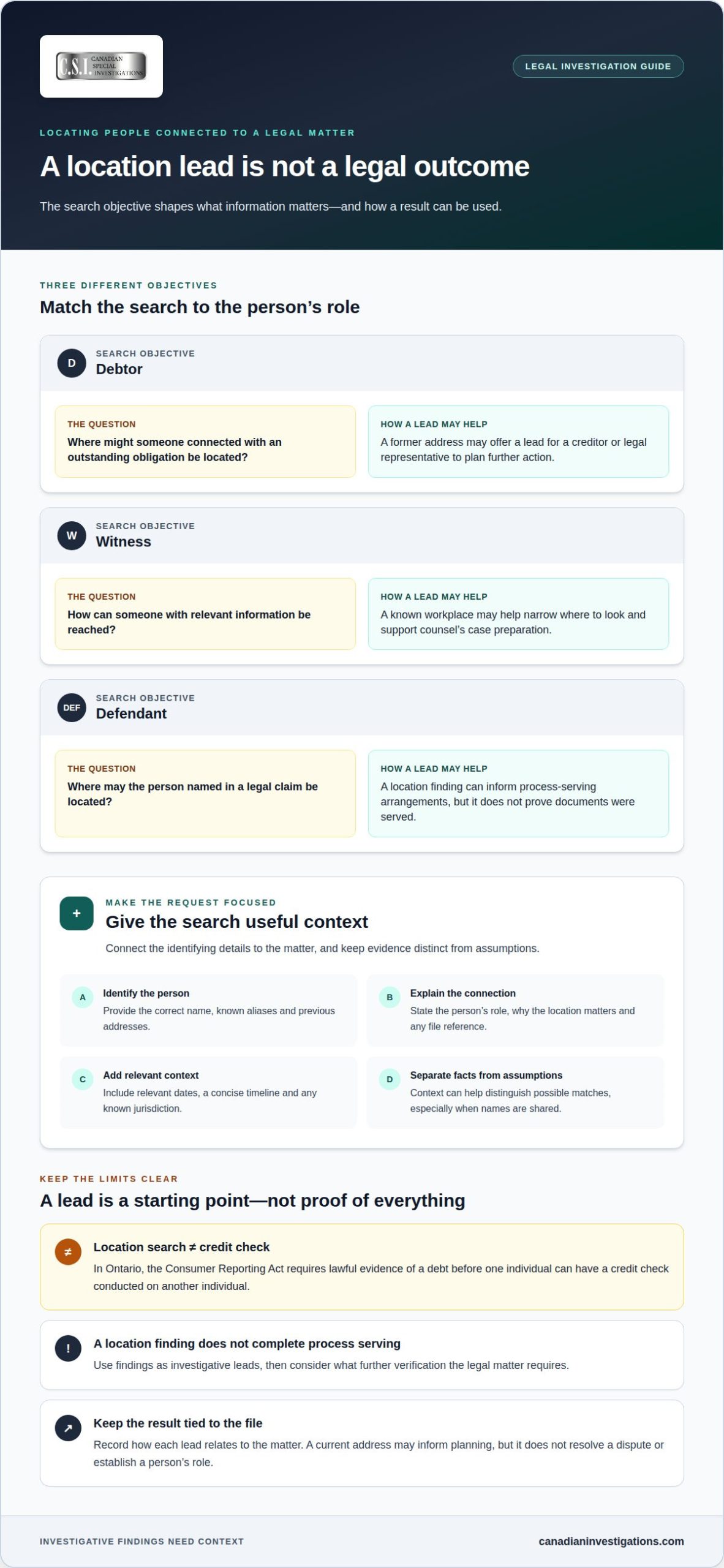
A debtor search aims to locate someone connected with an outstanding obligation. A witness search supports efforts to reach someone with relevant information. A defendant search focuses on finding a person named in a legal claim. Each objective shapes the search. A debtor’s former address, for example, may offer a lead, while a witness’s known workplace may help narrow where to look.
Useful requests connect the person to the matter. Provide the correct name, known aliases, previous addresses and relevant dates. Include a file reference or concise explanation of the person’s role. If a defendant shares a name with another individual, details such as a former city or business association can help distinguish possible matches. Keep documents and assumptions clearly separate.
Debt collection and process serving must have a lawful purpose and account for applicable provincial requirements. In Ontario, the Consumer Reporting Act requires lawful evidence of a debt before one individual can have a credit check conducted on another. A location search is not a credit check, and a location lead does not complete process serving.
Use the result to determine the next practical step. A debtor’s possible location may help a creditor or legal representative plan further action. A witness lead may help counsel assess how to pursue contact. For a defendant, a location finding can inform process-serving arrangements, but it is not proof that documents were served. Keep the date and source of each lead with the case record.
Separate locating a person from recovering money or establishing a legal claim. A skip trace can inform the search for a debtor, witness or defendant; it does not decide liability or resolve the dispute. For process serving, location information can guide the next step, while service itself remains distinct from the investigative search.
Skip tracing service costs
The cost of a skip trace depends on the case, so request a quote based on the work involved. The scope, urgency and quality of identifying details influence that work. A focused search for one person differs from a request involving several names, jurisdictions or connected businesses. Define the result you need before comparing proposed scopes.
In Ontario, a basic search and a rush search can involve different costs. Rush work may require investigators to prioritize the request. Complexity also matters: a debtor with several known addresses may require a different search plan from a witness identified only by name. These are differences in scope, not a universal price list.
Consider what the assignment must establish. A person-location search seeks a lead on someone’s whereabouts; an asset investigation examines a different question. If a legal matter involves a parent company and a related individual, explain that connection. The investigator can then assess whether the request requires separate person, company or asset inquiries. Each added objective can affect the work.
Before requesting a quote, organize the details that can define scope:
- The person’s full name, known aliases and previous addresses.
- The reason for the search and its connection to the legal matter.
- The relevant jurisdiction and any known business relationship.
- The required timing and whether the request is urgent.
Clear information can help avoid unnecessary search work. It also gives you a basis to compare what each proposed scope includes, such as the subject searched and the findings delivered. Ask for the scope and cost together to assess whether the work matches the decision or legal step ahead.
For an investigation connected to a legal matter, request a case-specific investigation quote and outline the search objective, urgency and available identifying details.
Canadian Special Investigations: Employment Investigations
Canadian Special Investigations conducts Employment Investigations when an employer needs to examine a workplace concern or verify information relevant to an employment matter. A location search and an employment investigation serve different purposes: one seeks a person’s whereabouts, while the other focuses on questions arising in the workplace.
Define the issue before proceeding. An employer, for example, may need investigative support concerning an employee’s conduct or information connected to a workplace dispute. Legal Investigations and Corporate Investigations can address concerns in their respective contexts. Clear objectives help keep the investigation focused on the matter at hand.
Contact Canadian Special Investigations to discuss an employment or legal investigation relevant to your circumstances.
Set a clear direction for your next step
Before acting on a location lead, define the decision or legal step it needs to support. A precise objective helps keep an investigation focused and makes relevant information easier to assess. Treat the result as one part of a broader review, not a substitute for sound judgment in employment, tenancy or legal matters.
Canadian Special Investigations offers Employment Investigations, Domestic / Infidelity Investigations and Corporate Investigations. These services address distinct concerns, from workplace matters to personal and business investigations. The right approach depends on the issue you need examined and its context.
For organizations considering skip tracing services in Canada, connect the search objective with the practical decision ahead. Share the matter’s context and the outcome you need to inform. A focused conversation with Canadian Special Investigations can help clarify the investigative path.
Contact Canadian Special Investigations to discuss your investigative needs and take a considered next step.
Frequently Asked Questions
Can you locate unit numbers in multi-residential buildings?
Sometimes a search identifies a building, but the address alone does not establish which unit belongs to the individual. A unit number may require a more specific record or additional identifying details. Provide the person’s full name and known address history, for example. Treat a building-level match as a lead, not confirmation of a specific residence.
Do you guarantee a locate?
No. A skip trace is an investigative search, not a guaranteed locate. Results depend in part on the accuracy and detail of the information provided, such as a correct name or previous address. If a search produces a possible match rather than a verified location, keep that distinction clear before using the finding to guide legal or business decisions.
How are results delivered?
Delivery formats can differ by assignment. For a useful handoff, request findings that identify the search subject, the location information found and any limits on what the results establish. A written record can help a legal team distinguish a confirmed detail from an investigative lead and document how the information relates to its file.
How do you handle privacy, security, and retention?
Share only information relevant to the search, and limit access to people working on the matter. Before transferring sensitive records, clarify how they’ll be sent, who can access them and how long they’ll be retained. A legal file, for example, may contain personal identifiers, so store investigative findings with appropriate access controls and follow your organization’s document-handling procedures.
How much do skip tracing services cost in Canada?
These are market ranges, not a quote for a particular assignment. Scope, urgency and the identifying information available can affect the work required. A search involving several people may require different work from locating one individual.
How accurate are Canadian skip tracing services, and what affects success rates?
There isn’t one accuracy rate that applies to every search. Results are more likely to be useful when the request includes reliable identifiers, such as a full name, former address or known business connection. Shared names, outdated details and limited records can complicate matching. Assess each result against the search’s purpose, and distinguish a possible lead from a verified identity or location.

