What if the changes you’ve noticed have another explanation? Signs of a cheating spouse can feel compelling when routines shift, communication cools or privacy suddenly matters more. But one change, or even several, can’t establish infidelity on its own.
It’s understandable to want a clear answer before raising a difficult concern. Acting on suspicion alone can intensify conflict, while attempts to access private accounts or track someone can create further problems. Start by identifying what has changed, when it began and what else may explain it.
This guide explains which behaviour patterns may warrant a conversation, what they cannot prove and how to choose a measured next step. You’ll learn how to raise concerns without presenting assumptions as facts, protect trust and privacy, and decide when professional fact-finding may be appropriate. For people in Ontario, a domestic investigation can provide a discreet way to gather information when uncertainty has significant consequences, without guaranteeing a particular outcome.
Key Takeaways
- Read signs of a cheating spouse as observations to assess, not as a checklist that confirms an affair.
- Look for repeated, observable changes and consider them in the context of your relationship.
- Separate what you’ve directly noticed from possible explanations, and identify what remains unknown.
- Take a measured next step: pause, make factual notes, consider context and avoid intrusive monitoring.
- If unresolved concerns carry significant consequences, professional fact-finding can help clarify the situation. Canadian Special Investigations is a fully licensed Toronto agency serving private clients across Ontario.
Signs of a Cheating Spouse: Changes That May Deserve Attention
Unexplained changes can feel unsettling, especially when they affect routines or communication. A change is a reason to pay attention, not a conclusion. Signs of a cheating spouse are best considered as observations that may matter together, alongside the history and circumstances of your relationship.
Look for a sustained shift from what’s usual for you as a couple. For example, secrecy may stand out if a spouse who once shared plans now avoids basic questions, or if explanations about availability repeatedly change. Emotional distance or unusual defensiveness may also be noticeable, but stress, health concerns, work demands and other personal pressures can affect behaviour. Understanding Infidelity includes different forms and contexts, a reminder that relationship concerns aren’t all the same.
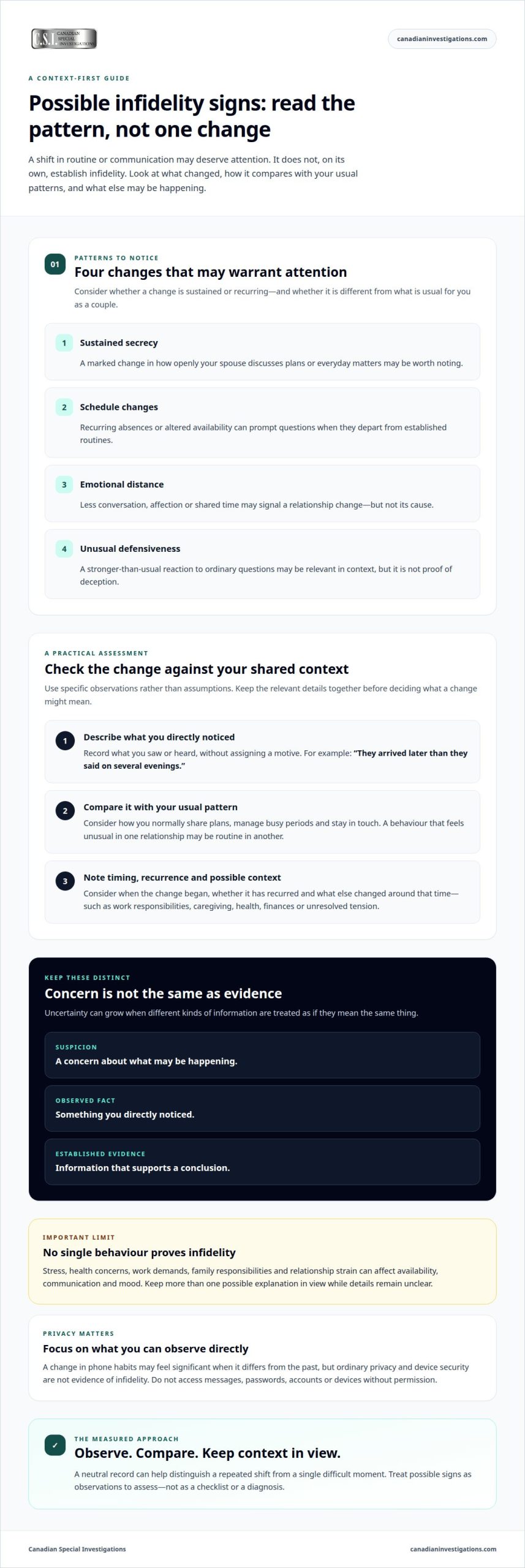
- Sustained secrecy: A marked change in how openly your spouse discusses plans or everyday matters may be worth noting.
- Schedule changes: Recurring absences or altered availability can prompt questions when they depart from established routines.
- Emotional distance: Less conversation, affection or shared time may signal a relationship change, but not its cause.
- Unusual defensiveness: A stronger-than-usual reaction to ordinary questions may be relevant in context, but it isn’t proof of deception.
No single behaviour proves a spouse is cheating. Consider whether observable changes persist, how they compare with past patterns and whether known circumstances could explain them. Don’t treat an online checklist as a diagnosis. A list can suggest questions to consider, but it can’t account for your relationship’s full context.
What changes in routine or communication might stand out?
Recurring unexplained absences or repeated changes in availability may be more notable than one late return. Reduced communication can also matter if it represents a clear, lasting departure from how you previously connected. Describe what you can observe: “They arrived later than they said on several evenings” is factual. “They must have been with someone else” assigns a motive the observation alone cannot establish.
When might changes in phone privacy raise questions?
Consider phone habits against your spouse’s previous pattern. A sudden change, such as consistently taking calls elsewhere when that wasn’t typical, may feel significant, but ordinary privacy and device security are not evidence of infidelity. Don’t access messages, passwords, accounts or devices without permission. Focus on the change you’ve personally observed and whether it coincides with other shifts in routine or communication.
Context can help you assess what you’ve noticed. A new work schedule, family responsibility or personal difficulty may account for changes that initially seem troubling. Consider what changed, how often it occurs and what you know directly. This distinction can help you approach a conversation with specific observations instead of accusations or unsupported conclusions.
How to Read Possible Infidelity Signs in Their Full Context
A meaningful pattern is a series of repeated, observable changes considered against the circumstances of your relationship. It isn’t a collection of behaviours pulled from an online checklist. A late return, a quiet evening or a tense exchange may have several explanations. Even intuition, though worth acknowledging, can’t establish what happened.
Keep three things distinct: suspicion is a concern, an observed fact is something you directly noticed, and established evidence is information that supports a conclusion. Confusing these categories can turn uncertainty into an accusation before you know enough. Avoid assigning a motive when important details are missing.
How can stress or relationship strain resemble a warning sign?
Pressure can affect availability and communication. A demanding period at work may mean longer days; a health concern or family responsibility may leave someone distracted or less interested in conversation. Conflict between partners can also lead to withdrawal or irritability. These possibilities aren’t explanations to assume are true. They’re context to consider before deciding what a change means.
Think about whether anything else changed around the same time, such as work responsibilities, caregiving, health, finances or unresolved tension between you. You don’t need to dismiss your concern or diagnose your spouse. Keep more than one explanation in view until you have clearer information.
Why does a change from the usual pattern matter?
There’s no universal checklist that fits every couple. What matters is the baseline you’ve established together: how you normally share plans, manage busy periods and stay in touch. A behaviour that feels unusual in one relationship may be routine in another. Compare what you’re seeing with your shared habits, not a general list of supposed signs.
To make that comparison more reliable, note when the change began and whether it has recurred. Keep the record neutral and specific, such as “plans changed twice this week” rather than “they’re hiding something.” Then consider what was happening in both your lives. A brief record can help you tell whether your concern is based on a repeated shift or a single difficult moment.
- Identify the change: Describe what you directly saw or heard.
- Check the baseline: Ask how this differs from your usual routine together.
- Consider timing: Note when it started and whether it repeats.
- Keep interpretations separate: Record possible explanations as possibilities, not facts.
Context can help you frame a calm, specific conversation, but it can’t confirm an affair. If uncertainty remains consequential after you’ve considered the pattern, professional fact-finding is one measured option. Canadian Special Investigations conducts domestic and infidelity investigations for private clients across Ontario. Learn about professional domestic investigations as a possible next step.
Warning Signs Versus Proof: Avoiding False Conclusions
A behaviour can raise a concern without explaining why it happened. Even repeated changes need to be assessed in context; several troubling moments don’t automatically establish infidelity. To avoid turning an observation into a conclusion, separate what you directly noticed from the explanations you’re considering.
| Observed behaviour | Possible interpretations | What remains unknown |
|---|---|---|
| Your spouse returned later than expected. | Plans or timing may have changed. | Why they were late, and whether the event relates to infidelity. |
| A planned conversation ended sooner than usual. | They may have been distracted or unavailable to talk. | What affected the conversation or whether this reflects a wider change. |
| Plans were cancelled more than once. | There may be circumstances affecting availability. | The reason for each change and whether the events are connected. |
The table doesn’t diagnose a relationship. It shows how the same event can support different explanations while leaving important facts unresolved. Signs of a cheating spouse aren’t a formula: repetition may justify a careful conversation, but it doesn’t replace reliable information about what occurred.
What is an observation, and what is an assumption?
An observation is a specific event you directly noticed, such as a changed plan or a conversation that didn’t happen. An assumption is an explanation for that event, such as deciding it was deliberate concealment. Keep notes neutral: record what happened, when and what was said, then label any interpretation as a possibility. This makes it easier to discuss facts without presenting a guess as established truth.
Can intuition help without becoming certainty?
Intuition can signal that something feels different and prompt reflection. It can’t establish what your spouse did or why. Anxiety, past experiences or strained trust may affect how an ambiguous event feels. Pause before confronting your spouse or making a major decision. Ask yourself what you know directly, what you fear may be happening and what information is still missing.
Purpose matters when assessing what counts as proof. Information that helps you explain a concern in a personal conversation may not be sufficient for a legal or other formal purpose. Requirements depend on the specific issue and decision-maker, so don’t assume suspicion, notes or a single item of information guarantees a particular conclusion.
Keep the distinction clear: an observation describes an event; an assumption proposes a reason; evidence is information assessed in relation to a specific question. You can take a concern seriously without treating uncertainty as certainty. A measured pause gives you room to decide what conversation or next step makes sense.
What to Do If You Notice Possible Signs of a Cheating Spouse
Possible signs of a cheating spouse can create pressure to act immediately. A measured response helps you think clearly and reduces the risk of escalating a concern before you understand it. Move through these steps:
- Pause. Give yourself time to settle before confronting your spouse or making a major decision.
- Record direct observations. Note dates, circumstances and what you personally saw or heard. Keep interpretations separate from facts.
- Consider context. Reflect on relevant changes in work, health, family responsibilities or your relationship.
- Choose a next step. Depending on what you know and how safe you feel, that might be a conversation, further reflection or professional advice.
Keep notes factual and private. Don’t try to fill gaps by accessing messages, guessing passwords, hacking accounts, secretly recording conversations or tracking someone without authorization. These actions can violate privacy and intensify conflict. If your concern has legal implications, get qualified legal advice before taking steps that could affect a separation, court matter or other significant decision—for example, individuals navigating joint property or estate issues abroad can consult private client law firms like Feltons Solicitors LLP to understand how relationship disputes impact their assets.
How can you raise a concern without making an accusation?
Choose a calm, private time if you feel safe doing so. Describe the specific change and its effect on you, rather than claiming to know its cause. For example: “Our plans have changed several times lately, and I’m feeling unsettled. Can you help me understand what’s been happening?” Ask an open question, then give your spouse room to respond. One conversation may not resolve the uncertainty, so focus first on listening and clarifying what you’ve observed.
Notice whether the discussion stays respectful, but don’t treat one reaction as a definitive answer. People may respond differently when surprised, stressed or hurt by a difficult subject. If emotions rise, pause and return to the conversation later. The aim is to explain your concern accurately, not to force a confession or settle every question in one sitting.
What should you avoid doing while you’re uncertain?
Avoid public accusations, threats or major decisions based on a single ambiguous event. Don’t access private devices or accounts, make hidden recordings or use unauthorized tracking to seek certainty. If a conversation could lead to intimidation, coercion or harm, prioritize your safety and seek appropriate support before raising the issue. You don’t have to confront someone alone or immediately.
If divorce or another legal issue is part of your concern, evidence requirements and appropriate next steps depend on the circumstances. Get advice from a qualified legal professional before collecting or relying on information for a legal purpose. In matters involving international property or cross-border domestic disputes, consulting resources such as israelcrossborderfamilylaw.com can help clarify jurisdictional considerations. For a distinct discussion of Ontario evidence gathering for divorce, see the article “Gathering Admissible Evidence for Divorce in Ontario.”
If uncertainty remains consequential and you want professional fact-finding, Canadian Special Investigations conducts domestic and infidelity investigations for private clients across Ontario. Discuss a confidential domestic investigation as a measured next step.
When an Ontario Infidelity Investigation May Help Clarify the Facts
Professional fact-finding is worth considering when concerns remain unresolved and uncertainty has significant consequences. It provides a structured way to gather information beyond interpreting behaviour alone. An investigation can’t guarantee that infidelity will be confirmed or determine what personal, relationship or legal decision you should make.
Canadian Special Investigations (CSI) is a fully licensed private investigation agency based in Toronto and serving private clients across Ontario. Its domestic and infidelity investigations can involve surveillance and evidence gathering, with investigative steps shaped by the circumstances and objectives of the case. The purpose is to clarify relevant facts, not promise a particular finding.
CSI serves clients in Toronto, Oakville, Burlington, Brampton, Mississauga, Hamilton, Ancaster, Niagara Falls, Kitchener, Waterloo, Scarborough, North York, Richmond Hill, Barrie, Milton, Etobicoke and Guelph. If you’re weighing possible signs of a cheating spouse against an important decision, first consider what you need to understand and why. You may be seeking clarity for your own decision-making or trying to understand what information may be relevant to a family matter. Those are different objectives. Direct legal questions, including whether information may be used in a particular proceeding, to qualified Ontario counsel.
What can a professional domestic investigation involve?
Domestic investigations may include surveillance and evidence gathering focused on the questions identified for the case. The scope and approach depend on the individual circumstances and objectives. A professional investigator can conduct fact-finding, but no method guarantees a specific result. If you’re considering an investigation in Toronto, the Infidelity Investigator Toronto: The Tactical Surveillance Buying Guide offers a related overview.
Investigative findings may help clarify what happened, but they don’t automatically settle a relationship decision or establish a legal outcome. If you need advice about legal relevance or next steps in a family matter, consult a qualified Ontario lawyer. That advice can help you understand your legal questions without assuming that every piece of information will be treated the same way.
How can you make a confidential inquiry in Ontario?
You can make a confidential case inquiry to CSI by phone or through its online contact form. An initial inquiry is an opportunity to describe the concern, explain what you hope to clarify and discuss professional fact-finding for your circumstances. An inquiry doesn’t commit you to proceeding. Keep the discussion focused on direct observations and your objectives; don’t access private accounts or track information without authorization.
If you’re considering an Ontario infidelity investigation, take the next step at your own pace. Discuss a confidential domestic investigation.
Choose Your Next Step With Care
Uncertainty can make every change feel loaded with meaning. Give yourself time to think clearly instead of forcing an immediate answer. Signs of a cheating spouse may prompt questions, but your next decision can be based on what you know, what you still need to understand and what feels safe for you.
Before taking action, consider what clarity would help you decide and whether you’re ready to have a direct conversation or explore professional fact-finding. You don’t have to settle every question at once. A deliberate next step can protect your privacy, reduce avoidable conflict and keep your choices grounded in your circumstances.
If professional support feels appropriate, you can make a confidential inquiry with Canadian Special Investigations without committing to a particular outcome. Call 905-332-4807 or make a confidential investigation inquiry online. Take the next step thoughtfully, at a pace that feels right for you.
Frequently Asked Questions
Can one sign prove that a spouse is cheating?
No, a single behaviour change can’t establish infidelity. Signs of a cheating spouse may also reflect changes in work, family responsibilities or relationship dynamics. Before acting, ask yourself whether the behaviour is new, whether it has happened more than once and what you know directly. A checklist can help identify a concern, but it can’t verify what happened or explain someone’s motives.
Is being protective of a phone a sign of cheating?
Not by itself. A new phone habit may prompt a question if it contrasts with how your spouse previously used their device, but privacy is not proof of infidelity. People may secure their phones for personal or practical reasons. Avoid opening messages or accounts without permission. If the change concerns you, describe the specific behaviour and ask about it without demanding passwords or access.
Can stress cause behaviour that looks like a sign of cheating?
Yes, stress can affect mood, availability and communication. For example, someone managing a demanding work project may be less responsive or have less energy for conversation. That possibility doesn’t explain every change, but it’s a reason to consider what else is happening before deciding what a behaviour means. Ask about the change calmly and openly, without diagnosing its cause for your spouse.
What should I do first if I suspect my spouse is cheating?
Pause and make a private note of what you directly observed, including the date and relevant circumstances. For example, record that a planned call didn’t happen, rather than writing that your spouse deliberately avoided you. Keep these details secure and don’t access private accounts or use unauthorized tracking. Then consider what you want from a conversation. If raising the issue could put you at risk, seek appropriate support first.
Can a private investigator investigate a spouse in Ontario?
Yes. Canadian Special Investigations is a fully licensed private investigation agency based in Toronto and serving clients across Ontario, including the Greater Toronto Area. It conducts domestic and infidelity investigations that may involve surveillance and evidence gathering, based on the circumstances. An investigation can’t promise a particular finding or legal result. For questions about divorce proceedings or the legal use of information, consult qualified Ontario legal counsel.
Should I confront my spouse when I notice possible signs of infidelity?
That depends on your safety, circumstances and readiness to talk. If you decide to raise it, choose a suitable private moment and focus on a specific concern rather than making a public accusation. You might say, “I’m concerned about this change and want to understand it.” Give your spouse time to respond. If you expect intimidation or the issue has legal consequences, seek appropriate support before confronting them.

