A guarded phone, unexplained changes in routine, or less communication can raise concern. But one unusual moment isn’t proof. The signs of a cheating partner matter more when they form a recurring pattern and are considered in the context of your relationship.
If you’re worried, it’s understandable to want reliable information before starting a difficult conversation. Acting on suspicion alone can increase tension, while secretly accessing someone’s devices or accounts can create serious privacy concerns.
This checklist will help you distinguish recurring changes from one-off events, prepare for a calm, direct conversation, and consider measured next steps in Ontario. You’ll also learn when discreet professional fact-finding may be appropriate if significant concerns remain unresolved. A confidential inquiry with a licensed private investigation agency can help you decide whether investigative support fits your situation, without assuming surveillance will confirm infidelity. The goal is clarity, not a rushed conclusion.
Key Takeaways
- Assess the signs of a cheating partner as recurring changes that may warrant discussion, not as proof or a scorecard.
- Consider how work, health, caregiving, financial pressure, or conflict could explain changes in communication and routine.
- Use specific observations and open questions to prepare for a measured conversation rather than making unsupported accusations.
- Keep your next steps proportionate: note what you’ve observed, clarify the context, and reassess after speaking with your partner.
- If significant concerns remain unresolved, learn when confidential fact-finding from a licensed Ontario agency may be an option.
What Counts as a Sign of a Cheating Partner, and What Does Not?
Uncertainty can make ordinary changes feel loaded with meaning. This checklist is a way to organize your observations, not diagnose your partner. A sign is an observable change that may be worth discussing. It is not proof of infidelity, and it should be considered in context rather than treated as a verdict.
People also differ in how they define relationship boundaries. The overview of Infidelity describes how the concept can vary across cultural and historical contexts. In your relationship, clarify what you and your partner understand as crossing a boundary instead of assuming you share the same definition.
Why a single behaviour cannot confirm infidelity
A change in communication or routine can have several explanations. Stress, health concerns, work demands, grief, or unresolved relationship conflict can affect how someone behaves. No checklist can determine what another person is doing, and the same behaviour can mean different things in different circumstances.
Look at context, duration, and repetition, not stereotypes about gender, personality, occupation, or technology use. A sign may prompt a question; it cannot answer it.
Suspicion is a concern, an observable fact is what you directly saw or heard, and verified information is what reliable evidence supports. Keeping those categories separate helps prevent a fear from being mistaken for a fact.
A useful way to read this checklist
Use the signs of a cheating partner as prompts for careful observation, not as a scoring system. If you notice a change, note what happened, when it began, and how often it has occurred. Keep the description specific: “They cancelled our plans twice this month” is clearer than “They’re always hiding something.”
Separate what you directly observed from your interpretation, your fear, or something another person told you. For example, “They took a call in another room” is an observation; “They must be speaking to someone they’re seeing” is an assumption. That distinction helps you decide what to raise in conversation.
- Write down the observation: Record what happened without guessing why.
- Add the context: Note when it happened and whether it has happened again.
- Mark what you don’t know: Keep second-hand information and assumptions separate from what you witnessed.
Pause before making an accusation or taking action that could compromise your safety, privacy, or trust. Don’t try to access a partner’s private accounts or devices. First establish what you know, what remains uncertain, and whether a calm conversation is appropriate. The next sections explain how to assess recurring changes without treating them as a verdict.
Seven Signs of a Cheating Partner to Assess as a Pattern
Use these signs of a cheating partner as prompts for reflection, not as a scorecard or test. A change may deserve a conversation, but its meaning depends on the circumstances and your relationship’s usual patterns. Psychology Today discusses several common signs of infidelity, including shifts in routine and emotional availability. No single behaviour confirms what’s happening.
Changes in routines, communication, or emotional closeness
Compare what you’re noticing with your partner’s usual behaviour. Focus on specific changes and whether they persist, rather than labelling someone “distant” or “secretive.” A demanding work period, health concern, grief, or relationship tension may also affect how much time or attention someone can offer.
- Less communication: Conversations or check-ins have decreased noticeably, or plans are repeatedly left unclear.
- Changed availability: Work or personal commitments have shifted, with recurring schedule changes you haven’t discussed.
- Reduced emotional closeness: Your partner seems less engaged in shared activities or avoids conversations that were previously comfortable.
Unusual privacy or inconsistencies in explanations
Privacy can be a healthy boundary, and people may change how they use devices for reasons unrelated to infidelity. Don’t search a partner’s phone or accounts. Instead, consider what changed and whether you can raise it respectfully. Conflicting explanations may warrant clarification, but memory, stress, or changing plans can also account for discrepancies.
- Newly guarded device habits: There’s a noticeable change in how your partner handles calls or messages, but that alone doesn’t tell you what those communications contain.
- Explanations that don’t align: Details about a particular plan seem to change. Note exactly what differs before drawing a conclusion.
- Unexplained spending: You notice a change in shared finances or spending that you don’t understand. Ask about the transaction rather than assigning it a cause.
- Repeated schedule changes: Plans shift more often than usual, and you haven’t yet had a clear conversation about why.
Repeated, unexplained changes merit discussion, but they do not establish infidelity. Consider how the signs relate to one another and to the broader context. A direct, measured question can help clarify an observation without turning it into an accusation.
If serious concerns remain unresolved after communication, you can learn more about domestic and infidelity investigations as one possible avenue for professional fact-finding. An inquiry can help you assess whether that kind of support suits your circumstances; it can’t guarantee a particular finding.
How to Tell a Warning Sign from an Innocent Explanation
A change may catch your attention, but context determines what questions are reasonable to ask. Work demands, health concerns, caregiving responsibilities, financial pressure, or conflict can all affect schedules and communication. The table below helps separate what you observed from possible explanations and a measured next step. None of the signs of a cheating partner establishes a cause on its own.
| Observation | Possible explanations | Context to clarify | Reasonable next step |
|---|---|---|---|
| Later or less predictable work hours | A changed workload, shift, commute, or other commitment | Is this new? Has your partner mentioned a change at work? | Ask what’s changed and discuss how it affects shared plans. |
| Less frequent communication | Stress, health concerns, caregiving, or a need for space | When did the change begin? Is it limited to busy or difficult periods? | Describe what you’ve noticed and ask how they’re doing. |
| Unclear or changing explanations about plans | Misremembered details, changing arrangements, or reluctance to discuss something | What detail differs, and have you checked it directly? | Ask a specific, neutral question without assuming why accounts differ. |
| Less openness about shared spending | Financial pressure, a private purchase, or a misunderstanding | Is there a concrete change in shared finances, or only an unanswered question? | Raise the financial concern directly and focus on its practical impact. |
Questions that put an observation in context
Check whether the behaviour is new, recurring, and clearly different from the established routine. Consider whether a known life event lines up with the timing. Then identify what remains unknown. A detailed checklist, such as this guide to what to do if you suspect cheating, may help you frame questions, but it can’t verify the cause of a change.
When a concerning pattern still does not prove cheating
Relationship dissatisfaction, privacy, and infidelity are separate possibilities. A partner may be unhappy without being unfaithful; an explanation may be incomplete without revealing why. Timing, repetition, and willingness to discuss a concern provide context, not a verdict. Body language alone can’t establish deception, and labels or certainty based on impressions can escalate conflict.
If direct communication hasn’t resolved serious concerns and you’re considering professional fact-finding, review this infidelity investigation guide for Toronto to understand the process and questions to consider. Keep any next step proportionate to what you know, and don’t treat an investigation as a guaranteed way to confirm infidelity.
What to Do If You Notice Signs of a Cheating Partner
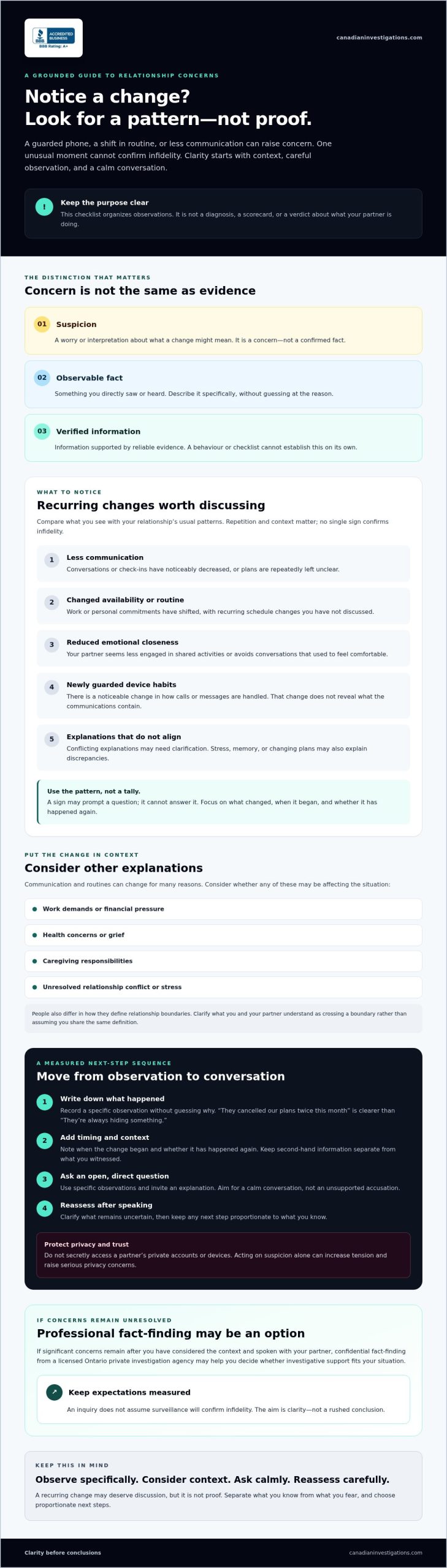
Concern can create pressure to act quickly. A measured sequence can help you stay grounded: record what you directly observed, consider the context, plan a conversation if it feels safe, then reassess what you know. The signs of a cheating partner are reasons to seek clarity, not a basis for an unsupported accusation.
- Note the observation. Record specific changes and when they happened. Separate what you saw or heard from your interpretation.
- Consider the context. Ask whether work, health, caregiving, financial strain, or relationship conflict could help explain the change.
- Plan a conversation. Choose a calm time and focus on understanding what has changed.
- Reassess afterward. Consider what was clarified, what remains uncertain, and whether further support would be useful.
Prepare for a direct, respectful conversation
Choose a private time when neither of you is under immediate pressure. Use first-person statements that identify the observation and its effect on you. For example: “I’ve noticed our plans have changed several times lately, and I’m feeling uncertain. Can you help me understand what’s going on?” This is more constructive than presenting a conclusion as fact.
Ask open questions and allow room for an answer. Decide what you want from the discussion: an explanation of a specific change, a clearer agreement about relationship boundaries, or a conversation about support. You don’t have to settle every issue at once. If the discussion becomes heated, pause and return to it when you can both speak calmly.
Protect your wellbeing and avoid risky evidence-gathering
Don’t hack, track, impersonate someone, or access a partner’s phone, email, financial accounts, or location data without authorization. These actions can compromise privacy, escalate conflict, and leave you with information gathered inappropriately. Keep to your own direct observations and information you’re entitled to access.
Consider speaking with a trusted person or qualified counsellor if the uncertainty is affecting your wellbeing or making it difficult to decide what to do. If you believe a conversation could put you at risk, don’t prioritize confrontation. Focus on personal safety and seek appropriate support before taking further steps.
If direct communication hasn’t resolved significant concerns, professional fact-finding may be one option to consider. Canadian Special Investigations is a Toronto-based private investigation agency serving individuals across Ontario, including Toronto, Oakville, Burlington, Brampton, Mississauga, Hamilton, Ancaster, Niagara Falls, Kitchener, Waterloo, Scarborough, North York, Richmond Hill, Barrie, Milton, Etobicoke, and Guelph. A confidential inquiry can help you clarify whether domestic or infidelity investigation support suits your circumstances; no process can guarantee a particular finding. Ask about domestic and infidelity investigations if you’re considering that measured next step.
When an Ontario Private Investigator May Help Clarify Concerns
Professional fact-finding may be worth considering when serious concerns remain unresolved after direct communication and you need objective information to decide what to do next. It’s an option, not a requirement. The signs of a cheating partner don’t establish infidelity, and an investigation can’t guarantee a particular finding or resolve a relationship issue.
Canadian Special Investigations (CSI) is a Toronto-based private investigation agency that identifies itself as licensed and serves individuals across Ontario. If you’re weighing this step, a confidential inquiry can help you explain your concern and ask whether investigative support may suit your circumstances. Before proceeding, clarify what the agency can and cannot do for your specific situation.
What to clarify before contacting an investigator
Prepare a concise account of what prompted your concern, what information you’re seeking, where the matter is taking place, and whether there are immediate safety considerations. Stick to facts you know directly. You don’t need to arrive with a conclusion or a complete record.
Ask practical questions before deciding whether to proceed:
- Licensing: How can you confirm the investigator’s current Ontario licence?
- Scope and methods: What work is proposed, and what is outside the assignment?
- Reporting: What information will be provided, and in what form?
- Confidentiality and privacy: How will your information be handled, and what limits apply?
- Legal boundaries: What requirements or restrictions may affect the proposed work?
Answers should be specific to your case. Ontario licensing details and applicable privacy or legal requirements can change or depend on the circumstances, so confirm current information rather than relying on general assumptions.
Deciding whether professional support is appropriate
Investigative support isn’t necessary for every relationship concern. If a conversation has clarified the issue, or you’re still deciding what outcome you want, you may choose to pause. If uncertainty remains and objective information could help you make an informed decision, ask about the process and its suitability before committing to a next step.
A careful inquiry should clarify the proposed scope, relevant limitations, and what you can reasonably expect, without promising proof or a particular result. You remain in control of whether to proceed. For a discreet first step, Contact Canadian Special Investigations confidentially to discuss your concern and determine whether an investigation may be appropriate.
Choose Your Next Step with Clarity
The signs of a cheating partner are prompts to look carefully, not proof of infidelity. Focus on recurring changes, consider reasonable explanations, and separate what you observed from what you fear. If it feels safe, a calm conversation using specific examples can help clarify what has changed and what you need next.
If important questions remain unresolved, professional fact-finding is one option, not a requirement. Canadian Special Investigations identifies itself as a fully licensed private investigation agency based in Toronto and serving clients across Ontario. The agency accepts confidential inquiries by phone or through its online contact form. An inquiry can help you discuss your concern and consider whether investigative support fits your circumstances, without promising a particular finding or outcome.
Make a confidential inquiry with Canadian Special Investigations to explore a measured next step. You can call 905-332-4807 or use the online contact form, ask clear questions, and take the time you need to make decisions based on reliable information.
Frequently Asked Questions
Is a sudden change in behaviour proof that a partner is cheating?
No. A sudden change can have many explanations, including stress, health concerns, work demands, or relationship difficulties. Consider what changed, when it began, and whether it keeps happening. A recurring concern still isn’t confirmation of infidelity. A calm conversation may clarify the context, but an online checklist can’t establish what your partner is doing. Keep observations, assumptions, and verified information separate as you decide what to ask next.
What are the most common signs of a cheating partner?
People often notice changes in communication, routines, emotional closeness, explanations, or privacy habits. These signs of a cheating partner don’t confirm infidelity on their own. Their significance depends on the person’s usual behaviour and the circumstances. Focus on specific, repeated observations rather than assumptions. For example, note that plans have repeatedly changed instead of concluding why they changed. Consider whether a direct, respectful conversation could clarify what’s different.
Can stress cause someone to act like they are hiding something?
Yes. Work pressure, health issues, financial strain, caregiving, grief, or relationship conflict can affect communication and routines. That doesn’t establish what’s happening in a particular relationship. Consider the broader context, then ask about the changes you’ve observed without presenting a guess as fact. If uncertainty is affecting your wellbeing, consider talking with someone you trust or a qualified counsellor. Support can help you decide what you need before taking further steps.
How can I talk to my partner about suspected cheating?
Choose a calm, private time and describe specific changes in neutral language. Explain how they’re affecting you, then ask an open question, such as, “Can you help me understand what’s changed?” Give your partner time to respond. Avoid accusations based on one observation or demands to access private accounts. Decide what you hope to clarify before the conversation. If raising the issue could put you at risk, prioritize safety and seek appropriate support first.
Should I check my partner’s phone if I suspect infidelity?
No. Don’t access another person’s phone, messages, accounts, or location data without authorization. Doing so can raise privacy concerns and may create legal or personal risks, depending on the circumstances. Avoid hacking, tracking, or impersonating someone to obtain information. Instead, rely on what you’ve directly observed, consider a conversation, or seek appropriate professional advice. If you have questions about the legal implications of a specific situation, verify them with a qualified Ontario professional.
When should I consider hiring a private investigator for infidelity concerns?
Consider asking about professional support if serious concerns remain unresolved, you need objective information, and discussion hasn’t answered your questions. Before deciding, clarify the investigator’s current licence, proposed scope, reporting, confidentiality, and applicable limitations. Canadian Special Investigations is a Toronto-based, licensed private investigation agency serving clients across Ontario. A confidential inquiry can help you assess whether investigative support suits your situation, but it can’t guarantee evidence or a particular outcome.
Can a private investigator in Ontario guarantee proof of cheating?
No. An investigator can’t responsibly guarantee a particular finding or outcome. Any report depends on information gathered within the agreed scope and applicable legal boundaries. Whether information is relevant or usable in a legal matter depends on the circumstances, so don’t assume an investigation will affect a court decision. Before proceeding, ask how the agency handles scope, reporting, confidentiality, and limitations, and verify current Ontario requirements directly.

