What if delivering the right documents the wrong way could complicate a court matter? With process serving ontario, the correct approach depends on the document, the case type and the rules that apply. Clear guidance is especially useful when deadlines matter or a recipient is difficult to find.
Canadian Special Investigations provides process serving as part of its legal support services for clients across Ontario, including Toronto, Mississauga and Hamilton. Clear instructions and accurate service records help show what was attempted and what happened. The procedure still depends on the document and applicable rules.
This guide explains how process serving works in Ontario, what a process server does and why court rules matter. You’ll learn what information and documents to prepare, how service methods can differ across civil, family and Small Claims Court matters, and what proof of service may be required. It also covers what to consider when a recipient is unavailable or hard to locate. Use it to prepare a clear request and understand the practical steps involved, while keeping in mind that requirements vary by case.
Key Takeaways
- For process serving ontario, the appropriate service method depends on the document, recipient, court and governing rules.
- Prepare clear instructions that identify the documents, recipient, service address, deadline and requesting party.
- Accurate, current recipient and location details help organize service attempts when someone is difficult to reach.
- Find out what proof of service your matter requires and keep clear records of the outcome.
- Canadian Special Investigations provides process serving across Ontario, including Toronto, Mississauga, Brampton, Hamilton and Oakville.
What Does Process Serving in Ontario Mean, and Why Does Proper Service Matter?
Process serving delivers court documents to a person or organization in the manner required by the applicable rules. Its purpose is to give the recipient notice of a legal proceeding or required step, so they have a fair opportunity to respond. In process serving ontario, the right approach depends on the document and the procedure governing the case, not simply on where the recipient can be found.
The broad concept is known as service of process: formally notifying someone of a legal action or proceeding. Ontario requirements can differ across civil, family and Small Claims Court matters. The document, the recipient’s role and the court process can all affect how service must be carried out. A method that works in one situation may not apply in another.
Arranging service is separate from deciding legal strategy. A process server carries out instructions and records what happened. The client or legal representative determines the case’s legal position, selects the documents to be served and provides direction about applicable deadlines. A server does not decide whether a claim is valid or interpret what a court should do with it.
What Does a Process Server Do in an Ontario Case?
A process server receives the request, reviews the instructions, attempts to deliver the documents as directed and reports the outcome. The report may describe whether service was completed or what happened during an unsuccessful attempt. The client or legal representative supplies the correct documents and accurate details about the intended recipient, such as their name and known address.
Clear instructions matter. An incomplete name, outdated address or unclear deadline can make it harder to carry out the request as intended. The process server acts on the instructions and documents the attempt; they do not fill gaps by making legal decisions or assess the merits of the case.
Why Do Ontario Service Requirements Matter?
Proper service supports notice and procedural fairness. It helps establish that a party had an opportunity to learn about a proceeding and take the next step available to them. The service record can also become relevant as a matter moves forward, so the method and details documented should align with the applicable requirements.
An incorrect method or missed timeline may create procedural complications, including delays or the need to address whether service was effective. That can disrupt planning for both the requesting party and the recipient. Consider the requirements before sending documents for service, rather than treating them as an administrative detail after an attempt.
Valid service helps establish that notice was given in the manner required for the specific proceeding, while clear records show what happened. Careful coordination between the legal representative and process server helps keep the assignment on track. Confirm the document, intended recipient, service instructions and relevant deadline before arranging an attempt. This is general information, not legal advice; direct case-specific procedural questions to the appropriate legal professional.
How Process Serving Works in Ontario: From Instructions to Proof
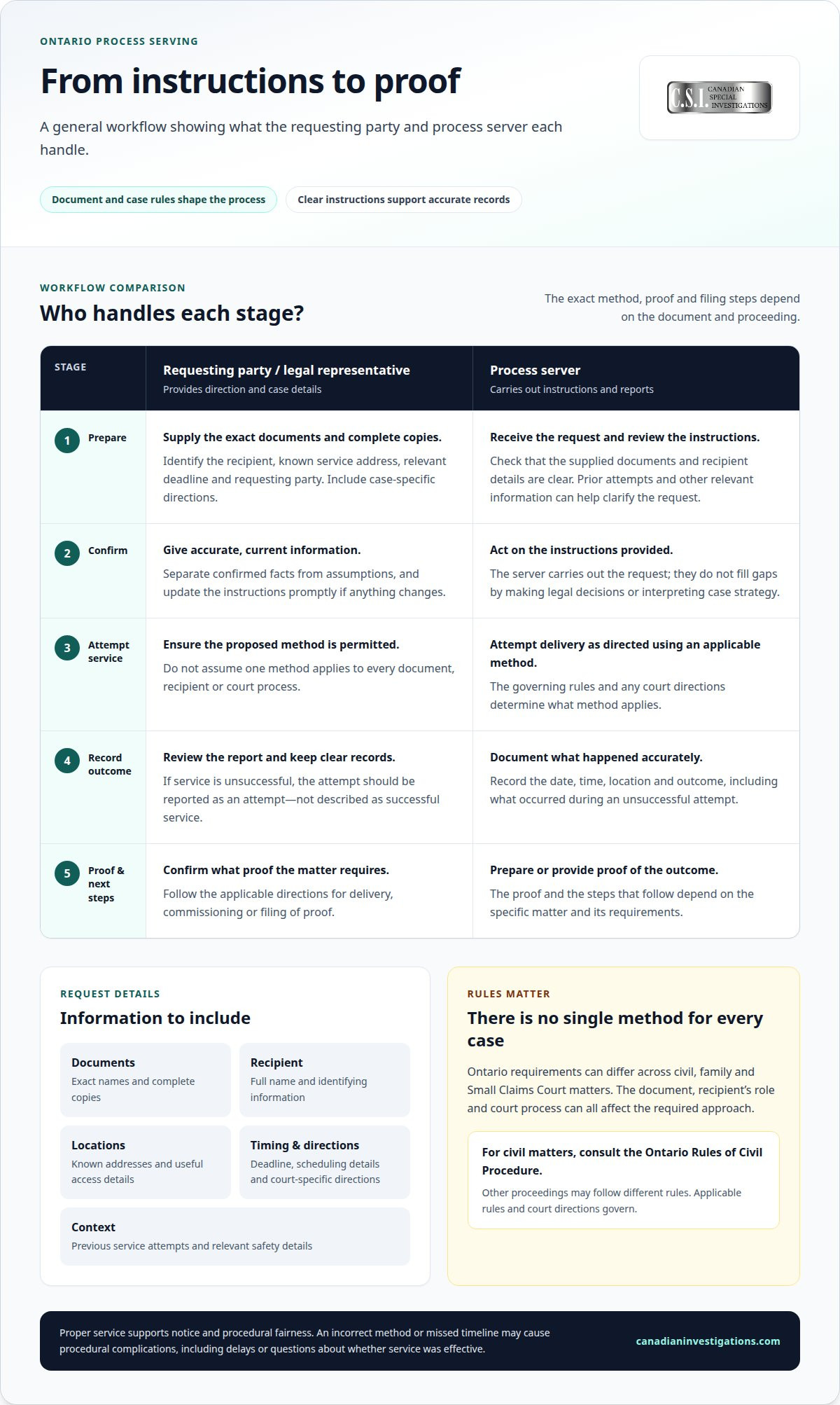
No single workflow applies to every court document. These steps offer a general framework for organizing process serving ontario, while the required method, proof and filing steps depend on the document and proceeding. For civil matters, consult the Ontario Rules of Civil Procedure; other proceedings may follow different rules. The applicable rules and any court directions govern.
- Provide complete instructions. Identify the exact document, intended recipient, service location, relevant deadline and requesting party. Include complete copies and any case-specific directions.
- Review the request. Make sure the supplied documents and recipient details are clear. Include prior attempts or other information that may affect how the request should be handled.
- Attempt service. The process server carries out the instructions using the method requested or otherwise applicable to the matter. Check that the method is permitted rather than assuming it is.
- Record what happened. Keep an accurate account of the attempt, including the date, time, location and outcome. If service is not completed, report the attempt rather than describing it as successful.
- Prepare or provide proof. Document the outcome in the form required for the matter, then follow the applicable directions for delivery, commissioning or filing.
What Information Should Instructions Include?
A clear request gives the process server the practical details needed to act without guessing. Provide the exact document names and complete copies, the recipient’s full name and other identifying information, known addresses, and the deadline supplied by the legal representative. Add access instructions, relevant scheduling or safety details, court-specific directions and a summary of previous service attempts. Update the instructions promptly if any information changes.
For example, a building name, unit number or entry procedure can distinguish the intended location from a general street address. Separate confirmed facts from assumptions so the server can understand what is known and report any issue accurately. The server should not be expected to resolve gaps in the case record or interpret legal strategy.
What Is Proof of Service?
Proof of service records what happened and may be required by the requesting party or as part of the court process. An Affidavit of Service is one possible form where applicable; its format and completion requirements depend on the proceeding. Confirm the required form, supporting information or attachments, commissioning requirements and filing steps for the specific matter before relying on a general template.
Keep the sequence clear: instructions establish what was requested, the service record describes what happened, and the applicable rules determine how that record is used. Legal professionals can arrange professional process serving support through Canadian Special Investigations for coordinated handling and clear reporting.
Which Ontario Service Method Applies to Your Document and Recipient?
Choose a service method based on the rules for the specific proceeding, not the recipient’s convenience. A method available for one document may not apply to another, and an approach used in Small Claims Court should not automatically be carried over to a different court process. The comparison below is a practical orientation, not a substitute for checking the governing rules and any court order.
| Method | What it generally means | What to verify |
|---|---|---|
| Personal service | The document is delivered directly to the person who is to be served. | Confirm who must receive it and the required delivery procedure for that document and proceeding. |
| Permitted alternative or substituted service | A different method may be used where the applicable rules allow it, or where the court has authorized it. | Check the rule or order for the permitted method and any conditions. Do not assume an unsuccessful attempt alone authorizes a substitute. |
| Service by another court-authorized method | A court may authorize a specific method for a particular matter where permitted. | Follow the order’s exact directions, including the method and any stated conditions or timing. |
How Do Personal and Alternative Service Differ?
In plain language, personal service means delivering the document directly to the person named to receive it. It does not mean that any household member, colleague or other nearby person can accept it. Alternative service is not a general fallback. It must be permitted by the applicable Ontario rules or authorized by a court. Legal Aid Ontario’s guidance on serving court documents offers a practical overview, while the governing rules determine what applies in a particular case.
Ontario’s Small Claims Court guide provides court-specific instructions for that process. Treat those instructions as an example, not a universal rule for every Ontario proceeding. Mailing documents or leaving them at an address is not automatically valid service; the method must be allowed for the document and circumstances.
Why Do the Court and Document Type Change the Rules?
Ontario has separate procedural frameworks, including the Rules of Civil Procedure and the Rules of the Small Claims Court. The correct framework depends on the proceeding, and the document being served can affect which service provisions apply. A general description of personal or alternative service cannot establish eligibility for a particular document. Check the applicable rules and any court direction before instructing a server.
Service requirements are specific to the document, recipient and proceeding; confirm the governing rule before choosing a method. For process serving ontario, this check helps legal professionals give precise instructions instead of treating a familiar method as universally acceptable.
How to Prepare for Ontario Process Serving and Handle an Unsuccessful Attempt
A complete handoff gives the process server a clear assignment and keeps the service record tied to the facts provided. Before arranging process serving ontario, assemble the documents, recipient information and case instructions in one organized request. Accurate details cannot guarantee that a recipient can be served, but they can reduce avoidable confusion, such as attending an incomplete address or working from outdated information.
What Should You Provide Before Service Begins?
Use this checklist to prepare the request. Separate confirmed information from assumptions, and flag anything that has changed since the earlier instructions were prepared.
- Documents: Provide complete, legible copies and identify each document that requires service. Label them clearly so there’s no uncertainty about what the request covers.
- Recipient: Supply the person’s known full name, any other known name relevant to identification, a description where useful, and context that can assist with identification.
- Locations: Give current and previous known addresses, including unit or building details. Share access instructions where relevant, distinguishing verified details from information that may be outdated.
- Timing and case details: State the relevant deadline and any upcoming court date. Include case-specific directions, scheduling or safety considerations, and details of prior service attempts.
Specifics matter. A building address without an apartment number, for instance, may not identify the intended destination. If an earlier attempt found that the recipient had moved, include that information rather than sending the same address without context. Clear instructions help organize the work and support an accurate account of what happens next.
What Happens If the Recipient Is Not Served?
An unsuccessful attempt should be reported as an outcome, not treated as proof that the recipient was avoiding service. The report should record relevant details such as when and where the attempt occurred and what was directly observed. Factual notes help the requesting party assess what happened without turning an observation into an unsupported conclusion.
Before deciding how to proceed, check the rules for the specific court and document, and obtain legal advice about procedural options if needed. Don’t assume that a delay, a new address or an attempted delivery changes a deadline or permits a different method. Canadian Special Investigations provides professional process serving support with coordinated instructions and reporting.
Arrange Professional Process Serving Across Ontario with Canadian Special Investigations
Canadian Special Investigations is a Toronto-based, fully licensed private investigation agency offering process serving as legal support for clients handling court matters. A clear request aligns the documents, recipient information and instructions, while service reporting records what took place. The agency accepts confidential case inquiries by phone or through its online contact form.
Coverage includes Toronto, Mississauga, Brampton, Hamilton and Oakville, as well as Burlington, Kitchener and Waterloo. For law firms, businesses and individuals, professional process serving helps coordinate the practical task of attempting service and documenting the outcome. The applicable court rules determine which method is appropriate and what proof may be needed.
When Can Professional Process Serving Help?
Arranging service can help when a legal matter requires documents to be delivered and the requesting party needs a clear record of the attempt or result. A well-organized handoff gives the process server specific instructions and keeps communication focused on the assignment. It doesn’t transfer responsibility for legal strategy: the client or legal representative remains responsible for the case and for determining which procedural steps apply.
How to Start a Process Serving Request
Before submitting an inquiry, gather the materials and details that define the assignment. A concise, complete request can include:
- The complete, legible documents to be served, with each document clearly identified.
- The recipient’s name and identifying details, along with current known address information.
- The relevant deadline and any upcoming court date.
- Case-specific directions, access details, relevant scheduling or safety information, and prior service attempts.
Keep the instructions factual and distinguish confirmed information from details that may be outdated. If something changes, such as a new address or revised deadline, include that update in the request. These details establish what the assignment involves and support clear communication about the attempt and its outcome. Address procedural questions about the correct method or next steps with the legal representative responsible for the matter.
To discuss the scope of an assignment, discuss your process-serving requirements with Canadian Special Investigations. For process serving ontario, have your documents, recipient details, deadline and case instructions ready, then contact Canadian Special Investigations about process serving by phone or through the online contact form.
Move Your Service Request Forward with Clarity
Make the next step deliberate. Before assigning service, align the request with the requirements for the specific proceeding and keep the responsible legal professional involved in procedural decisions. That preparation gives everyone working on the matter a clearer basis for moving forward, especially if circumstances change or an attempt does not go as planned.
For process serving ontario, a well-prepared request is more useful than assumptions about what will happen next. Keep your case information organized, identify unresolved procedural questions, and choose a service partner that can support the practical assignment with clear communication and reporting.
Canadian Special Investigations accepts confidential case inquiries by phone or online. Contact Canadian Special Investigations about process serving to discuss your request and take the next step.
Frequently Asked Questions
What does process serving mean in Ontario?
Process serving means delivering court documents in a way that follows the rules for the particular proceeding. It gives the person named in the documents notice and a chance to respond. For example, a document starting a claim and a document used later in a case may have different service requirements. For process serving ontario, identify the court and document before selecting a method, rather than relying on a familiar approach.
Who can serve court documents in Ontario?
Generally, a person who is at least 18 and not a party to the case can serve documents in Ontario. There is no mandatory province-wide government licence or certification for process servers. However, a specific court rule or order may affect the requirements for a particular matter. A professional process-serving agency can coordinate the assignment, while the legal representative remains responsible for determining the appropriate procedure.
How long does process serving take in Ontario?
There is no single timeframe that applies to every request, and timing depends on factors such as the recipient’s location and availability, the accuracy of the address and the assignment instructions. If a court deadline is approaching, provide it at the outset and discuss the procedural implications with the legal representative handling the case.
What happens if a process server cannot find the recipient?
The process server should report the attempt and relevant facts, such as the date, location and observations. The requesting party can then review the report, check whether address information needs updating and decide on next steps with their legal representative. Further attempts or an alternative method depend on the instructions and applicable rules. An unsuccessful attempt doesn’t automatically authorize substituted service or extend a deadline.
Can court documents be served by mail in Ontario?
Sometimes, but mailing is not a universal method for serving Ontario court documents. Whether it is permitted depends on the document, recipient and governing court rules, and a court order may set specific directions. Don’t assume that sending a copy by regular post is sufficient. Before relying on mail, check the rules for the proceeding and any required steps for establishing or documenting service.
What is an Affidavit of Service in Ontario?
An Affidavit of Service is a sworn record describing how and when documents were served. The form depends on the proceeding: Form 16B for civil matters, Form 6B for family matters and Form 8A for Small Claims Court. The required details, attachments, commissioning and filing process can vary, so confirm the form and steps that apply to the specific case.
How much does process serving cost in Ontario?
Process-serving fees are commercial service charges, separate from court filing fees, and aren’t set by the government. Canadian Special Investigations uses flat-rate pricing for defined legal support deliverables, including process serving. The fee depends on the assignment, so provide the service details when making an inquiry.
Can a process server serve documents anywhere in Ontario?
Canadian Special Investigations serves clients across Ontario, including Toronto, Oakville, Burlington, Brampton, Mississauga, Hamilton, Ancaster, Niagara Falls, Kitchener, Waterloo, Scarborough, North York, Richmond Hill, Barrie, Milton, Etobicoke and Guelph. Include the recipient’s municipality and known address when arranging service so the assignment is organized around the correct location. The applicable service method still depends on the case and its governing rules.

