A single bad hire in Ontario can cost your organization more than just a salary; it can dismantle years of brand equity and invite devastating legal liability. You’ve likely realized that the hiring landscape has shifted significantly. With the January 2026 updates to the Employment Standards Act and the rigid requirements of the Ontario Human Rights Code, the pressure to execute flawless pre-employment screening ontario is immense. You aren’t just looking for a resume; you’re looking for a low-risk asset who fits your corporate culture.
We understand the anxiety that comes with high-stakes hiring and the fear of running afoul of complex privacy laws. This tactical guide provides the framework you need to master the legal complexities and gain a strategic advantage through professional background screening. We will break down the 2026 regulatory changes, clarify the confusion surrounding police record checks, and explain why investigative depth is your best defence against internal theft and reputational damage. By the end of this guide, you will have a clear roadmap to protect your company assets and maintain absolute compliance.
Key Takeaways
- Learn how to distinguish between provincially and federally regulated employment laws to ensure your pre-employment screening ontario program remains fully compliant with 2026 standards.
- Discover why automated software often returns false positives and how field-verified reports from licensed investigators provide the tactical depth needed for high-stakes hiring.
- Identify the essential pillars of a professional screening report and why you must move beyond generic checkbox exercises to protect your company’s culture and assets.
- Master the legal process of obtaining candidate authorization and managing sensitive non-conviction data without violating the Ontario Human Rights Code.
- Implement a tiered screening framework that matches investigative intensity to the specific risk profile of every role within your organization.
Understanding Pre-Employment Screening in Ontario’s Regulatory Environment
Effective pre-employment screening ontario is far more than an administrative hurdle; it’s a multi-layered investigative process designed to verify claims and identify hidden risks before they enter your payroll. In 2026, the rise of remote-first roles and sophisticated digital fraud makes this vetting essential. Employers can no longer rely on a handshake or a cursory glance at a LinkedIn profile. You need a methodology that stands up to legal scrutiny and protects your bottom line. Professional screening acts as a tactical filter, ensuring that only verified, high-integrity candidates reach your inner circle.
Ontario’s regulatory environment is distinct and requires a nuanced approach. While federally regulated sectors like banking or telecommunications fall under PIPEDA, most Ontario businesses operate under provincial jurisdiction. This means the Ontario Human Rights Code is your primary guide. It dictates what you can ask and how you can use the information you find. By 2026, 87% of employers have integrated background checks into their hiring workflow. However, new provincial regulations now require employers to disclose the use of AI in screening and provide transparency regarding salary ranges. This makes the regulatory environment more complex than ever.
The Legal Foundation: PIPEDA vs. The Ontario Human Rights Code
Personal information handling is a legal minefield. Federally regulated entities must adhere to PIPEDA, but provincially regulated employers focus on the Ontario Human Rights Code. The key concept here is the “bona fide occupational requirement” (BFOR). Any screen you conduct must be directly relevant to the job’s essential duties. You cannot legally investigate a candidate’s history without their explicit, written consent. This isn’t just a best practice; it’s a mandatory shield against litigation. Tactical screening ensures that every check performed is defensible under the law.
Why Tactical Screening Outperforms Basic Background Checks
Basic checks often rely on automated data scraping, which can be riddled with errors or outdated information. A tactical background check conducted by a licensed investigator involves professional verification of records at the source. In the Toronto corporate sector, a bad hire can cost hundreds of thousands in lost productivity, theft, and legal fees. Tactical screening provides proactive due diligence. It identifies red flags that software-level checks miss, ensuring your hiring decisions are based on verified evidence rather than assumptions. This level of precision is the only way to truly mitigate risk in a high-stakes environment.
Essential Components of a Professional Screening Report
A professional report is the cornerstone of a defensive hiring strategy. Relying on a one-size-fits-all checklist is a liability that leaves your sensitive corporate assets exposed. For effective pre-employment screening ontario, you must prioritize direct verification over automated data aggregation. While software can scrape databases, it cannot verify the nuance of an employment gap or the authenticity of a degree from a defunct institution. Tactical reports rely on human-led verification to ensure that the individual entering your organization is exactly who they claim to be. Engaging professional employment investigations ensures these pillars are built on evidence, not automation.
Criminal Record Checks: CRC, PIC, and VSC
Understanding the hierarchy of police checks is vital for legal compliance. A basic Criminal Record Check (CRC) discloses only summary and indictable convictions. For roles requiring a higher level of trust, a Police Information Check (PIC) is necessary; it includes outstanding charges and warrants. The most intensive tier is the Vulnerable Sector Check (VSC). Unlike standard checks, the VSC is strictly regulated. Private sector businesses can only request a VSC if the role involves a position of authority or trust over children or vulnerable persons. This mirrors the rigorous standards found in the Ontario Public Service hiring process, where screening intensity is matched strictly to the job’s risk profile.
Financial and Credit Investigations
Financial screening is a tactical necessity for roles with fiduciary responsibilities. However, Ontario law imposes strict limits on its application. You cannot legally run a credit check on every applicant. It must be a bona fide requirement of the position, such as for a Chief Financial Officer or a payroll manager. A professional report analyzes debt-to-income ratios and signs of financial distress that could motivate internal theft. For a deeper dive into the mechanics of these documents, consult our resource on background reports for businesses. We ensure your financial vetting remains compliant with the Consumer Reporting Act.
Social Media and Digital Footprint Analysis
Modern screening must include a behavioral component. Digital footprint analysis identifies reputational risks that criminal records miss, such as a history of harassment or public hate speech. This is a high-stakes area. If you discover “protected grounds” information, such as a candidate’s religion or sexual orientation during a social media search, you risk a human rights complaint if they aren’t hired. Professional investigators use masked search techniques to filter out protected information while identifying legitimate behavioral red flags. This keeps your organization safe from both bad actors and legal retribution.
Navigating Legal Compliance and Privacy Obligations
Every investigative action must begin with explicit, written authorization from the candidate. This isn’t a mere formality; it’s your primary legal shield. In the context of pre-employment screening ontario, failing to secure a signed consent form before querying databases or contacting references is a direct violation of privacy standards. You must ensure your process is transparent, letting the candidate know exactly which records will be accessed and for what purpose. This proactive approach doesn’t just satisfy the law; it establishes a standard of professional integrity from day one.
Handling non-conviction information requires surgical precision. Under the Police Record Checks Reform Act, 2015, candidates in Ontario must receive their results before they’re shared with the employer. This allows the applicant to dispute inaccuracies or provide context before a hiring decision is finalized. You cannot simply disqualify someone based on a “non-conviction” record without risking a human rights complaint. Your evaluation must be objective, focusing solely on how the information relates to the specific duties of the job.
The duty to accommodate isn’t suspended during the hiring phase. If a screening result reveals a disability or another protected ground, you’re legally required to evaluate whether reasonable accommodations can be made before you choose to disqualify the applicant. Once the process is complete, the storage and disposal of this sensitive data must be handled with care. Under 2026 regulations, you must keep job postings and related application forms for three years, but the actual investigative reports should be stored in encrypted environments and destroyed once they’re no longer required for legal or business purposes.
Avoid Discriminatory Hiring Pitfalls
The Ontario Human Rights Code protects candidates from discrimination based on age, race, disability, sexual orientation, and record of offences, among other grounds. When Requesting job-related sensitive information, you must pivot toward “screening-in” for essential qualifications rather than “screening-out” based on personal characteristics. To justify a failed background check legally, your organization must prove that the disqualifying factor represents a genuine risk to the essential duties of the role. Vague concerns about “culture fit” will not survive a legal challenge if they mask underlying bias.
The Role of Consent and Transparency
Transparency is a tactical advantage that builds trust with high-calibre talent. A compliant “Notice of Investigation” clearly outlines the scope of the pre-employment screening ontario process, including whether AI tools are used for initial assessments. High-stakes candidates value organizations that operate with discipline and respect for privacy. By allowing candidates the right to dispute inaccurate information, you demonstrate a commitment to evidence-based hiring. This level of transparency also ensures you comply with the 2026 requirement to notify interviewed candidates of a hiring decision within 45 days of their final interview.
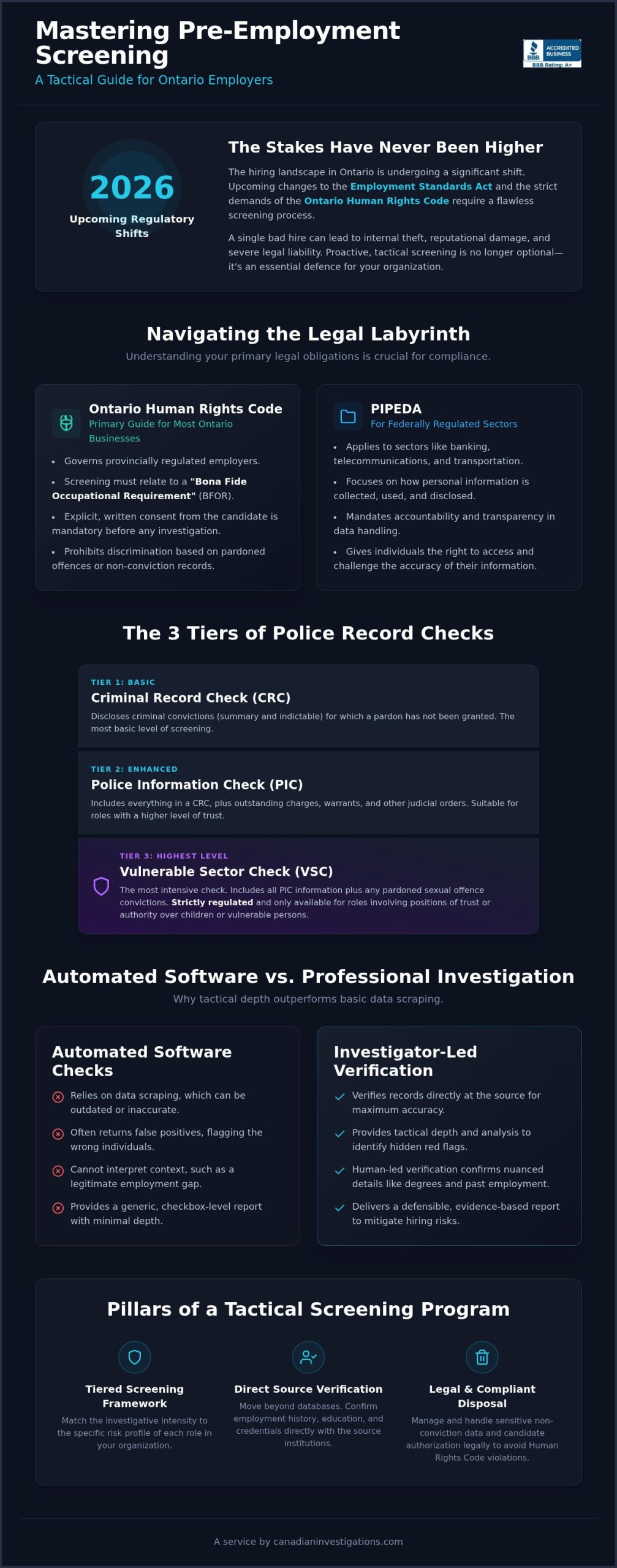
Automated Software vs. Licensed Private Investigators
Speed is a seductive metric in modern HR, but it’s often the enemy of tactical precision. Automated software platforms promise instant results by scraping public databases, yet these systems frequently return outdated or irrelevant data. In the context of pre-employment screening ontario, a “clear” result from a software tool might simply mean the database hasn’t updated its records since a candidate’s recent conviction. Licensed private investigators provide a field-verified alternative that goes beyond digital footprints to confirm the ground truth through manual verification and direct source contact. This human-led approach identifies nuances that algorithms inherently ignore.
The Limits of Database Scraping
Many “instant” background check companies rely on US-based software that lacks the specific legal nuances of Ontario’s jurisdiction. This creates a significant blind spot for your HR team. Automated tools can’t distinguish between a minor regulatory infraction and a serious criminal offence that hasn’t been properly categorized by a web scraper. Professional investigators utilize tactical networking and direct courthouse searches to uncover “off-book” information, such as pending litigation or local police interactions, that automated systems consistently miss. Relying on cached data is a gamble that high-stakes businesses simply can’t afford to take.
Data without expert interpretation is a significant corporate liability. A licensed investigator doesn’t just deliver a raw data dump; they provide a comprehensive analysis that considers the specific context of the findings. This professional oversight is crucial if a hiring decision is ever challenged in a tribunal or court. Evidence gathered by a licensed agency is far more likely to be deemed admissible because it’s collected through documented, legal, and professional channels. Relying on a software-generated PDF provides little protection when you’re forced to justify a non-hire decision under the Ontario Human Rights Code. A tactical report provides the clarity your legal team needs to mount a successful defence.
Why Licensing Matters: The PSISA Factor
In Ontario, the Private Security and Investigative Services Act (PSISA) governs who can legally conduct investigative work. Hiring an unlicensed “background check” firm isn’t just a poor strategic choice; it’s a legal risk that could expose your business to regulatory penalties and reputational damage. Canadian Special Investigations operates with absolute discipline, ensuring every report meets the high standards required by the PSISA. Our corporate investigations team provides the tactical oversight necessary to protect your organization from high-stakes hiring errors while maintaining full legal compliance.
Implementing a Tactical Screening Program with Canadian Special Investigations
Establishing a robust pre-employment screening ontario program requires more than just selecting a service provider; it demands a disciplined, tiered strategy that aligns with your organization’s specific risk tolerances. Risk is not uniform across your payroll. A warehouse associate requires a different investigative depth than a Chief Financial Officer with access to multi-million dollar wire transfers. By following a structured implementation plan, you ensure that your vetting process is both legally defensible and tactically sound.
- Step 1: Define the Risk Profile: Categorize every role based on its access to sensitive data, physical assets, or vulnerable populations.
- Step 2: Secure Professional Oversight: Partner with a licensed Ontario investigative agency to ensure objective, third-party verification that internal HR teams often lack.
- Step 3: Standardize Documentation: Ensure your consent forms and disclosure notices are current with 2026 provincial regulations to prevent procedural litigation.
- Step 4: Integrate the Data: Use your screening results as the foundation for a broader corporate investigator Toronto strategy that monitors for long-term internal threats.
Customizing Your Investigation Scope
Precision in screening means matching the intensity of the investigation to the potential impact of a “bad hire.” For entry-level positions, a standard criminal record check and employment verification may suffice. However, for executive-level appointments or roles involving high-value inventory, you must expand the scope. In cases where internal fraud is suspected or high-level intellectual property is at stake, integrating corporate surveillance services toronto into the onboarding or auditing process provides a level of certainty that databases cannot offer. Maintaining a consistent, policy-driven approach prevents claims of unfair treatment while ensuring no critical red flags are ignored.
The CSI Advantage: Precision and Discretion
Canadian Special Investigations (CSI) operates as a sophisticated ally for Ontario businesses that cannot afford to gamble on talent. We specialize in high-level background research that identifies deceptive candidates through professional field experience and advanced database analysis. Our investigators are trained to spot the subtle inconsistencies in resumes and interview statements that automated software misses. We provide the clarity you need to make decisive hiring choices with absolute confidence. Our methodology prioritizes discretion, ensuring that your organization’s reputation remains protected throughout the investigative process.
Don’t leave your corporate culture or assets to chance. Contact Canadian Special Investigations today for a confidential consultation on your pre-employment screening ontario needs and secure the tactical advantage your business deserves.
Securing Your Corporate Future with Investigative Precision
In 2026, the margin for error in hiring has vanished. You’ve seen how the distinction between simple database scraping and field-verified evidence can determine whether your business thrives or faces a human rights tribunal. Mastering pre-employment screening ontario is about more than just checking boxes; it’s about building a defensive perimeter around your most valuable assets. By implementing a tiered risk profile and prioritizing transparency, you ensure that every new addition to your team is a verified asset rather than a liability.
As a fully licensed Ontario private investigation agency, Canadian Special Investigations provides the tactical background reports by experienced investigators you need to make decisive moves. We deliver confidential and legally compliant results that stand up to rigorous scrutiny. Don’t leave your organization’s integrity to chance. Secure Your Next Hire with Professional Ontario Screening. Take control of your recruitment strategy today and hire with absolute confidence.
Frequently Asked Questions
Is pre-employment screening legal in Ontario?
Yes, pre-employment screening ontario is entirely legal as long as you adhere to the Ontario Human Rights Code and the Police Record Checks Reform Act. You must ensure the information gathered is directly relevant to the specific duties of the role. For businesses in Toronto or Mississauga, this means focusing on bona fide occupational requirements. You cannot use the process to discriminate against protected grounds, such as race, age, or disability status.
Can an Ontario employer ask for a criminal record check before an interview?
You should wait until after a conditional offer of employment is made to request a criminal record check. Requesting this information before an interview can expose your organization to claims of bias or discrimination under provincial law. Most sophisticated firms in Burlington and Oakville use a tiered approach; they interview first and then initiate the investigative phase only for the final candidate to ensure the process remains objective and legally defensible.
What is the difference between a CRC and a Vulnerable Sector Check?
A Criminal Record Check (CRC) discloses only summary and indictable convictions. In contrast, a Vulnerable Sector Check (VSC) is a much more intensive search that includes pardoned sex offences and non-conviction information. Under Ontario law, you can only request a VSC if the position involves a high degree of trust or authority over children or vulnerable persons. It is a strictly regulated tool that requires specific legal justification.
How far back do background checks go in Ontario?
Criminal convictions in Ontario typically appear on a record indefinitely unless the individual has received a formal record suspension or pardon. For other components like credit history or past employment, investigators generally focus on the last seven to ten years of activity. In high-stakes corporate environments in North York or Richmond Hill, we prioritize recent, verifiable data that provides the most accurate picture of a candidate’s current risk profile.
Can I refuse to hire someone because of their social media posts in Ontario?
You can refuse to hire a candidate based on social media content if it reveals behavioural red flags like hate speech, harassment, or illegal activities that threaten your reputation. However, you must be extremely careful. If your search uncovers protected information like a candidate’s religion or sexual orientation, using that data to disqualify them is a direct violation of the Ontario Human Rights Code. Professional investigators use masked searches to mitigate this risk.
Do I need a candidate’s consent to perform a background check?
You must obtain explicit, written consent from every candidate before performing any background check. This is a non-negotiable legal requirement in Ontario. A professional pre-employment screening ontario program includes a clear Notice of Investigation that outlines the scope of the search. Transparency not only protects your business from legal liability but also builds a foundation of trust with high-calibre talent in competitive markets like Kitchener and Waterloo.
How long does a professional pre-employment screening take to complete?
A professional screening typically takes between three and five business days to complete, depending on the depth of the investigation. While automated software might promise instant results, these often lack the field-verified accuracy required for high-level roles. Manual verifications of education and past employment in Hamilton or Brampton take time because they involve direct contact with institutions and previous employers to ensure the data is current and authentic.
What happens if a candidate has a “hit” on their criminal record check?
If a hit appears, you must evaluate its relevance to the job’s essential duties before making a final decision. Under provincial law, you cannot automatically disqualify a candidate for having a record of offences unless it directly impacts their ability to perform the role safely and effectively. You must provide the candidate with the opportunity to review the report and dispute any inaccuracies before you finalize your hiring choice.

