A corporate investigation should establish what happened, not simply confirm a suspicion. For employers seeking internal corporate investigations in Toronto, the work can examine alleged misconduct, workplace harassment, conflicts of interest, suspected fraud, and other concerns affecting a business. Investigators gather and assess relevant evidence, then document findings in a report that distinguishes established facts from unresolved issues.
Employers need a fair, controlled process when allegations involve employees, business records, or sensitive information. The investigation’s scope and methods should fit the concern, with applicable workplace policies, privacy considerations, and legal requirements guiding how evidence is handled and findings are presented.
This article explains what corporate investigations can cover, how an investigation typically moves from initial concerns to evidence gathering and reporting, and what a fact-based report may address. It also outlines warning signs that can prompt an investigation, factors to consider when choosing an approach, and how external investigative support can help employers reach a clearer, more defensible understanding of the facts.
Key Takeaways
- Match the investigation’s scope and methods to the specific concern, whether it involves workplace conduct, suspected fraud, or a conflict of interest.
- Use applicable workplace policies and legal requirements to guide how complaints are received, examined, and documented.
- Separate verified evidence from allegations and assumptions so decision-makers can assess findings on a clear factual record.
- Protect sensitive information while giving the people involved a fair opportunity to respond to relevant concerns.
- Use an investigation report to understand the findings, identify unresolved issues, and consider appropriate next steps.
Workplace investigations for public and private sector employers
Toronto employers should investigate credible complaints of harassment, violence, discrimination, or misconduct. Begin when a complaint, observed incident, or documented pattern raises a workplace concern.
Harassment, Bullying and Misconduct Complaints
Workplace investigations can examine allegations of harassment, bullying, threats, discrimination, retaliation, or other misconduct. For example, a complaint about repeated humiliating comments calls for examining what was said, when it happened, and who witnessed it. A separate allegation of intimidation may require assessing specific conduct and its effect on workplace integrity.
Investigators can interview the complainant, the respondent, and relevant witnesses, then compare their accounts with available records. Define the allegations before interviews begin to keep questions focused and give each person a meaningful opportunity to address the events. An external investigator may be appropriate when internal relationships could create a conflict or undermine confidence in an impartial process.
Applicable Ontario Laws
Ontario employers must have workplace harassment and violence policies that explain how to report and investigate complaints. The Occupational Health and Safety Act (the “OHSA”) may govern workplace investigations in Ontario. Ontario’s Bill 168 amended the OHSA in 2010 to strengthen employee protections from workplace violence and harassment. Bill 132 amended the OHSA in 2016, creating new rules and strengthening employers’ required legal actions involving sexual violence and harassment.
The applicable legal framework depends on the workplace and its jurisdiction. Depending on the context, investigations may need to account for the Human Rights Code, the Canadian Human Rights Act, or the Canada Labour Code. Legislation, common law, or an employer’s own policies may also require a workplace investigation. Identify the applicable framework before setting the investigation’s scope, interview plan, and evidence-handling approach.
Complaint Types and Investigation Timing
Complaints can involve harassment, bullying, workplace violence, discrimination, retaliation, or breaches of internal conduct policies. For example, assess a sexual harassment concern against the employer’s reporting and investigation procedures. Unrelated allegations may require separate questions and evidence records to keep findings clear and specific.
When should a Toronto company conduct an internal investigation? Start promptly when a complaint or other credible information raises a workplace concern, and assess the applicable policy and legal duties. An investigation may also be needed when an employee is not given the right to refuse unsafe work. Prompt planning helps preserve relevant evidence and identify who needs to be interviewed.
Start by recording the concern, identifying the conduct alleged, and deciding whether immediate workplace measures are needed. Then preserve relevant documents and set an impartial investigation plan. Public- and private-sector employers should account for their own policies and applicable jurisdiction rather than assume one process fits every workplace.
Employee misconduct and conflicts of interest
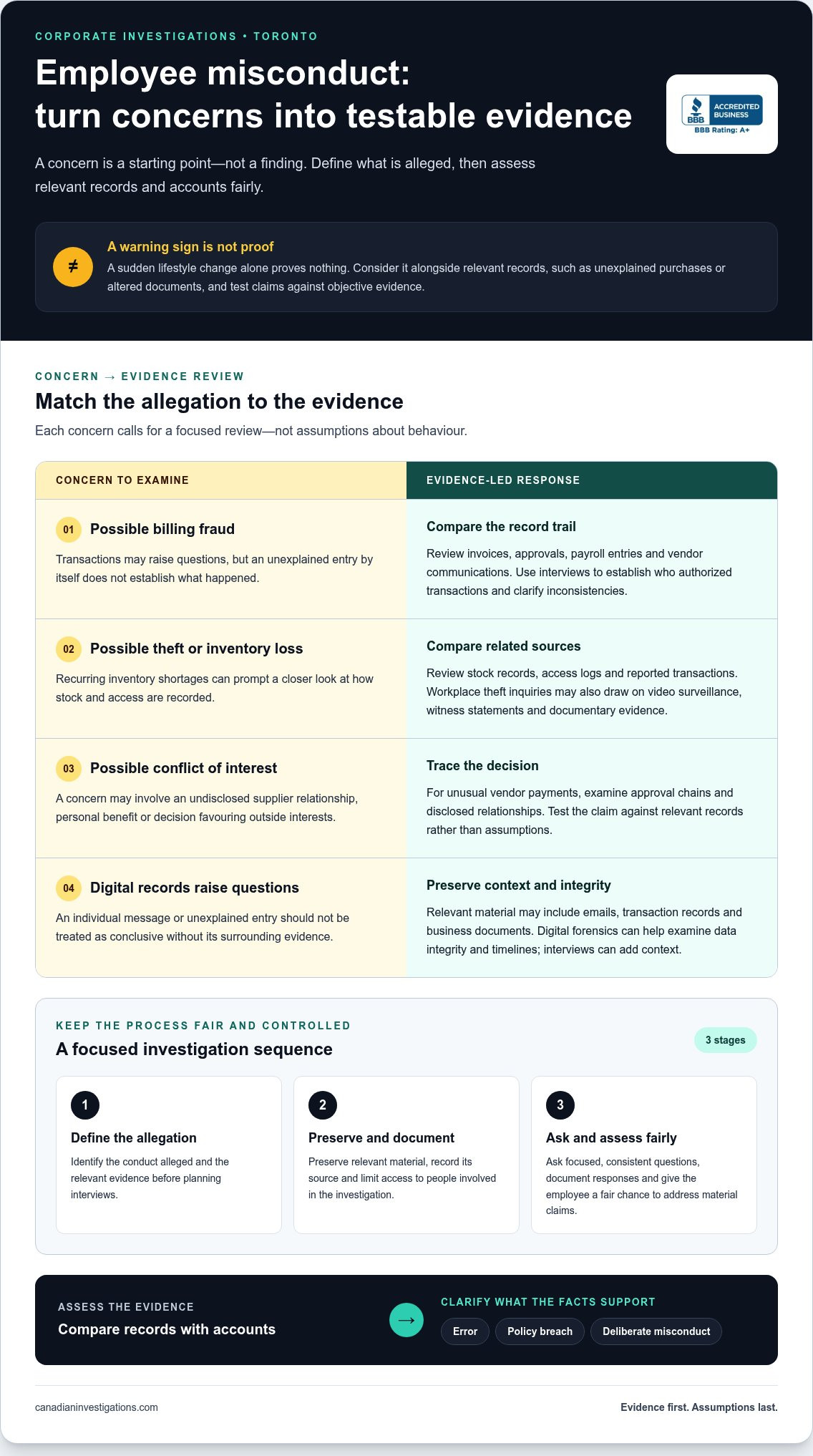
Employee misconduct investigations examine specific conduct, records, and competing explanations. A sudden lifestyle change alone proves nothing, but alongside unexplained purchases or altered records, it may warrant careful review. Conflicts of interest can involve undisclosed supplier relationships, personal benefits, or decisions favouring an employee’s outside interests. Test claims against objective evidence, not assumptions about behaviour.
Planning begins by defining the allegation and identifying relevant evidence. For suspected billing fraud, an organization can compare invoices, approvals, payroll entries, and vendor communications. Interviews can establish who authorized transactions and clarify inconsistencies. Ask focused, consistent questions, document responses, and give the employee a fair chance to address material claims. This helps distinguish an error from a policy breach or deliberate misconduct.
Digital evidence may include emails, transaction records, and other business documents relevant to the allegation. Digital forensics can help examine data integrity and timelines, while interviews add context to the records. Preserve relevant material, record its source, and limit access to people involved in the investigation. Do not treat a single message or unexplained entry as conclusive without considering the surrounding evidence.
Workplace theft inquiries may draw on video surveillance, witness statements, and documentary evidence. For example, recurring inventory shortages in a retail setting could prompt a comparison of stock records, access logs, and reported transactions. In a professional office, unusual vendor payments might lead investigators to examine approval chains and disclosed relationships. Match the method to the suspected conduct and available evidence.
Organizations across public and private sectors may need investigations, including employers in retail, finance, health care, or logistics. These examples reflect different workplace settings, not an assumption that misconduct occurs in any industry. External support can be useful when an internal investigator has a personal connection, senior staff are implicated, or impartiality could reasonably be questioned. A defined scope helps keep the inquiry objective.
Investigation findings can inform employment decisions, including discipline or termination, but an allegation alone is not a finding. Compare substantiated facts with relevant policies, employment terms, and the seriousness of the conduct. Record why the evidence supports a conclusion and how the employee’s response was considered. This provides a clearer basis for action than workplace rumour or a single unverified claim.
Ontario employers and their directors could face fines of up to $1,500,000.00 for failing to put mandated investigation measures in place under the Occupational Health and Safety Act. They could also face jail terms of up to 12 months. These potential consequences make it important to identify applicable duties and document the steps taken. For organizations assessing suspected workplace wrongdoing, a structured corporate investigation can help organize evidence and clarify findings.
What are corporate investigation services?
Corporate investigations examine reported concerns, gather relevant evidence, and establish findings to inform an organization’s response. For workplace allegations, the scope should reflect the complaint, applicable policies, and legal requirements.
Whistleblower and Workplace Complaints
A whistleblower complaint may raise concerns about fraud, unsafe work, harassment, discrimination, or misconduct. Define each allegation, identify relevant records, and interview people with direct knowledge. For an occupational health and safety complaint, this may include reviewing the reported hazard and the employer’s response.
Retaliation concerns also require attention. Record the alleged adverse treatment, its timing, and the people involved. A union member or other complainant should have a clear way to provide relevant information. Assess each claim using evidence, not assumptions about motive or position.
Confidentiality, Privacy and Legal Compliance
Confidentiality means limiting sensitive details to people who need them for the investigation and response. It does not mean promising absolute secrecy, since relevant information may need to be shared to assess allegations fairly. Tell interview participants how their information may be used, and manage records securely.
Privacy considerations affect what information is collected, who can access it, and how it is retained. Gather material relevant to the defined scope, not unrelated personal details. The process should also account for applicable employment, privacy, and evidence-admissibility requirements. Clear documentation helps show how information was handled.
Choosing and Conducting an Investigation
How can a company choose a qualified corporate investigations firm in Toronto? Look for a licensed and insured private investigation firm that follows applicable laws and can explain its proposed scope, methods, and reporting process.
Who conducts workplace and corporate investigations in Toronto? An employer may assign an impartial internal investigator or engage an external private investigator. Independence matters when internal relationships could affect confidence in the findings.
What are the steps in a corporate internal investigation in Ontario? Define the allegations, preserve relevant records, plan interviews, gather and assess evidence, then document findings. The investigator should compare accounts and records before drawing conclusions.
Investigation Timelines
How long do internal corporate investigations typically take in Toronto? Timelines depend on the number of allegations, witnesses, records, and investigative steps involved. A focused complaint with accessible documentation calls for a different plan than a matter involving several departments or conflicting accounts.
Set the scope early, identify evidence sources, and schedule interviews in a logical sequence. Delays can arise when key records are difficult to retrieve or participants are unavailable. Regular progress reviews help identify obstacles without compromising the inquiry’s thoroughness or fairness.
Fact-based investigation reports and legal analysis
A useful investigation report links each finding to evidence, addresses conflicting accounts, and explains the analysis. Its structure should help employers and lawyers understand what the record supports.
Investigation Findings and Legal Analysis
A fact-based report separates the complaint, evidence gathered, analysis, and findings. For each allegation, it can identify the relevant policy, summarize interview evidence, and explain how documents support or conflict with witness accounts. For example, a bullying allegation may involve contrasting statements and dated messages. State what evidence was considered and what conclusion it supports.
Legal analysis can assess findings against applicable legislation, workplace policies, and case law. An external workplace investigator may prepare a report that includes this analysis, helping decision-makers consider the relevant framework alongside established facts. Connect each specific finding to the rule or policy at issue, rather than treating every allegation as proven.
Reports can distinguish corroborated evidence from disputed or inconclusive details. If an employee denies a claim but records support part of it, explain the distinction. Clear reasoning helps employers assess appropriate next steps without overstating what the investigation established. Where findings support them, recommendations may identify procedural improvements, training needs, or further review.
Reporting, Testimony and Legal Support
Investigation reporting should provide a traceable account of the work. A practical report can set out the mandate, allegations examined, evidence reviewed, interview summaries, findings, and recommendations. Identify relevant limitations, such as unavailable records or conflicting evidence, and explain how they affected the analysis. This makes the report easier to assess and use.
In Canada, investigators may provide expert testimony in legal proceedings when needed. A report intended for possible proceedings should use precise language, connect conclusions to evidence, and preserve a clear record of investigative steps. Investigators should be ready to explain their methods and reasoning, including how they assessed inconsistent accounts or documentary evidence.
Lawyers can advise employers on applicable legal considerations, review investigation plans, and interpret findings in context. Their role differs from the investigator’s evidence-gathering and reporting work. For example, an investigation into a sexual harassment complaint can document relevant accounts and evidence, while legal review considers applicable legislation and employer policies.
Before relying on a report, decision-makers should check that each conclusion answers a defined allegation and follows from the evidence described. A finding about misconduct should not rest solely on an assumption or recommendation. Linking evidence, analysis, and action helps organizations make decisions grounded in the investigation record.
Confidentiality and due process
Confidentiality and fairness shape how an employer collects, handles, and shares investigation information. Start by limiting access to people with a defined role, such as the investigator, decision-maker, or adviser. For example, a manager who is not involved in assessing a complaint generally does not need interview notes. Restricting circulation can reduce workplace speculation and protect the reputations of complainants, respondents, and witnesses.
Confidentiality does not mean promising that information will never be disclosed. A respondent needs enough detail about an allegation to provide a meaningful response. If a witness describes a specific incident, assess what information the respondent needs to address the account fairly. Explain the process at the outset, including how participants’ information may be used and who may receive relevant findings.
Privacy-conscious evidence handling starts with a defined investigation scope. Collect records connected to the concerns, such as relevant emails, schedules, or incident reports, rather than unrelated personal material. Record what was collected, where it came from, and who accessed it. If a witness shares a document, note its source and preserve it with the investigation file so its context remains clear.
Due process requires a neutral method for testing allegations. Give the complainant an opportunity to explain the concern, then put the relevant allegations to the respondent and invite a response. Ask witnesses about events they observed directly, not workplace rumour. If accounts conflict, document the differences and assess them against available evidence. This approach helps a thorough workplace investigation distinguish supported findings from unresolved disputes.
Protecting the process also means avoiding premature conclusions. A supervisor should not describe an employee as responsible before the evidence is assessed. Keep interim workplace decisions separate from final findings, and document the reason for each step. For example, if schedules are adjusted during an inquiry, record the operational reason without treating the adjustment as proof of misconduct. Consistent records help decision-makers review the sequence later.
Before closing the investigation, review whether the report includes relevant evidence, the respondent’s account, and reasons for each finding. Limit distribution of the final report to people who need it for workplace decisions. A documented review can identify gaps, such as an unanswered material allegation or an unverified record, before the employer acts. These safeguards support fair decisions while helping contain reputational harm.
For support handling sensitive workplace evidence and process concerns, discuss an investigation.
Canadian Special Investigations: Employment Investigations
Canadian Special Investigations conducts Employment Investigations when workplace allegations, employee conduct, or related concerns require impartial fact-finding. Its Corporate Investigations can address suspected wrongdoing affecting an organization, while Legal Investigations can assist with matters involving legal proceedings. These services help employers gather and document evidence to inform decisions, rather than relying on rumour or incomplete accounts. The investigation should reflect the concern, its context, and the information available. For sensitive workplace matters, an external investigator can provide an independent perspective and help clarify what the evidence supports. If your organization is assessing a workplace concern, contact Canadian Special Investigations to discuss its investigative services and the issue you need examined.
Set a Clear Direction for Your Next Step
Before an investigation begins, decide what the organization needs to understand and what decision the findings will inform. This focus keeps the inquiry proportionate, directs attention to relevant evidence, and gives decision-makers a practical basis for moving forward. For employers considering internal corporate investigations in Toronto, define the concern, identify the outcome needed, and determine whether impartial investigative support would help.
Canadian Special Investigations offers Employment Investigations, Domestic / Infidelity Investigations, and Corporate Investigations. The appropriate service depends on the issue requiring examination. A clear initial discussion can establish the concern’s scope and the investigative support that fits it. Contact Canadian Special Investigations to discuss your organization’s needs and take a considered step toward greater clarity.
Frequently Asked Questions
What do internal corporate investigations in Toronto involve?
They examine specific concerns affecting an organization, such as suspected fraud, conflicts of interest, or workplace misconduct. The investigator’s mandate defines which people, transactions, and records are relevant. For example, a concern about supplier favouritism could involve reviewing purchasing approvals and disclosed relationships. The work concludes with documented findings to help management decide what action, if any, the evidence supports.
What Ontario laws govern internal corporate investigations and workplace investigations?
The applicable rules depend on the workplace, the allegations, and whether the employer falls under provincial or federal jurisdiction. Ontario workplace complaints may involve the Occupational Health and Safety Act and the Human Rights Code. The Canadian Human Rights Act or Canada Labour Code may apply in other relevant contexts. Identify the correct legal framework and the employer’s policies before setting an investigation’s scope or deciding next steps.
What privacy and employee rights rules apply to internal investigations in Ontario?
Employers should collect information relevant to the complaint, restrict access to people who need it, and handle records carefully. Employees involved should receive enough information about the allegations to respond meaningfully. For instance, an interview about a disputed approval should identify the transaction and conduct at issue. Manage confidentiality carefully rather than promising absolute secrecy, since fair assessment may require sharing relevant details with respondents and decision-makers.
When should a company hire external investigators or lawyers for an internal investigation?
External investigators can help when a senior manager is implicated, internal relationships could affect impartiality, or the organization lacks suitable investigative capacity. Lawyers may help interpret applicable legislation, policies, and potential legal exposure. Their role differs from gathering evidence and assessing witness accounts. For example, a company could engage an external investigator to examine allegations involving an executive while counsel advises on the legal framework.
How should Toronto companies preserve evidence and conduct employee interviews?
First, identify records tied to the allegation and prevent routine deletion where appropriate. Keep original documents intact, record where each item came from, and note who handled it. Before interviews, prepare consistent questions based on the complaint and available records. Speak with witnesses separately, distinguish firsthand observations from workplace hearsay, and document responses accurately. If an account conflicts with a record, ask focused follow-up questions rather than assuming either is conclusive.
What risks arise from mishandling an internal corporate investigation?
A poorly managed investigation can produce unreliable findings, unfair employment decisions, damaged workplace relationships, and avoidable legal disputes. Missing records or leading interview questions can weaken the evidence behind a decision. Sharing allegations too widely can harm reputations and undermine confidence in the process. In Ontario, failing to meet mandated investigation measures can also expose employers and directors to penalties under the Occupational Health and Safety Act.

