What if proof of infidelity could clarify your next legal step, but not deliver the financial advantage you expect? A search for “infidelity investigation ontario” often begins with a pressing question: how can you document what’s happening in a way your lawyer can assess?
It’s reasonable to worry about being discovered, what a court may accept, and how long surveillance could take. In Ontario, adultery can provide a ground for divorce without waiting through a year of separation, but it generally doesn’t determine property division, spousal support, or parenting decisions. Evidence must also be gathered lawfully, and no investigator can guarantee that a court will admit it.
This article explains how professional surveillance can document relevant activity through photos, video, and detailed investigation logs for your lawyer’s review. You’ll learn what to ask about evidence, planning, and case duration before authorizing surveillance. Canadian Special Investigations is licensed by the Ontario Solicitor General and conducts investigations across Ontario, from Toronto to Niagara Falls. The objective is clear: replace uncertainty with reliable information and a professional record that helps you decide what to do next.
Key Takeaways
- An infidelity investigation ontario should be planned around a clear objective, not suspicion alone. Define what you need documented before surveillance begins.
- Surveillance tactics may need to adapt to the setting, from dense GTA traffic and neighbourhoods to rural routes around Barrie or Niagara.
- Ask how photos, video, notes, and other records will be documented and preserved. A clear chain of custody can help your lawyer assess the evidence.
- Before hiring an investigator, verify the agency’s Ontario licence and ask how the initial intake will shape a discreet, focused plan.
- Find out how the investigator will assess the subject’s routine before active surveillance, and what factors may affect the investigation’s duration.
Infidelity Investigation Ontario: Understanding the Legal Framework
An infidelity investigation gathers evidence about a partner’s suspected extramarital activities through professional observation and documentation. In Ontario, the value of that evidence depends on the legal question it may help answer, not simply whether it confirms an affair. A disciplined investigator records relevant observations without trespassing, interfering, or overstating what the evidence shows.
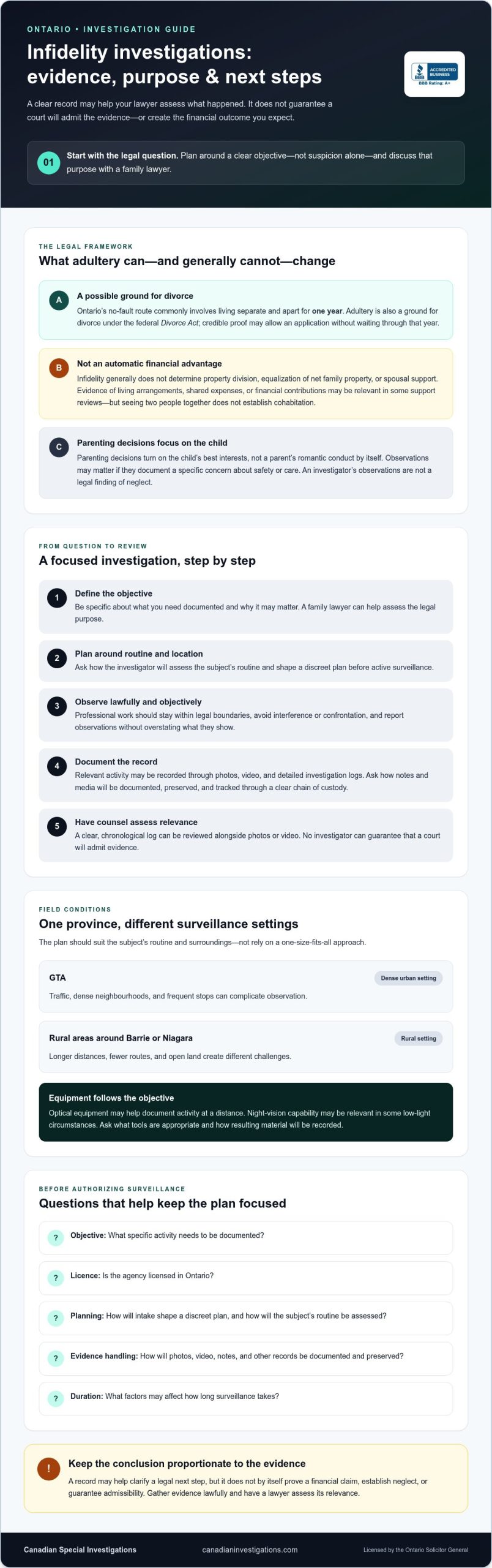
Ontario’s divorce system is commonly described as no-fault: spouses can apply for divorce after living separate and apart for one year, without proving misconduct. Adultery is also a ground for divorce under the federal Divorce Act, so credible proof may allow an application without waiting for that year. It generally doesn’t determine property division, spousal support, or parenting outcomes. A focused infidelity investigation ontario file should therefore be guided by a specific legal purpose discussed with a family lawyer.
An Ontario-licensed private investigator conducts investigative work under the Private Security and Investigative Services Act, 2005 and its applicable regulations. Discretion matters as much as compliance. A professional approach means keeping the assignment confidential, using measured surveillance, and reporting observations objectively rather than provoking or confronting anyone. For general background on the profession and Canadian licensing, see Private investigators in Canada.
No-Fault Divorce vs. Material Evidence
Evidence of a new relationship doesn’t automatically change support obligations. In some cases, however, facts about a partner’s living arrangements, shared expenses, or financial contributions may be relevant when support is reviewed. Cohabitation is a factual issue, not a conclusion that follows from seeing two people together. Likewise, infidelity itself doesn’t alter equalization of net family property. Evidence may help a lawyer examine inconsistent lifestyle or financial claims, including concerns that family assets were spent or depleted, but it doesn’t establish those claims on its own.
Custody and Parental Conduct
Parenting decisions turn on the child’s best interests, not on a parent’s romantic conduct by itself. Surveillance may become relevant if it documents behaviour that raises a specific concern about a child’s safety or care, such as an apparent failure to supervise or a child’s exposure to a demonstrable risk. Context matters: an investigator’s observations are not a legal finding of neglect, and a lawyer should assess whether the information is relevant before it is used.
If the concern shifts from a partner’s relationship to parenting conduct, the investigative objective must shift too. Discuss the child-focused issue with counsel and consider whether child custody surveillance in Ontario is appropriate. A clear mandate helps keep evidence collection focused, discreet, and relevant.
Tactical Surveillance Methods for Diverse Ontario Terrains
A surveillance specialist does more than follow a vehicle. The work calls for advance planning, sound judgement, and an approach suited to the subject’s routine and surroundings. In the GTA, traffic, dense neighbourhoods, and frequent stops can complicate observation. In rural areas around Barrie or Niagara, longer distances, fewer routes, and open land create different challenges. A sound plan adapts without drawing attention or crossing legal boundaries.
Equipment should serve the investigative objective, not drive it. Optical equipment may help document activity at a distance, while night-vision capability may be relevant in some low-light circumstances. Ask what tools an investigator can use, when they’re appropriate, and how any resulting material will be documented. Canadian Special Investigations is licensed by the Ontario Solicitor General and conducts surveillance across Ontario. Investigators must work within the applicable provincial framework, including the Private Security and Investigative Services Act.
The core deliverable is more than a collection of images. A professional surveillance log records observations in a clear, chronological format for legal counsel to review alongside photos or video. It should distinguish what the investigator directly observed from interpretation. For an infidelity investigation ontario assignment, that organized record can help a lawyer assess whether the evidence is relevant to the client’s specific legal concern.
UAV and Drone Monitoring in the GTA
In some settings, a UAV may offer a broader view of movement than a ground position alone, potentially helping investigators understand activity across a large area. It isn’t a default solution for Toronto or Mississauga: airspace, privacy, safety, and the specific circumstances all matter. Any drone use must comply with applicable Transport Canada requirements. Before an assignment, ask whether UAV surveillance is lawful, feasible, and necessary for the objective.
Ghillie Suits and Rural Stealth
On rural properties, a vehicle-based position may be conspicuous or poorly placed. Ghillie suit concealment can provide another option for surveillance where the terrain and assignment make it suitable. It doesn’t authorize entry onto private property or guarantee concealment. The investigator must select a lawful observation position and adapt to the setting. Canadian Special Investigations offers Camo Ghillie Suit Surveillance Services. Ask how this method could fit your circumstances.
Choosing between a vehicle, a concealed ground position, or a UAV depends on the facts, not a one-size-fits-all tactic. To understand the available surveillance investigation services and discuss which approach may suit your case, review the investigator’s methods and proposed documentation before authorizing work.
Admissible Evidence: What Holds Up in Ontario Courts?
Evidence can be compelling without being admissible, and admissibility is ultimately for the court to decide. Direct evidence records what an investigator personally observed, such as a subject arriving at a location or meeting someone. Hearsay generally refers to an out-of-court statement offered to prove that what it says is true. An investigator’s report may document observations and help a lawyer assess the case, but it doesn’t automatically make every statement or image admissible. The applicable rules depend on the proceeding; the federal Canada Evidence Act, for example, applies in matters within its scope, not as a blanket rule for every Ontario family court issue.
A professional surveillance log should connect each observation to when and where it occurred, with supporting photographs or video identified clearly. Chain of custody means keeping a record of how evidence was collected, handled, stored, and transferred. This helps counsel evaluate whether digital files or physical material are complete and reliable. No documentation process can guarantee a court will accept the evidence.
DIY tracking and “spy apps” can create serious problems. Installing a device on a vehicle without proper authority, accessing someone’s account or phone, or recording private communications may breach privacy or other laws and expose the person responsible to legal consequences. Before taking any action, get legal advice and ask an Ontario-licensed investigator to explain lawful options. A professional infidelity investigation ontario assignment should rely on objective observation, not unauthorized access or surveillance that crosses legal boundaries.
Video Evidence and Privacy Laws
There’s no simple rule that anything visible in public is fair to record in every circumstance. A reasonable expectation of privacy is assessed contextually, considering the place, the activity, and whether a person could reasonably expect that conduct to remain private. A park bench may involve less privacy than a fenced suburban backyard, but the setting alone doesn’t settle the question. Investigators must not trespass to obtain a view or use recording methods unlawfully. They should also avoid persistent, confrontational conduct that could become harassment or raise stalking concerns.
The Role of GPS Tracking in Ontario
GPS tracking requires particular caution. Vehicle ownership, consent, and authority to track can involve fact-specific legal questions; a client shouldn’t assume that owning or sharing a vehicle automatically permits placing a tracker on it. Investigators should confirm the lawful basis for any proposed tracking and decline methods that lack proper authority. For a technical overview of the service and its uses, see the guide to GPS tracking for investigations.
The Investigative Process: Planning for Discretion
Effective surveillance starts before an investigator takes position. During the initial intake, the investigator clarifies the concern, the legal objective, and what information would be useful to the client’s lawyer. This is also the time to discuss discretion, communication preferences, practical limits, and circumstances that could compromise an assignment. A clear plan helps prevent unnecessary activity and keeps the investigation focused.
Investigators may assess a subject’s routine, sometimes described as a “pattern of life,” using information provided by the client and lawful preliminary research. The goal is to identify when and where relevant activity may occur, not to assume wrongdoing. A defined communication protocol can limit unnecessary contact and establish how updates will be delivered. No process can promise zero exposure, but disciplined planning can reduce avoidable risks. The investigator should prioritize lawful, methodical work over a quick result that could compromise the file.
Intake and Subject Profiling
Useful details can include the subject’s vehicle make, model, colour, and licence plate, known schedules, recurring locations, and the names or descriptions of relevant associates. Share only information you can provide lawfully, and distinguish what you know from what you suspect. Investigators can use these details to plan observation periods and consider locations where surveillance may be difficult or conspicuous, such as restricted-access sites or busy areas with limited safe vantage points.
Careful preparation may help focus field time, though it can’t guarantee a particular duration or outcome. For an overview of factors to discuss when budgeting an investigation, consult this guide to private investigator Toronto cost and rates. Avoid choosing an assignment solely by its estimated duration; the objective, practical constraints, and reporting needs matter too.
Surveillance Execution and Reporting
There is no universal 24-hour field cycle. Surveillance timing should reflect the information available, the assignment’s scope, and the subject’s likely routine. An investigator should explain the proposed coverage rather than imply continuous observation. If circumstances change, the agency and client can follow their agreed communication protocol to determine whether the plan needs adjustment.
The final report should present observations in a chronological, factual format, supported where available by time-stamped photographs or video and professional surveillance logs. A timestamp provides context, not a conclusion: counsel should review what the footage shows, what it cannot establish, and how it fits the wider legal file.
For a discreetly planned infidelity investigation ontario assignment, provide accurate background and ask how the agency will communicate, document observations, and address risks before surveillance begins. Discuss domestic and infidelity investigation options with Canadian Special Investigations.
Selecting an Infidelity Investigator in the GTA and Ontario
Choosing an investigator is about more than equipment or proximity. For an infidelity investigation ontario assignment, confirm that the agency holds the required Ontario private investigator licence. The Ontario Solicitor General regulates private investigators, so check the agency’s licensing through the Solicitor General’s official resources and ask who will conduct the work. Also ask how observations will be documented and what reporting you can expect. Evidence may support your lawyer’s assessment, but no agency can guarantee what a court will admit or decide.
Why Local Expertise Matters
Surveillance conditions change across the region. Downtown Toronto’s congestion, parking constraints, and dense streets call for different planning than suburban Oakville or Burlington, where routes and observation points may differ. Familiarity with local patterns can help an investigator plan positioning and respond to changes without making assumptions about where a subject will go. CSI serves the GTA and surrounding communities, with coverage extending across the Golden Horseshoe and from Toronto to Niagara Falls.
Ask how the investigator’s local knowledge will shape the proposed plan. Relevant experience should mean practical understanding of the assignment’s geography, not a promise that the subject’s movements can be predicted.
The CSI Tactical Advantage
A specialist considers how terrain, visibility, and the subject’s routine affect the approach. Canadian Special Investigations has decades of industry experience and offers UAV technology and ghillie suit concealment where appropriate and lawful. These methods aren’t suitable for every case; the investigator should explain why a specific tactic fits the objective and how it will be used within applicable rules.
Before hiring, discuss confidentiality, surveillance planning, and the professional logs provided for your lawyer’s review. Ask what the investigator can document, how limitations will be reported, and how information will be communicated discreetly. Professional oversight can bring clarity, but the evidence must speak for itself.
To discuss a discreet domestic investigation in Ontario, consult with CSI about your circumstances and the investigative options available. A clear mandate is the first step toward understanding what’s happening and deciding how to move forward.
Move Forward with Clear, Lawful Evidence
The right next step is not simply to confirm a suspicion. It’s to define what information could help you make an informed decision, then ensure any investigation is planned and documented with care. In Ontario, infidelity doesn’t usually decide financial or parenting outcomes, and evidence is never guaranteed to be admitted. Its value depends on the issue, how it was gathered, and your lawyer’s assessment.
For an infidelity investigation ontario file, choose an agency with Ontario licensing, a clear approach to discretion, and the ability to adapt surveillance to the circumstances. Canadian Special Investigations is licensed by the Ontario Solicitor General and has decades of industry experience, with UAV and ghillie suit capabilities for appropriate assignments. Its professional logs give legal counsel an organized record to review.
Clarity starts with a focused conversation about your concerns, objectives, and lawful options. Contact Canadian Special Investigations for a confidential consultation to discuss a discreet domestic investigation. You can also call 905-332-4807. With professional oversight, you can replace uncertainty with a clearer basis for deciding what comes next.
Frequently Asked Questions
Is infidelity illegal in Ontario or does it affect divorce settlements?
Adultery isn’t a criminal offence in Ontario. It is a ground for divorce under the federal Divorce Act, which may allow a spouse to apply without waiting until they’ve lived separate and apart for a year. However, infidelity generally doesn’t determine property division or spousal support. Evidence that marital funds were spent or assets depleted may raise a separate financial issue for a lawyer to assess.
Can I use evidence from a private investigator in Ontario family court?
Potentially, but hiring an investigator doesn’t guarantee the court will admit or rely on the evidence. The court considers factors such as relevance and how the material was obtained. Lawful observations, clearly documented in a professional report and supported by properly handled photos or video, can help your lawyer assess its value. Share the complete file with counsel, who can advise whether and how to use it.
How much does a private investigator for infidelity cost in Ontario?
There’s no single cost for an infidelity investigation; the scope and duration depend on the circumstances. Canadian Special Investigations charges for professional surveillance, evidence gathering, and background research, with investigative fees structured hourly or by project. Before authorizing work, ask what the proposed assignment includes, how time and expenses are handled, and how you’ll approve any change in scope. Don’t rely on a general estimate as a case-specific quote.
Will my spouse find out that I hired a private investigator?
No investigator can guarantee that a spouse won’t discover surveillance. A subject may notice a vehicle, recognize an investigator, or infer that information is being gathered. A discreet plan and careful communication can reduce avoidable exposure, but they can’t eliminate risk. Tell the agency about safety concerns and agree on a communication method that doesn’t draw attention. Don’t contact or confront your spouse based on an ongoing assignment without considering your lawyer’s advice.
Is it legal for a private investigator to follow someone in Ontario?
Licensed investigators may conduct surveillance only within applicable legal limits. Whether a particular observation is lawful depends on the circumstances, including location and conduct. Investigators must not trespass, unlawfully record private communications, or engage in conduct that amounts to harassment or stalking. Ontario private investigators are regulated under provincial licensing requirements. Ask an investigator to explain the proposed methods and boundaries before surveillance begins.
How long does a typical infidelity investigation take to get results?
There’s no standard timeline. Results depend on the investigative objective, available schedule information, the subject’s routine, and whether relevant activity can be observed during planned surveillance. CSI serves clients in Toronto, Oakville, Burlington, Brampton, Mississauga, Hamilton, Ancaster, Niagara Falls, Kitchener, Waterloo, Scarborough, North York, Richmond Hill, Barrie, Milton, Etobicoke, and Guelph. Ask the agency how it will review progress and discuss next steps without promising a set result date.
Can a private investigator track a cell phone in Ontario?
A private investigator shouldn’t access someone’s phone, accounts, or location data without lawful authority. Installing a tracking app or otherwise covertly monitoring a person’s phone can create serious legal and privacy risks. GPS tracking is a distinct investigative method and also requires a proper legal basis. Don’t install software or devices yourself. Explain your objective to an Ontario-licensed investigator and ask what lawful options, if any, are available for your circumstances.
What happens if the investigator is “burned” or spotted during surveillance?
If an investigator believes they’ve been identified, the priority is to avoid escalation and protect the integrity of the assignment. They may disengage, document what occurred, and reassess whether continuing is appropriate. The agency should communicate any material change through the agreed client contact method and explain possible next steps. Don’t approach the subject or attempt to resume surveillance yourself. A professional investigation should never risk safety or lawful conduct for a quick result.

