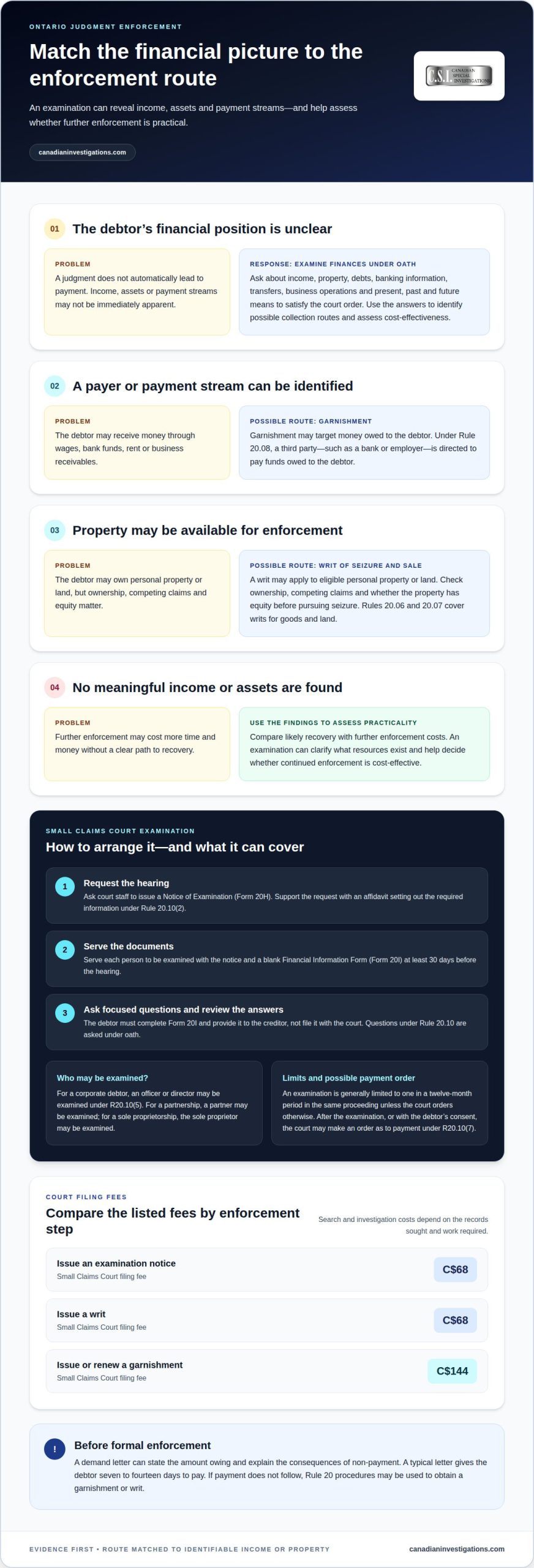
A judgment debtor investigation in Ontario can establish whether a debtor has income, assets or payment streams available for enforcement, even when nothing is immediately apparent. If the debtor has no meaningful income or assets, an examination can help you assess whether continued enforcement is cost-effective. In Small Claims Court, the process uses a Notice of Examination (Form 20H) and a Financial Information Form (Form 20I).
A judgment does not automatically lead to payment. Enforcement depends on identifying assets or income that can legally be reached. An examination in aid of execution gives creditors a structured way to ask about finances under oath; the debtor must provide the required financial information and answer proper questions.
This guide explains how to investigate a debtor’s financial position, how Ontario garnishment and seizure options work, and what to expect at an examination. It also clarifies the practical difference between having a judgment and identifying a viable path to collect it.
Key Takeaways
- Use an examination to clarify the debtor’s financial position and help decide whether further enforcement is practical.
- Compare garnishment with seizure options, matching each step to identifiable income, debts owed to the debtor or property.
- Investigate business and financial relationships to uncover payment streams or assets that may not be obvious at first.
- Understand the creditor’s enforcement steps and the debtor’s duties, including the importance of attending and answering proper questions.
What If the Debtor Has No Income or Assets?
An examination in aid of execution can clarify what resources exist and whether enforcement is practical. Use the findings to assess options such as garnishment or seizure and sale of personal property.
-
Arrange an examination hearing
Request an examination hearing to obtain financial information for enforcing the judgment. In Ontario Small Claims Court, ask court staff to issue a Notice of Examination (Form 20H), then serve each person to be examined with the notice and a blank Financial Information Form (Form 20I). Support the request with an affidavit setting out the required information under Rule 20.10(2). Serve the notice at least 30 days before the hearing.
-
Examine income, property and ability to pay
Prepare questions that connect the debtor’s finances to realistic enforcement steps. Under Rule 20.10, a creditor may question the debtor under oath about income, property, debts, banking information, transfers, business operations, and present, past and future means to satisfy the court order. The examination can identify payment streams for garnishment or assets for seizure and sale. Ask focused questions, and use answers to evaluate whether further enforcement is cost-effective.
-
Identify who can be examined
For a corporate debtor, an officer or director may be examined under R20.10(5). Questions can address financial statements, customers, contracts, equipment, shareholders, directors, and transactions between related companies. For a partnership debtor, a partner may be examined; for a sole proprietorship, the sole proprietor may be examined. The debtor must complete Form 20I and provide it to the creditor, not file it with the court. An examination is generally limited to one in a twelve-month period in the same proceeding unless the court orders otherwise. After the examination, or with the debtor’s consent, the court may make an order as to payment under R20.10(7).
Ontario judgment enforcement options
Ontario Small Claims Court offers garnishment and writs of seizure and sale. Court fees include C$68 to issue an examination notice or writ, and C$144 to issue or renew a garnishment. Search and investigation costs depend on the records sought and work required; investigation pricing depends on the case and is provided after a quote request.
-
Choose an Ontario enforcement method
Connect each enforcement step to identifiable income or property. Garnishment may target money owed to the debtor, including wages, bank funds, rent or business receivables. A writ of seizure and sale may apply to eligible personal property or land. Before pursuing seizure, check ownership, competing claims and whether the property has equity. If an examination reveals no meaningful assets or income, weigh the likely recovery against further enforcement costs.
-
Enforce a Small Claims Court judgment
Send a demand letter before formal enforcement, state the amount owing, and explain the consequences of non-payment. A typical letter gives the debtor seven to fourteen days to pay. If payment does not follow, use Rule 20 procedures to obtain a garnishment or writ. Garnishment under Rule 20.08 directs a third party, such as a bank or employer, to pay funds owed to the debtor. Rules 20.06 and 20.07 cover writs for goods and land.
-
Review fees and typical costs
Separate court filing fees from investigation expenses when estimating the next step. Small Claims Court lists C$68 to issue an examination notice and C$68 to issue a writ; issuing or renewing a garnishment costs C$144. Enforcement searches have no single typical total because the work depends on the debtor’s identity, business links, and records required. Compare each expense with the debtor’s ability to pay and the assets that searches may help locate.
Accurate delivery of court documents is part of effective enforcement; Ontario process serving can support that step.
What is a judgment debtor examination in Ontario?
An examination helps build an evidence-based picture of a debtor’s finances and relationships. Use the answers alongside records to identify assets, assess collection options and flag transfers that may need closer review.
-
Investigate income, assets and debts
Compare examination answers with available invoices, contracts, corporate documents and litigation records. Look for employment income, bank accounts, real estate, receivables, loans, debts and business interests. Check whether related companies receive payments or hold property used by the debtor. A transfer may warrant investigation, but it does not by itself prove improper conduct. Record the dates, entities and documents supporting each connection.
-
Find assets and employment
Compare reported income and assets with practical collection routes. An employer or customer that owes the debtor money may be relevant to garnishment; equipment or vehicles may warrant review for seizure and sale. Employment Investigations can help establish employment information relevant to a judgment debt. A Mareva injunction may restrain dealings with assets. Under Ontario’s Rules of Civil Procedure, an injunction granted without notice is limited to ten days.
-
Search land and business records
Search civil court records, land-title information, corporate filings and Personal Property Security Act registrations for documented links. Anyone may obtain a registrar’s certificate about registrations against a named individual, business debtor or vehicle identification number by paying the fee. Civil court documents are generally open for inspection, subject to statutory or court-ordered restrictions. Federal significant-control information is public, while disclosure from Ontario corporation registers is restricted. Handle personal information carefully, and distinguish evidence from suspicion.
-
Assess exemptions and asset disposal
Check exemptions before recommending seizure or garnishment. In Ontario, 80% of ordinary wages are generally exempt; employment insurance, social assistance, and pension payments cannot be garnished, even after deposit. Some personal property may be exempt from seizure, so check the applicable exemptions before recommending enforcement. Household furnishings and appliances have a prescribed exemption of C$17,091 in the consolidation in force since 19 December 2025. Review transaction records for asset disposals, dates, recipients, and business purpose before drawing conclusions.
Creditor and debtor roles
Ontario enforcement works best when everyone understands their responsibilities. Creditors must choose lawful steps; debtors must respond to court process and disclose relevant financial information.
- As a creditor, organize the judgment, current balance and evidence linking assets or income to the debtor. In Small Claims Court, choose an enforcement method that matches what you can establish, such as bank accounts for garnishment or property for seizure. The sheriff enforces a writ, while the creditor provides accurate information to direct that action. Do not treat a debtor’s use of property as proof of ownership.
- Serve court documents correctly and keep proof of service. A Notice of Examination requires the debtor to attend and answer proper financial questions under oath. Focus on relevant facts, including income, debts, transfers and payment sources. If the debtor fails to attend or satisfactorily answer proper questions, the court may address contempt. Enforcement is a court process, not permission to apply personal pressure or make threats.
- As a debtor, read each notice, attend the scheduled examination and provide complete financial information. Accurately identify income, property, debts and business interests, and explain documents that clarify ownership or transfers. You can raise legitimate issues about exempt property or disputed ownership through the court process. Ignoring a notice does not erase the judgment and may lead to further court consequences, including potential contempt proceedings where defence counsel such as Carroll Legal Services is needed to protect an individual’s legal interests.
- If you are served with a garnishment, distinguish your role from the debtor’s. A bank or employer served as garnishee must address funds or amounts it owes, subject to applicable exemptions and court procedures. A joint account, disputed debt or protected payment can affect what is payable. The creditor should compare the garnishee’s response with the claim; the debtor should raise relevant ownership or exemption issues through the proper process.
For evidence that can support a lawful enforcement decision, request investigative support.
Canadian Special Investigations: Employment Investigations
Canadian Special Investigations offers Employment Investigations when uncertainty about a debtor’s employment affects your next enforcement decision. Employment-related findings can help you assess whether a potential income source warrants further attention through the court process. They do not replace an examination, establish that wages are available for garnishment or authorize seizure.
Consider an investigation when the debtor’s reported work situation conflicts with other available information, or when clearer facts could help you choose what to do next. For a corporate debtor, Corporate Investigations may help examine relevant business relationships. Focus the investigation on the question you need answered and how the findings could inform lawful enforcement.
Contact Canadian Special Investigations to discuss an investigation relevant to your judgment enforcement matter.
Make the Next Move with Clear Evidence
A judgment debtor investigation in Ontario is most useful when it answers a specific enforcement question. Before taking another step, identify what remains uncertain: the debtor’s employment, business connections or the reliability of information already available. A focused investigation can clarify those facts and inform a more deliberate decision about how to proceed.
Canadian Special Investigations offers Employment Investigations, Domestic / Infidelity Investigations and Corporate Investigations. The appropriate service depends on the issue under review and the evidence needed to assess it. Keep the objective clear, preserve relevant records and use findings to support lawful next steps rather than assumptions.
For a discreet discussion about investigative support for your matter, contact Canadian Special Investigations. A clear question is a strong starting point, and a considered next step can bring greater certainty to a difficult enforcement decision.
Frequently Asked Questions
How Long Do You Have to Enforce?
Ontario generally has no limitation period for proceedings to enforce court orders under section 16(1)(b) of the Limitations Act, 2002. However, specific enforcement tools have renewal and timing rules. A writ of seizure and sale expires on its sixth anniversary unless renewed, and issuing certain writs or garnishments more than six years after the order generally requires court permission. Track each enforcement document separately.
How do I find out where the person works or what they own?
Start with reliable identifiers, such as the debtor’s full legal name and known business names, then compare relevant records. Corporate or court records may point to business connections, while documents obtained through an examination can clarify income and ownership. A company connection alone does not establish employment. For example, invoices or contracts may indicate business revenue even when the debtor has no conventional employer.
Is it worth suing someone with no assets?
A lack of assets today does not automatically make a claim uneconomic. Assess the evidence of current income and property, the debtor’s ability to pay, and the costs of litigation and future enforcement. A judgment can remain enforceable for years and may be renewed. Consider whether the debtor’s financial position could change, not just what is visible now.
What if the debtor moves to another province?
A move changes where you may need to pursue enforcement; it does not, by itself, resolve the Ontario judgment. Gather the debtor’s new address and reliable information about employment, property or business interests there. Before acting, determine the recognition and enforcement process that applies in that province. Keep the Ontario order and an up-to-date account of the amount owing organized for that step.
What is a judgment debtor investigation in Ontario?
A judgment debtor investigation is a focused effort to identify information that can guide collection of an Ontario judgment debt. It may combine examination answers, relevant records and checks of business or financial connections. For example, if a debtor says a vehicle is financed, ownership and financing documents can help assess whether it has equity before seizure is considered. The investigation informs enforcement decisions; it does not collect the debt.
What information can a judgment creditor legally investigate about a debtor in Ontario?
A creditor can investigate information relevant to enforcing a judgment, including employment, income, property, debts, accounts, transfers and business activity. Keep inquiries tied to that purpose and use lawful records or court-authorized disclosure. Ontario civil court documents are generally open for inspection unless a statute or court order restricts access. Access to corporate ownership information also differs between federal and Ontario corporations.

