Could an investigation clarify what’s happening without escalating conflict or undermining your position? Hiring a private investigator for child custody may help document specific, relevant facts, but surveillance cannot decide parenting arrangements. Its purpose is to record what can be observed responsibly, not to build a case around suspicion.
Concerns about privacy, cost and whether evidence gathered improperly could backfire are reasonable. That is why a focused assignment matters. An investigator can gather information; a family-law lawyer can advise whether it is relevant to your case and how to use it. No investigator can guarantee that evidence will affect a court’s decision.
This guide explains when investigative support may be useful in an Ontario parenting dispute, what responsible evidence gathering can involve, and how to prepare clear, proportionate instructions. It also covers what to consider before proceeding and why discussing the plan with counsel can keep the focus on the child’s best interests. Canadian Special Investigations is a licensed, Toronto-based agency that conducts domestic and legal investigations, including surveillance and evidence gathering, for clients across Ontario.
Key Takeaways
- Hiring a private investigator for child custody may help clarify a specific concern when fact-finding could inform your next steps.
- Investigative material can take different forms, but a court decides whether evidence is admissible and what weight to give it.
- Before proceeding, assess the concern, the information you already have and whether further observations could add useful facts.
- Define a focused assignment and coordinate with your lawyer when legal strategy or court deadlines are involved.
- Canadian Special Investigations conducts domestic and legal investigations, surveillance and evidence gathering across Ontario. Investigative findings do not determine parenting outcomes.
When hiring a private investigator for child custody may help in Ontario
Considering an investigation during a parenting dispute is a serious decision. An investigator can gather and document information about a defined concern, but cannot decide who should have parenting time or make decisions for a child. Those decisions belong to the court, based on the child’s circumstances and the issues before it.
That distinction matters. An observation may clarify a disputed fact, but it does not automatically show that a parent is unfit or that a particular parenting arrangement is appropriate. General background on child custody terminology is available in Child Custody on Wikipedia, though it is not a guide to Ontario law. Discuss how a concern relates to your case with your family-law lawyer.
What a private investigator can document in a custody matter
An investigator’s role is to record relevant observations using appropriate investigative methods and report what the information does, and does not, establish. Depending on the assignment, this might include an observed routine, a location visited or conduct related to a clearly stated concern. A report should separate what the investigator directly observed from allegations, assumptions or information provided by someone else.
For example, a record of a parent arriving at a particular location does not prove what happened there or why. Context matters. Investigative findings describe observations; they do not independently determine parental fitness, explain intent or establish that a child was harmed. A court assesses the evidence in the context of the case.
When investigative support may be worth considering
A specific, verifiable concern is more actionable than a broad suspicion. If you can identify the fact in dispute, why it matters to the child’s circumstances and what information could clarify it, an investigator may be able to conduct focused fact-finding. Hiring a private investigator for child custody is not automatically necessary, and the fact that an investigation took place does not prove misconduct.
Start with what you already know. Existing messages, records or information from a witness may answer the question, or help you and your lawyer decide whether further observation could add useful detail. Avoid treating ordinary differences in household routines, discipline or parenting preferences as evidence of risk unless there is a specific reason connected to the child’s well-being.
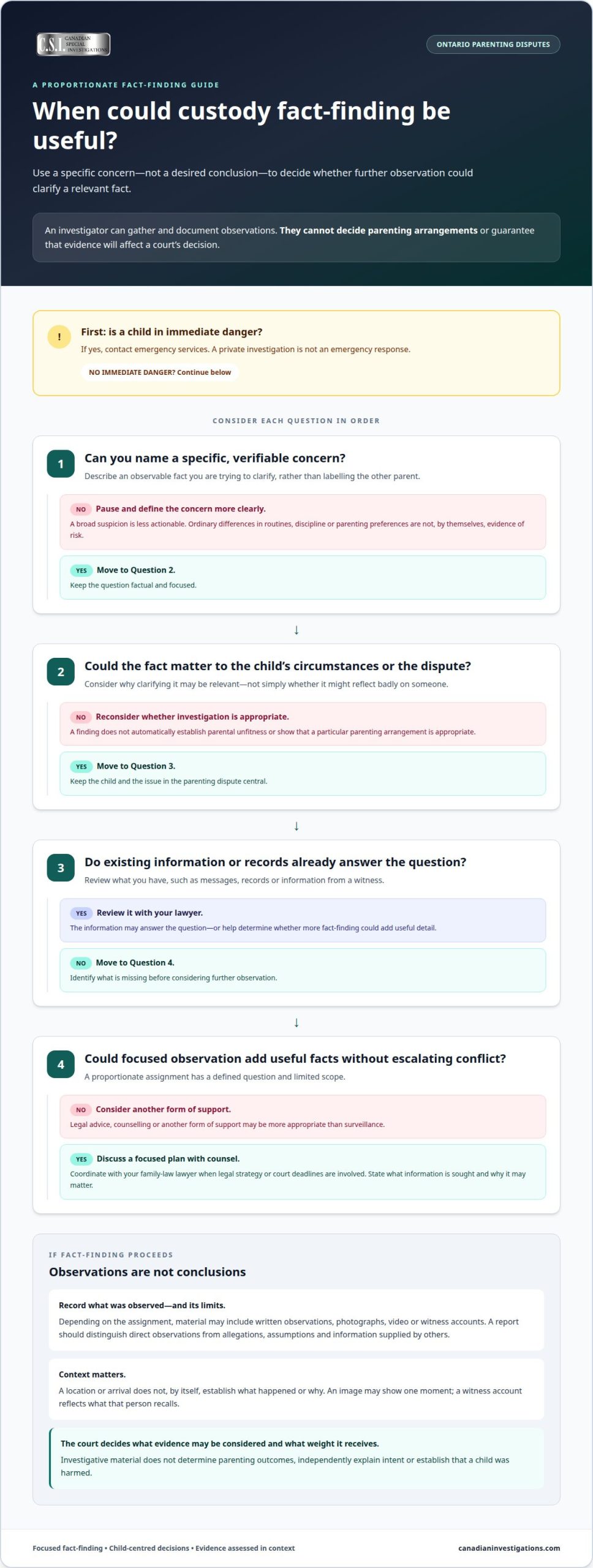
A proportionate decision starts with a clear question, not a desired conclusion. Before proceeding, consider:
- What is the concern? Describe the observable fact you are trying to clarify, rather than labelling the other parent.
- Why could it matter? Connect the concern to the child’s circumstances or an issue in the parenting dispute.
- What information is missing? Review records and known witness information. Consider whether further fact-finding is likely to add relevant detail.
- Could the assignment increase conflict? Keep the scope limited and child-centred. Discuss legal strategy with counsel where appropriate.
Some disputes call for legal advice, counselling or another form of support, not surveillance. If a child faces immediate danger, contact emergency services rather than treating a private investigation as an emergency response. The aim is measured clarification, not escalation.
How custody evidence is gathered and assessed in Ontario
Investigative material does not decide a parenting dispute. A private investigator may collect and organize information, but the court determines whether particular evidence can be considered and, if so, how much weight it deserves. A report, photograph or video is not automatically admissible or persuasive just because an investigator produced it.
In parenting matters, the child’s best interests are central. The applicable legal framework depends on the matter. The federal Divorce Act uses terms such as “parenting time” and “decision-making responsibility,” while Ontario proceedings may involve provincial family law. What matters is how the evidence relates to the child and the issues before the court, not how dramatic it appears.
What makes investigative documentation useful
Useful documentation is specific, neutral and connected to a defined issue. A factual record can identify the date, time, location and circumstances of an observation, then distinguish what the investigator directly saw from information supplied by someone else. “The vehicle arrived at 5:10 p.m.” is an observation. A conclusion about why it arrived or what it proves requires additional evidence.
Depending on the assignment, information may include written observations, photographs, video or witness accounts. Each has limits: an image may show only one moment, while a witness account reflects what that person recalls. Context helps counsel and the court assess what the material does, and does not, establish.
Admissibility is not the same as influence
Admissibility and evidentiary weight are separate questions. The court decides whether material may be considered under the circumstances, then evaluates its reliability, relevance and significance alongside the rest of the evidence. A recording might be admitted yet carry little weight if it is incomplete, unclear or disconnected from an issue in the parenting dispute. No format guarantees a particular result.
Privacy, surveillance and recording questions are fact-specific. The setting, method of collection, people involved and purpose can all matter. Do not assume that something accessible or visible can automatically be recorded or used in court. Discuss the proposed scope and recording-related concerns with your family-law lawyer before fieldwork, especially if evidence may affect a hearing or another court deadline.
- Observations: Record what was seen or heard, with relevant time and context.
- Reports: Organize observations and distinguish them from interpretation or second-hand information.
- Photographs and video: Provide visual records, but may not show what happened before or after the captured moment.
- Witness evidence: May offer another account, which can be assessed against other information.
Clear instructions help keep collection focused on the question that matters, rather than encouraging speculation. If you are considering hiring a private investigator for child custody, coordinate the assignment with counsel so the investigative objective and evidence-handling questions are considered together. Canadian Special Investigations conducts domestic and legal investigations, including surveillance and evidence gathering across Ontario. A confidential inquiry about Ontario investigative support can help you discuss a focused fact-finding assignment.
How to assess whether hiring a private investigator fits your custody concern
Before commissioning an investigation, match the concern to the information you actually need. A focused question can help you decide whether fact-finding could add useful, current information or whether another route is more appropriate. The aim is not to collect material against the other parent at any cost. It is to make a proportionate decision centred on the child.
Use this framework to compare the issue, the information you already have and a reasonable next step:
Concern
Information already available
Potential investigative value
Possible next step
A specific concern about a parent’s routine during parenting time
Messages, schedules or dated notes
May help document an observable pattern, if relevant to the dispute
Review the records with counsel and define what remains unknown
A disagreement about ordinary household rules or parenting preferences
Accounts from each parent, with no clear safety issue
Surveillance may add little and could intensify conflict
Consider legal advice or counselling instead
Immediate concern that a child may be in danger
Information about the immediate circumstances
Routine surveillance is not an emergency response
Use appropriate emergency or child-protection channels
A broader question about parenting capacity or the child’s needs
Existing court materials or professional information
An investigator’s observations may not answer the broader question
Ask counsel about available processes, including a court-directed assessment
Match the question to the information needed
Turn a broad allegation into a neutral, observable question. Instead of instructing an investigator to prove that a parent is irresponsible, identify the specific current conduct you are concerned about and why it may matter to the parenting dispute. Consider whether that conduct can be documented lawfully and whether the answer would change a practical next step. Keep immediate safety needs separate from non-urgent fact-finding.
Consider risks, limits and alternatives
An investigation can involve expense, privacy concerns and a risk of escalating conflict. Observations may not support your concern or answer it. Existing documents, witness information or counsel’s advice may provide a more direct route. Do not involve the child in surveillance, ask them to gather evidence or coach them about what to say. Keep the assignment adult-led and focused.
Different needs call for different support. A family-law lawyer advises on legal options; counselling may help address family or communication issues; emergency services and child-protection channels address urgent safety concerns. A court-directed assessment may address broader questions than a private investigator’s fact-finding, but serves a different purpose. Hiring a private investigator for child custody can inform a case, but no investigation guarantees a particular parenting arrangement. The decision should turn on relevance, proportionality and whether the information sought could genuinely clarify the issue.
How to prepare for a child custody investigation
Preparation sets the purpose and limits of an assignment. Before hiring a private investigator for child custody, organize the facts, identify what remains unknown and consider how the information could relate to your parenting matter. A focused scope helps keep investigative work relevant and proportionate. If legal strategy or an active court deadline is involved, speak with your family-law lawyer before fieldwork begins.
Follow a practical preparation sequence
Work through these steps before giving investigative instructions. The goal is a clear brief, not a conclusion about what the investigation should find.
- Define the concern. Describe the specific, current issue in neutral terms. State what you want clarified, not what you expect the investigator to prove.
- Build a dated timeline. Note relevant events, approximate times and locations. Mark which details you observed yourself and which came from another person, an online claim or an assumption.
- Gather relevant records. Organize messages, schedules, existing documents and other information related to the question. Keep the original material and note where each item came from.
- Flag court-related constraints. Identify relevant orders, upcoming court dates and deadlines. Ask your lawyer how they may affect the timing, scope or use of investigative information.
- Set a limited objective. Explain what information is missing and how it could clarify an issue in the parenting dispute. Avoid broad instructions to monitor a parent without a defined question.
- Agree on communication and review. Discuss the proposed scope, reporting and how updates or findings will be shared. Decide how you will review the results and what next steps may be appropriate.
Organize a clear, factual case brief
Keep the brief concise enough to guide the work, but detailed enough to prevent guesswork. Separate first-hand knowledge from what you have heard, inferred or seen online. For example, label a message as a document you received, not as proof of what happened beyond its contents. Note uncertainties clearly. This lets the assignment start from verifiable information rather than treating an allegation as established fact.
Set expectations and protect the child’s interests
Before work begins, discuss the objective, boundaries, reporting approach, communication and privacy considerations. Instructions must not ask an investigator to trespass, access private accounts or provoke a response. Keep the child out of surveillance and evidence collection. Do not ask them to watch, report on, photograph or question a parent. A child-centred assignment avoids placing them in the middle of adult conflict.
If you need to understand how a court may assess investigative material, consult your lawyer while planning the assignment. Preparation can clarify the question, but it cannot guarantee what evidence will be accepted or how a parenting issue will be decided. Canadian Special Investigations conducts domestic and legal investigations, surveillance and evidence gathering across Ontario. To discuss a focused fact-finding assignment, make a confidential inquiry.
Hiring Canadian Special Investigations for Ontario custody fact-finding
For a sensitive parenting dispute, investigative support should begin with a clear purpose and realistic expectations. Canadian Special Investigations (CSI) is a fully licensed, Toronto-based private investigation agency serving private individuals and law firms across Ontario. Its domestic and legal investigations include surveillance and evidence gathering, focused on documenting relevant facts rather than predicting or promising a court outcome.
Hiring a private investigator for child custody may be worth discussing when you have a defined question that could be addressed through focused fact-finding. An investigator gathers information; your family-law lawyer advises on legal strategy, and the court decides what evidence to consider and how it relates to parenting arrangements.
What to expect when discussing your circumstances with CSI
A useful first conversation can start with a concise account of the issue. Summarize the specific concern, relevant dates and locations, what information you already have, and any active court dates or deadlines. You do not need to present assumptions as established facts. Separating what you personally know from what you have heard helps keep the discussion grounded and the proposed assignment focused.
The conversation can clarify the investigative objective, potential scope and appropriate next steps. Explain what you need the information to clarify, so the work can be considered in context rather than framed around a predetermined conclusion. CSI accepts confidential case inquiries by phone or through its online contact form.
Take the next step with a focused plan
Before fieldwork begins, coordinate with your family-law counsel if the proposed investigation may affect legal strategy, evidence questions or an active court deadline. Counsel can help you assess how the question fits your matter. CSI serves clients across Ontario from Toronto, including in Oakville, Burlington, Brampton, Mississauga, Hamilton, Ancaster, Niagara Falls, Kitchener, Waterloo, Scarborough, North York, Richmond Hill, Barrie, Milton, Etobicoke and Guelph.
Keep the assignment proportionate. A narrow question, clear boundaries and relevant context help establish what the investigation is intended to address while avoiding unnecessary intrusion or escalation. No investigative service can guarantee that a finding will be admitted, given weight or lead to a preferred parenting arrangement. The purpose is disciplined fact-finding, not a promised result.
If you are ready to discuss a specific concern, share the relevant context and the question you need clarified. Discuss your investigative needs with Canadian Special Investigations through a confidential inquiry by phone at 905-332-4807 or through the online contact form.
Choose a focused next step
Before acting, identify the uncertainty you need to resolve and what a clearer factual record could help you decide. Hiring a private investigator for child custody should support informed, child-centred planning, not fuel conflict or create expectations about a court’s decision. If you are working with a family-law lawyer, align investigative questions with their advice before proceeding.
When fact-finding appears appropriate, a focused conversation can help turn a broad concern into a defined investigative objective. Canadian Special Investigations brings decades of industry experience to investigative matters and conducts surveillance and evidence gathering. Findings may clarify information, but cannot guarantee a particular parenting outcome.
Take the next step at your pace. Discuss your investigative needs with Canadian Special Investigations and outline the specific question you are seeking to clarify. A careful, well-defined plan can help you move forward with greater confidence while keeping your child’s interests at the centre.
Frequently Asked Questions
Is it legal to hire a private investigator for child custody in Ontario?
Generally, a parent may hire a private investigator, but that does not make every investigative method lawful. The circumstances, location and way information is collected can affect whether surveillance or recording respects privacy rights and applicable laws. Do not assume a conversation or activity can be recorded just because you are involved in the dispute. Discuss the proposed methods and scope with your family-law lawyer before giving instructions.
Can a private investigator guarantee that I will get custody?
No. Hiring a private investigator for child custody can help document information, but an investigator cannot determine parenting arrangements or control a court’s decision. Findings may support, contradict or have little connection to a claim. For instance, an observation about one event may not establish a broader pattern. The court considers the case and the child’s best interests, so treat investigative work as fact-finding, not a route to a guaranteed outcome.
Can a private investigator testify in a child custody case?
An investigator may be asked to explain their observations or report, depending on the case and legal process. Whether testimony is required or useful is a legal-strategy question, not something a report alone settles. If an observation may be disputed, contemporaneous notes and consistent records can help clarify how it was made. Ask your lawyer how the investigator’s role, documentation and any possible testimony fit the evidence plan for your matter.
Will a private investigator interview my child during a custody investigation?
A child should not be pressured or placed in the role of gathering evidence about a parent. Do not ask your child to monitor visits, take photos, keep secrets or rehearse an account. If a concern involves something your child has said, record their words as accurately as you can without leading questions, then seek legal guidance before deciding what to do. Protecting the child from adult conflict should remain a priority.
How long does a child custody investigation take?
There is no standard duration. Timing depends on the question, relevant dates and locations, whether the conduct can be observed and the agreed scope. A question tied to a particular upcoming event may require different planning from one concerning a recurring routine. Share court dates and deadlines at the outset, and discuss how they affect the assignment plan. An investigator cannot guarantee what will be observed or when.
What information should I give an investigator before a custody investigation?
Provide a concise timeline, the specific issue, relevant dates and locations, and any related documents or court orders. Label what you witnessed directly and what came from someone else. For example, distinguish a message you received from your own observation of an event. Include upcoming legal deadlines and explain what fact you need clarified. Avoid speculation or instructions that presume wrongdoing; your lawyer can help align the question with your case.
Can evidence from a private investigator change an existing parenting order?
Investigative evidence does not change an order by itself. Whether information could support an application depends on the circumstances, the applicable legal process and the court’s assessment of the child’s interests. Keep the existing order in place unless it is changed through the proper process or you receive legal advice about your situation. Give any new information to your family-law lawyer, who can assess its relevance and explain whether further steps may be appropriate.

