Corporate investigation services in Mississauga can help businesses examine suspected fraud, employee theft, embezzlement, and other workplace misconduct. Investigators gather and assess relevant information to clarify events and support informed business decisions. The right approach depends on the concern, the records available, and the workplace context.
When something seems wrong, acting on suspicion alone can create more uncertainty. A structured investigation can establish a clearer picture while keeping the inquiry focused and discreet. This article explains what corporate and workplace investigations may cover, how they can proceed, and what to consider when deciding on next steps. It also explores how these services can support Mississauga businesses, from examining suspected internal misconduct to documenting evidence related to fraud concerns.
Key Takeaways
- A workplace investigation can help clarify employee misconduct concerns by gathering relevant information and documenting findings.
- Fraud inquiries can use records such as receipts, emails and text messages to help establish what happened.
- A focused investigation can examine suspected employee theft or embezzlement while considering the business’s records and circumstances.
- The right investigative approach depends on the concern, the evidence available and the needs of the business in Mississauga or nearby areas.
Workplace investigations and employee misconduct
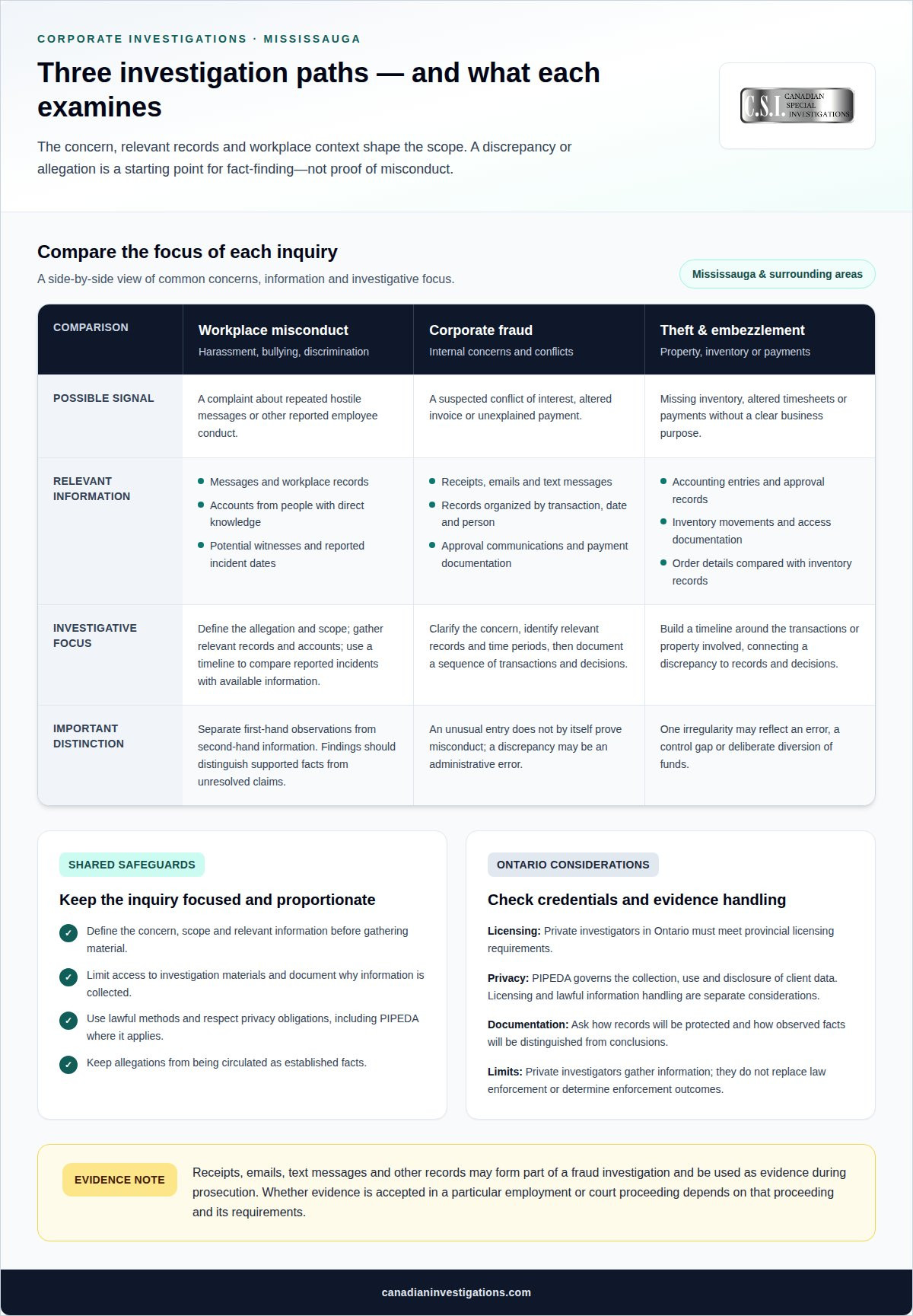
A workplace investigation can clarify allegations of harassment, bullying, discrimination, or other employee misconduct. A structured process defines the concern and scope, then gathers relevant information. For example, a complaint about repeated hostile messages may involve reviewing the messages and interviewing people with direct knowledge. Clear findings help employers decide on appropriate workplace measures without treating an allegation as proven.
In Ontario, private investigators must meet provincial licensing requirements, so businesses should engage appropriately licensed investigators. Investigative work must also respect privacy obligations. The Personal Information Protection and Electronic Documents Act (PIPEDA) governs the collection, use, and disclosure of client data. Licensing and lawful information handling are separate considerations, and both matter when planning an investigation.
Evidence may include records directly related to the allegation. The Competition Bureau Canada notes that receipts, emails, text messages, and other records may form part of a fraud investigation and be used as evidence during prosecution. Investigators can organize relevant material and document how it was obtained. Whether evidence is accepted in a particular employment or court proceeding depends on that proceeding and its requirements.
For harassment or bullying complaints, investigators can outline the allegations, identify potential witnesses, and gather accounts and relevant records. Separate interviews help distinguish first-hand observations from second-hand information. A timeline can show when reported incidents occurred and whether accounts align with available messages or workplace records. Findings should separate supported facts from unresolved claims.
WSIB-related inquiries may address concerns about an injury claim or an employee’s reported activities. Businesses may face significant annual costs associated with false WSIB claims. Investigators can document relevant observations and compare them with the specific concern, keeping the inquiry focused on evidence rather than assumptions. Careful, proportionate fact-finding supports both workplace operations and employee integrity.
Confidentiality, privacy, and reputation require attention from the outset. Limit access to investigation materials, record why information is being collected, and avoid circulating allegations as established facts. Private investigators gather information; they do not replace law enforcement or determine enforcement outcomes. A clear scope, controlled records, and objective reporting help reduce unnecessary exposure while an employer addresses a workplace concern.
Corporate fraud and internal misconduct investigations
A suspected conflict of interest, altered invoice, or unexplained payment can prompt a corporate fraud inquiry. Investigators first define the concern, then identify relevant records, people, and time periods. A clear scope helps distinguish a genuine discrepancy from an administrative error. It also allows a business to preserve evidence before routine processes overwrite or disperse important information.
The Competition Bureau Canada notes that receipts, emails, text messages, and other records may form part of a fraud investigation and be used as evidence during prosecution. Investigators can organize records by transaction, date, and person involved. For example, an invoice review may compare approval communications with payment documentation. The purpose is to establish a documented sequence, not to assume that one unusual entry proves misconduct.
When comparing corporate investigation firms, assess Ontario licensing, relevant experience, proposed scope, and how findings will be documented. Ask how records will be protected and how observed facts will be distinguished from conclusions. A background check or member interview should have a clear connection to the concern. Credentials matter, as do a case-appropriate method and a clear account of what the work can deliver.
Lawful surveillance and background checks in Ontario require a defined purpose, proportionate information gathering, and respect for privacy obligations. Investigators should use lawful methods and handle personal information in accordance with applicable privacy rules, including PIPEDA where it applies. A background check should focus on information relevant to the inquiry, not unrelated personal details. Surveillance plans should likewise address specific questions, such as whether reported business activity matches observed conduct.
Internal misconduct can involve harassment, misuse of confidential information, or a competitive relationship that creates undisclosed conflicts. Investigators can examine relevant communications and decision records, then document how each item relates to the allegation. Limit distribution to people responsible for the inquiry. This helps reduce unnecessary reputational harm if suspicion proves unfounded, while preserving a clear record for business decisions or later proceedings.
A focused corporate investigation approach can help a business organize concerns into a defined inquiry, with the scope shaped by the evidence and operational needs.
Employee theft and embezzlement investigations
Employee theft and embezzlement concerns often emerge from a specific discrepancy: missing inventory, altered timesheets, or payments without a clear business purpose. An investigation should connect that signal to records and decisions rather than assume misconduct from one irregularity. For example, an unexplained supplier payment may reflect an error, a control gap, or deliberate diversion of funds.
A focused inquiry builds a timeline around the transactions or property involved. Investigators can examine relevant accounting entries, approval records, inventory movements, and access documentation. If stock repeatedly disappears after certain orders, comparing order details with inventory records may help identify where the discrepancy occurs. Keep the scope tied to the concern and to individuals with relevant access or decision-making roles.
A practical investigative sequence can include:
- Define the suspected loss, affected records, and relevant business process.
- Compare transaction, inventory, and authorization records for inconsistencies.
- Document findings and identify questions that require interviews or follow-up.
For suspected embezzlement, investigators can trace how a payment moved through approval and accounting processes. A recurring vendor payment, for example, can be examined alongside purchase documentation and the roles involved in authorizing it. The goal is to establish a clear evidentiary account, including information that may explain an apparent discrepancy. Confidential handling also helps limit unnecessary exposure of employees and business records.
A former employee may remain relevant when a concern involves transactions, access, or inventory from their period of employment. Investigators can focus on records tied to that timeframe and distinguish documented activity from inference. In Ontario, businesses should keep inquiries proportionate and handle personal information with privacy in mind. Careful documentation helps decision-makers assess the evidence and determine appropriate next steps.
Not every loss points to an individual employee. Weak approval controls, shared credentials, or unclear stock procedures can create gaps that obscure responsibility. An investigation can identify process issues alongside any evidence of individual conduct. This distinction gives a business a stronger basis for responding to suspected theft, addressing control weaknesses, and reducing the chance of similar discrepancies.
Investigative services in Mississauga and surrounding areas
For a Mississauga business, an investigation may involve a workplace, transaction, person, or event connected to another community. A delivery dispute, for example, could involve a local warehouse and records from a Toronto supplier. Defining the relevant locations and business question helps investigators focus their work and gather useful information without disrupting routine operations.
Surveillance may help when direct observation can clarify a specific concern. The plan should identify what needs to be observed, where the activity is relevant, and how information will be documented. For example, observations related to a reported delivery pattern may clarify timing or activity. Undercover techniques involve different considerations and should not be treated as the default response to a business concern.
Mississauga businesses may also need an inquiry that connects information across departments or locations. A discrepancy involving inventory, for instance, can require reviewing which division handled an order and when records changed. Investigators can organize relevant observations and documents into a clear account, helping decision-makers understand what happened and which questions remain. This approach can assist businesses without treating an allegation as established fact.
- Define the concern and the locations, records, or individuals relevant to it.
- Select investigative techniques that fit the question and available evidence.
- Document findings so business decision-makers can assess the next step.
For work spanning Mississauga, Toronto, or other Ontario communities, clear coordination matters. A consistent scope keeps records and observations tied to the same inquiry, even when business activity crosses municipal boundaries. In Canada, privacy considerations also shape how personal information is collected, used, and disclosed, so keep information relevant to the investigation’s purpose.
Businesses dealing with a concern in Mississauga or nearby areas can discuss investigative support for their situation and identify the question that needs answering.
Canadian Special Investigations: Corporate Investigations
Canadian Special Investigations conducts Corporate Investigations for businesses facing suspected fraud, theft, or internal misconduct. Each investigation can be tailored to the concern, the organization’s operations, and the information needed to clarify events. Discreet fact-finding can help limit interruptions while the inquiry proceeds.
When an employee complaint is central, Employment Investigations can address workplace concerns. Surveillance may also support an inquiry when direct observation is relevant to the questions being examined. The appropriate approach depends on the circumstances and the evidence sought, not assumptions about an individual.
Bring forward the concern, relevant records, and the business decision you need to make. Canadian Special Investigations can discuss whether an investigation fits the situation and what information may help define its scope. Contact Canadian Special Investigations to discuss your business’s investigative needs.
Take the next step with a defined investigation
Before an internal concern becomes a wider business issue, decide what needs clarifying and which records or people are relevant. A focused scope gives the investigation a clear purpose and keeps attention on facts that inform your next decision. For businesses seeking corporate investigation services in Mississauga, start with a concise account of the concern and its impact on operations.
Canadian Special Investigations offers Corporate Investigations for business concerns, Employment Investigations for workplace matters, and Domestic / Infidelity Investigations for personal circumstances. The appropriate service depends on the issue you need addressed. Share the central concern and its context to discuss whether an investigation fits your needs.
Contact Canadian Special Investigations today to discuss a practical next step for your situation.
Frequently Asked Questions
Looking for a Private Investigator in Mississauga?
Canadian Special Investigations is a fully licensed private investigation agency serving businesses and individuals in Ontario, including Mississauga. To begin, outline the concern, the people or business activities involved, and the decision you need to make. That context helps define whether an investigation is appropriate and what information may help assess the matter.
What corporate investigation services are available in Mississauga, Ontario?
Businesses can seek Corporate Investigations for internal concerns, Employment Investigations for workplace matters, and Insurance / WSIB Investigations for related claim concerns. Surveillance, including drone surveillance, may also be relevant to a defined inquiry. For businesses seeking corporate investigation services in Mississauga, the appropriate service depends on the concern, the information required, and the investigation’s purpose.
Which licensed corporate investigation firms serve Mississauga and the Greater Toronto Area?
Canadian Special Investigations is a fully licensed agency based in Toronto and serving clients across Ontario. Its local service area includes Mississauga, Toronto, Oakville, Burlington, Brampton, Hamilton, Ancaster, Niagara Falls, Kitchener, Waterloo, Scarborough, North York, Richmond Hill, Barrie, Milton, Etobicoke, and Guelph. Businesses can describe their location and concern when discussing an investigation’s scope.
What types of workplace fraud, theft, and employee misconduct can corporate investigators investigate?
Investigators can examine concerns such as suspected inventory diversion, questionable expense claims, undisclosed conflicts of interest, or conduct that breaches workplace expectations. A useful starting point is to identify the specific activity and its business impact. For example, a pattern of unexplained stock adjustments may warrant an inquiry into how inventory records are managed and who is authorized to change them.
What is the process for hiring a corporate investigator in Mississauga?
Start by explaining the concern, relevant context, and what decision the business needs to make. The investigation’s scope can then be discussed, including which records or activities relate to the issue. Canadian Special Investigations accepts confidential case inquiries by phone at 905-332-4807 or toll-free at 1-888-668-7308, and through its online contact form.

