Finding the best agency for surveillance depends on the assignment, contract terms, and equipment required. Compare cancellation conditions and any refund period in writing, then assess whether night vision and image clarity suit the conditions where footage must be captured. No single option fits every case.
A low-commitment agreement can look appealing, but the key questions are what it covers, what happens if plans change, and whether the images will be clear enough to use. A practical comparison should explain these trade-offs, not just list features.
This guide compares surveillance options by contract terms, refund periods, night vision, and image clarity. You’ll learn which details deserve close attention and how to weigh them against the purpose of the surveillance, helping you make an informed decision with Canadian Special Investigations in Canada.
Key Takeaways
- Compare contract length, cancellation terms and money-back periods together to understand the full commitment before choosing an option.
- Assess night vision and image clarity against the conditions and details the surveillance needs to capture.
- Use credentials, insurance information and relevant references to evaluate a firm’s professional suitability for your assignment.
- Ask about the investigator’s methods, reporting and what the agreed scope includes before work begins.
- Weigh practical limitations, including changing conditions and the possibility that footage may not capture every relevant detail.
How do surveillance providers compare on experience, coverage, and client reviews?
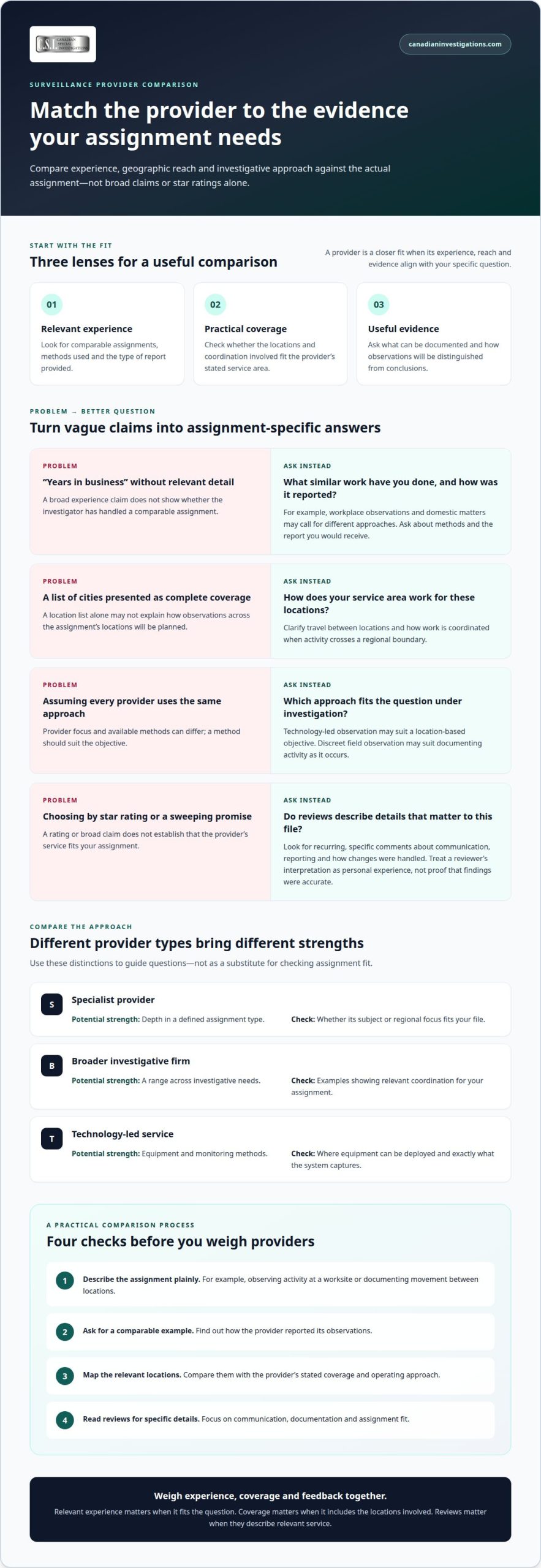
Compare providers by assignment fit, geographic reach, and evidence supporting their claims. An investigator experienced in workplace observations may approach a file differently from one focused on domestic matters. Ask about comparable assignments, methods used, and the type of report provided. Specific answers help you assess relevant experience beyond broad claims such as “years in business.”
Coverage means more than listing cities. It also means planning observations across the locations involved in your assignment. A workplace inquiry may centre on one site, while a legal matter could involve several. Ask how the firm defines its service area, handles travel between locations, and coordinates work when activity crosses a regional boundary. These details show whether coverage fits the assignment.
Providers differ in investigative focus and available methods. A specialist may offer narrower expertise, while a full-service investigative firm may handle different types of assignments. Technology-led observation can suit a location-based objective, while discreet field observation may be more appropriate when activity needs to be documented as it occurs. Match the method to the question under investigation rather than assuming every provider works the same way.
| Comparison factor | Specialist provider | Broader investigative firm | Technology-led service |
|---|---|---|---|
| Experience | Depth in a defined assignment type | Range across investigative needs | Strength in equipment and monitoring methods |
| Coverage | May focus on a particular subject or region | May coordinate different assignment types | Depends on where equipment can be deployed |
| Useful evidence | Comparable case examples | Examples showing relevant coordination | Clear explanation of what the system captures |
Read reviews for useful detail, not just star ratings. A helpful review describes the service, communication, reporting, or how the provider handled a change. For example, a comment about clear progress updates offers more insight than “excellent service.” Look for recurring themes and note whether reviews discuss the type of assignment you’re considering.
Separate verifiable facts from a reviewer’s interpretation. A comment about prompt communication reflects personal experience; it doesn’t prove an investigation’s findings were accurate. Compare review dates and the range of comments, looking for concrete details that match your priorities. Treat broad claims such as “solves every case” as marketing unless the provider explains their scope.
Use this comparison process before selecting a provider:
- Describe the assignment in plain terms, such as observing activity at a worksite or documenting movement between locations.
- Ask for an example of similar work and how the provider reported its observations.
- Map the relevant locations against the provider’s stated coverage and operating approach.
- Read reviews for specific comments about communication, documentation, and assignment fit.
Choose an alternative by matching experience, coverage, and client feedback to the assignment’s actual requirements. Experience matters when it is relevant to the question; coverage matters when it includes the locations involved; reviews matter when they describe relevant service. Weigh these factors together, then compare the proposed approach with the evidence you need.
Consider whether the provider’s stated reach is specific enough to assess. A service area is more useful when the firm explains what coverage means for your assignment. Treat broad claims as prompts for follow-up, not proof that a provider can work wherever needed. Ask what can be documented, who will provide updates, and how the final report will distinguish observations from conclusions. Clear explanations make comparisons more meaningful, even when providers offer similar services.
Verification also depends on what is being checked. Two-factor authentication requires an account holder to provide a password and another form of security to confirm account ownership. That is a separate example of checking a claim through more than one form of evidence. For a provincial geographic comparison, consider how Canadian provincial wildlife management areas operate under regional regulations and boundaries. A provider’s coverage claim, by contrast, should be assessed against the locations and coordination your own assignment requires, rather than treated as a complete answer on its own.
How can I verify a surveillance firm’s credentials, insurance, and references?
Start by identifying the legal business name on the proposal and contract. Compare it with the name on the firm’s website, invoice, and insurance documents. A trading name may differ from a registered name, so ask how the names are connected. Consistent details help identify the organization responsible for the assignment.
Next, ask which credentials apply to the work and who holds them. A company’s general statement about qualifications doesn’t tell you which investigator will handle your file. Request the assigned investigator’s name, role, and relevant credentials. Then check the issuing organization’s public directory or contact it using independently found details. Verify the credential holder’s name and status, not just the firm’s marketing language.
Requirements can differ across Canadian provinces and territories. Confirm which jurisdiction governs the assignment, then consult the relevant government or regulatory authority about applicable credentials. Don’t rely on a badge, certificate image, or social media claim alone. For work spanning jurisdictions, establish which investigators will handle each part and which credentials apply where the work takes place.
Review insurance separately. Request a current certificate of insurance and compare its named insured with the contracting business. Check the policy period, insurer, coverage types, and stated limits. Consider whether the described work fits the coverage shown. For example, general commercial coverage may not answer questions about professional liability or vehicle use. Ask the broker or insurer to clarify the wording if the distinction affects your decision.
A certificate doesn’t guarantee that every possible loss is covered. It summarizes insurance details, while exclusions and conditions may appear in the policy. Ask which party is responsible for damage, injury, or third-party claims during the assignment. Confirm that the contract’s responsibility clauses align with the insurance documents. Keep the documents with the signed agreement and note the policy’s expiry date.
References can show how a firm communicates and documents its work. Request references for assignments with a similar purpose and complexity, while respecting confidentiality. A firm may provide anonymized examples rather than disclose a former client’s identity or sensitive case details. Ask about the agreed scope, progress updates, report usefulness, and how changes were handled. These answers offer more practical insight than a general endorsement.
Use a consistent verification sequence:
- Match the legal business name across the proposal, contract, and insurance certificate.
- Record the investigator’s credentials and verify them with the issuing organization.
- Compare the insurance period, named insured, coverage types, and contract responsibilities.
- Discuss comparable references, focusing on communication and reporting rather than confidential case facts.
- Save written answers and documents alongside the final agreement.
For an insurance or WSIB matter, insurance investigation services can be a relevant next step. Apply the same checks to the proposed scope, assigned personnel, documentation, and insurance records before authorizing work.
What should I ask before hiring a surveillance investigator
Begin with the objective. Ask, “What specific question will this assignment answer?” A workplace concern, disputed insurance claim, and location-based observation require different plans. Explain what you know, identify the activity that matters, and ask the investigator to describe the proposed scope in plain language. A clear objective helps prevent unrelated observation from expanding the assignment.
Next, ask how the investigator will conduct the work. Will the plan use mobile observation, a fixed position, or specialized equipment? A moving subject, for example, may require a different approach than activity at one fixed location. Ask why the method suits the setting, what conditions could affect it, and how the investigator will adjust if circumstances change.
Discuss night vision and image clarity if the assignment may involve low light. Ask what equipment captures images after dark, whether it uses infrared illumination, and what detail the resulting footage can show. A clear image of movement may not identify a person or object. Ask about the difference using a relevant example, such as identifying a vehicle versus recording that one was present.
Ask how the investigator will document observations. Find out whether the final report includes dates, times, locations, written notes, photographs, or video, as appropriate to the assignment. Ask how the report separates direct observations from interpretation. For example, “the subject entered the building” is a recorded observation; explaining why they entered requires separate evidence.
Contract terms need precise answers. Ask what activities are included, when the assignment starts, and what circumstances can change its scope. Clarify cancellation terms, any refund period, and how unused work or changed plans are handled. Request the complete wording in writing. A verbal summary may omit exclusions, deadlines, or refund conditions.
Agree on communication before observation begins. Ask who will provide updates, which channel they’ll use, and what events trigger a report. For example, you might agree that a significant location change prompts an update. Also ask who can receive the findings, how sensitive information is handled, and whether anyone else may take part in the assignment.
Use these questions to assess the proposed plan:
- What specific information will the assignment document, and what falls outside its scope?
- Which observation method fits the location, timing, and expected activity?
- How will night images be captured, and what details can the resulting footage distinguish?
- What formats will the report include, and how will observations be separated from conclusions?
- What do the contract’s cancellation, refund, and scope-change terms require?
- Who communicates updates, and how are findings delivered?
Finally, ask what could make the assignment unproductive. A planned observation may be affected by changing locations, poor visibility, or activity that doesn’t occur. Ask how those conditions affect the agreed scope and reporting. Specific answers help you compare proposals by method, documentation, and contract terms rather than broad promises about results.
Before agreeing to a proposed method, ask whether it relies on information you plan to share on social media or equipment such as trail cameras. Share information carefully online, since a hostile person may read your posts. Keep this in mind when discussing the assignment or describing related activity, and ask what information should remain private.
If trail cameras are proposed, ask what role they would serve and whether their use fits the assignment. Check the relevant state wildlife management organization’s regulations before using trail cameras. Ask who will check those regulations and how the plan will change if camera use is not appropriate. Before authorizing any method, make sure the investigator can explain its purpose in relation to the objective, and that you understand what information it may produce and how that information will be reported.
What risks or limitations should I consider when hiring a surveillance firm?
Surveillance records observable activity; it cannot control what happens during an assignment. If someone changes their routine, enters a crowded location, or doesn’t appear, the available evidence may be limited. A plan focused on one address, for example, may miss activity that shifts elsewhere. Define the key question and relevant locations before work begins, then clarify how the investigator handles changing circumstances.
Visibility affects both observation and recorded detail. Darkness, rain, glare, obstructions, and distance can limit what a camera captures. Night vision may show movement without clearly identifying a face, vehicle, or other distinguishing feature. Ask what the proposed equipment can document in the expected lighting and surroundings. Distinguish between recording activity and identifying a person or detail in the resulting image.
Discuss privacy and appropriate conduct clearly. Explain the assignment’s purpose and ask how the plan limits collection to relevant observations. For example, a request to document activity around a workplace should define the activity and setting, rather than invite broad monitoring of unrelated people. Ask how the investigator considers privacy and applicable requirements for the location. Keep the objective specific and the agreed scope in writing.
Evidence has limits beyond image quality. A photograph may show a moment without establishing what happened before or after it. A report can describe an observation, while interpretation may require additional context. Ask how notes, timestamps, photographs, and video will be presented together. If findings may support an employment, insurance, or legal decision, identify the required format and intended audience before the assignment starts.
Unclear contract terms can create practical risks. Review what the work includes, what counts as a change, and how cancellation or a refund works. Confirm who receives updates and who may access the findings. If a location change requires a revised plan, clarify how that affects authorization and reporting. Written terms help prevent different expectations about the investigator’s work.
Before approving the plan, consider these limitations:
- Unpredictable activity can leave gaps in the observation record.
- Low light, weather, distance, and obstructions can reduce image detail.
- Ground, fixed-camera, and aerial methods each depend on different site conditions.
- Footage and notes document observations, but may not explain their full context.
- A change in location or scope can affect the planned work and its reporting.
For a focused review of surveillance requirements and assignment limitations, discuss your surveillance needs before work begins. A defined objective, suitable method, and written scope create a clearer basis for assessing the resulting evidence.
Canadian Special Investigations: Employment Investigations
Canadian Special Investigations conducts Employment Investigations for employers seeking objective information about workplace concerns. A defined assignment can clarify which activity is relevant and what findings should be documented. The firm also handles Corporate Investigations, Legal Investigations, and Domestic / Infidelity Investigations, with an approach suited to the matter rather than treating every case alike.
If you’re weighing surveillance options, bring the central question, relevant circumstances, and intended use of the findings into the discussion. That gives the investigation a clear purpose and helps align its scope with your needs. For workplace matters, contact Canadian Special Investigations to discuss Employment Investigations.
Define the decision you need to make
Surveillance is most useful when its purpose supports a real decision. Before proceeding, identify who will review the findings and what information would help them act. A concise timeline, relevant locations, and known constraints can frame the discussion without assuming what an investigation will uncover.
If you’re comparing surveillance alternatives, consider whether your concern is workplace-related, corporate, or personal. Canadian Special Investigations offers Employment Investigations, Corporate Investigations, and Domestic / Infidelity Investigations. Each addresses a different concern, so describe the issue plainly and identify the outcome you need to assess. This gives the next conversation a clear starting point.
Bring your objective and relevant context into a discussion about the investigative approach that suits your situation. Contact Canadian Special Investigations to discuss your needs and possible next steps. A clear purpose puts you in a stronger position to move forward thoughtfully.
Frequently Asked Questions
Which Canadian private investigation firms offer surveillance services?
Canadian Special Investigations is one Canadian firm offering surveillance services, including Camo Ghillie Suit Surveillance Services and U.A.V. (Quadcopter / Drones) Surveillance. Its investigations also address employment, domestic, corporate, legal, and insurance or WSIB matters. To assess fit, connect the assignment’s purpose with the type of investigation required. For example, a workplace concern may call for Employment Investigations, while a corporate matter may require Corporate Investigations.

