In a custody dispute, documented observations can clarify concerns that accusations alone may leave unresolved. Hiring a child custody investigator in Kitchener means engaging a licensed Ontario private investigator to document relevant conduct; investigators must hold a valid licence and carry it while on duty. This is separate from an Office of the Children’s Lawyer investigation, which requires a court order.
It’s understandable to want clear, objective information when you’re concerned about a child’s safety, supervision, or care during parenting time. This article explains what to consider when hiring an investigator, what a custody investigation may document, and how photographs, video, audio, and digital evidence may support a case. It also explains why the method of gathering evidence matters and how a private investigation differs from a court-directed assessment or report.
Key Takeaways
- Focus an investigation on specific, observable concerns, such as recurring problems with parenting-time arrangements, rather than broad accusations.
- Learn how photographs, video and digital records can add context, and why the way evidence is gathered matters.
- Understand the difference between a private investigation and a court-directed Office of the Children’s Lawyer investigation.
- See when objective documentation may help clarify a child’s circumstances, and when an investigation may not be necessary.
How do I hire a Private Investigator in Kitchener?
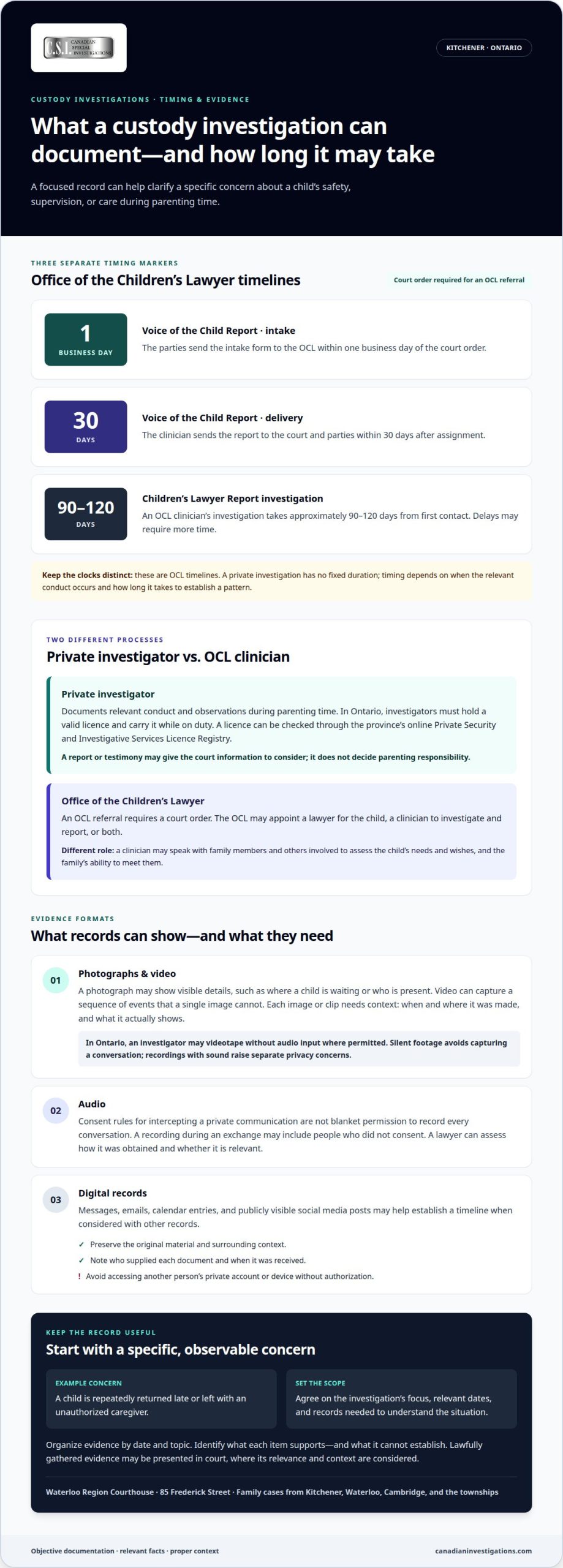
Start with a specific concern tied to a parenting agreement or court order. For example, note dates when a child was returned late or left with an unauthorized caregiver. An investigator may be asked to document whether a pattern exists during parenting time. In Ontario, private investigators must hold a valid licence and carry it while on duty. You can verify an investigator’s licence through the province’s online Private Security and Investigative Services Licence Registry. Agree on the investigation’s focus, relevant dates, and the records needed to understand the situation.
Useful findings need clear context. An investigator may prepare a detailed report describing observations, dates, and circumstances, rather than conclusions based on hearsay. Family law counsel can use that record to assess how it relates to the dispute, separation, or divorce proceedings. Investigators may also be asked to testify about their findings. A report or testimony can provide information for the family court to consider, but it doesn’t decide parenting responsibility.
Kitchener family cases are heard at the Waterloo Region Courthouse, 85 Frederick Street. The courthouse serves family cases from Kitchener, Waterloo, Cambridge, and the townships. A private investigation is distinct from an Office of the Children’s Lawyer (OCL) investigation. An OCL referral requires a court order. The OCL may appoint a lawyer for the child, a clinician to investigate and report, or both. Under section 112 of the Courts of Justice Act, clinicians can conduct investigations and prepare reports. A clinician may also assist an OCL lawyer under section 89 when serious clinical concerns need attention.
For a Voice of the Child Report, parties send the intake form to the OCL within one business day of the court order. The clinician sends the report to the court and parties within 30 days after assignment. Hiring an investigator carries risks: intrusive or poorly targeted surveillance can intensify conflict, and observations without context may be misinterpreted. Keep the purpose focused on relevant conduct and the child’s circumstances.
Photographs, video, audio, and digital evidence
Photographs can record visible details relevant to a parenting-time concern, such as where a child is waiting or who is present. Video can show a sequence of events that a single image cannot capture. In Ontario, an investigator may videotape without audio input where permitted. The distinction matters: a silent recording avoids capturing a conversation, while footage with sound raises separate privacy concerns. Each image or clip needs context, including when and where it was made and what it actually shows.
Audio requires particular care. The Government of Canada describes an interception consent exception when the originator of a private communication or its intended recipient consents. This rule concerns consent to intercept a communication; it is not blanket permission to record every conversation. For example, a recording made during an exchange may involve people who did not consent. A lawyer can assess how the recording was obtained and whether it is relevant to the dispute.
Digital evidence may include messages, emails, calendar entries, or publicly visible social media posts. A message about a missed pickup, for instance, may help establish a timeline when considered alongside other records. Preserve the original material and its surrounding context. A cropped screenshot can omit earlier messages, while an altered file may make its source harder to assess. Note who supplied each document and when it was received. Avoid accessing another person’s private account or device without authorization.
Evidence is more useful when it answers a specific question, rather than simply adding volume to a difficult family situation. A photograph may show an event, but not explain what happened before or after it. Digital records may also involve family members who are not directly involved in the parenting issue. Organize material by date and topic, then identify what each item supports and what it cannot establish. Lawfully gathered evidence may be presented in court, but the judge considers its relevance and context. A structured review of investigative evidence can help keep the record focused.
Child custody investigations in Kitchener
A custody investigation can document a child’s safety, supervision, or well-being during a parent’s parenting time. In Kitchener, observations may address a specific concern, such as whether a caregiver is present or a child is left unsupervised. Investigators may also document suspected substance use while a parent is responsible for the child. The purpose is to establish relevant facts, not decide which parent should prevail. Ontario family courts consider the child’s best interests when resolving parenting disputes.
How long does a custody investigation take in Kitchener-Waterloo? A private investigation has no fixed duration; the timeframe depends on when relevant conduct occurs and how long it takes to establish a pattern. An Office of the Children’s Lawyer clinician’s investigation for a Children’s Lawyer Report takes approximately 90-120 days from first contact, with delays sometimes requiring more time.
The investigation’s scope should match the concern. It may examine alleged violence or abuse, criminal activity, neglect, or other issues affecting a parent’s ability to care for the child. Repeated concerns about supervision, for example, call for observations connected to the child’s routine, not isolated assumptions. A private investigation is not necessary in every dispute. Consider whether objective documentation would address a specific unresolved question following separation.
Private investigators and Office of the Children’s Lawyer clinicians have different roles. A clinician may speak with family members and others involved to assess the child’s needs and wishes, and the family’s ability to meet them. A Custody and Access Report may recommend arrangements involving custody, access, child support, or education. Its recommendations inform the court but do not finally determine the issues. By contrast, a private assessor may be appointed by the court or by one parent with the other parent’s agreement; parents are responsible for the assessor’s fee. A separation agreement may already set out parenting arrangements, but new concerns can still require careful assessment. Legal assistance can help parents understand how investigation findings relate to their situation in Waterloo Region.
What laws and privacy rules govern custody investigations in Ontario?
Ontario’s private investigation industry is regulated under the Private Security and Investigative Services Act (PSISA). Investigators must hold a valid licence and carry it while on duty. These rules set professional boundaries, but they do not authorize unrestricted surveillance or access to private information. An investigator may not make an arrest or pretend to be a government agent in Ontario. A clear investigation plan should focus on relevant conduct and lawful ways to document it.
Audio recordings require particular care. According to the Government of Canada, the consent exception for intercepting a private communication applies when the originator or intended recipient consents, expressly or impliedly. This exception concerns consent to intercept a communication; it is not blanket permission to record conversations. For example, being present during a conversation does not automatically establish consent from another participant. Video may be recorded without audio input where permitted, avoiding the separate issue of capturing private communications.
Evidence gathered by a private investigator may be presented in court if obtained legally. That does not mean every photograph, recording, or digital item will be relevant or persuasive. A judge may consider what it shows, how it was obtained, and whether its context supports the point being made. Keep original files and records intact, and distinguish direct observations from interpretation. A report should clearly describe the method and circumstances so family court can assess the material rather than rely on unsupported conclusions.
Privacy concerns also affect how an investigation should be scoped. Accessing another person’s account or device without authorization is different from documenting an observation through lawful means. Keep the purpose tied to a specific parenting concern, and avoid collecting unrelated details about family members. Ontario agencies are required to carry general liability insurance under the PSISA framework. For a focused discussion about evidence and investigative boundaries, request a legal investigation.
Canadian Special Investigations
Canadian Special Investigations helps individuals seeking objective information for sensitive personal or legal concerns. For a family-law dispute, Legal Investigations may help clarify a specific issue through documented facts. Domestic / Infidelity Investigations address sensitive concerns within personal relationships. The appropriate approach depends on the question, the information needed, and the need to gather it lawfully.
Before moving forward, define the concern and how you may use the information. A focused scope keeps investigative work relevant rather than gathering unrelated details. Canadian Special Investigations also conducts Employment Investigations and Corporate Investigations for distinct investigative needs.
For a discreet discussion about your circumstances and investigative needs, contact Canadian Special Investigations.
Choose a focused next step
Before moving forward, define the decision you need to make. Is the concern about a recurring parenting-time issue, a child’s supervision, or information that needs independent documentation? A clear objective helps keep the next step proportionate to the family situation. It also gives you a practical basis for considering whether a child custody investigator in Kitchener fits your needs.
Canadian Special Investigations offers Legal Investigations when organized, relevant information is important. Share the concern, the purpose of gathering evidence, and any timing that affects the situation. This context can help frame a focused discussion about investigative needs without treating an investigation as a substitute for family-court advice.
Take the next step with a clear objective and a considered plan. Contact Canadian Special Investigations to discuss your circumstances. A measured approach can help you move forward with greater clarity.
Frequently Asked Questions
What does a child custody investigator do in Kitchener, Ontario?
A child custody investigator in Kitchener gathers objective information about a child’s circumstances during parenting time. An investigation may document whether agreed arrangements are followed or what care is provided during a particular visit. The investigator reports observations, not a custody decision or clinical assessment. Family court considers evidence alongside the broader circumstances and the child’s best interests.
How do I find a licensed child custody investigator in Kitchener-Waterloo?
Use Ontario’s online Private Security and Investigative Services Licence Registry to look up an investigator’s licence. Ontario investigators must hold a valid licence and carry it while on duty. Confirm that the registry entry matches the person you are considering, rather than relying only on a business description or online profile. This establishes licensing status, not whether a particular investigation suits your family-law matter.
What qualifications and experience should a custody investigator have in Ontario?
In Ontario, the essential regulatory qualification is a valid private investigator licence, which must be carried while on duty. Relevant experience also matters: look for an investigator who can document observations accurately, distinguish direct evidence from assumptions, and explain findings clearly in a report. A custody investigation differs from a clinical assessment. The investigator gathers information, rather than assessing a child’s wishes or recommending parenting arrangements.
Can a parent hire a custody investigator, or must the family court order one in Ontario?
A parent can hire a private investigator; a court order is required for a referral to the Office of the Children’s Lawyer, not for a private investigation. That distinction matters when deciding whether you need independent observations or a court-directed investigation. The Office of the Children’s Lawyer may assign a lawyer, a clinician, or both. Its involvement follows a separate court process from privately commissioned investigative work.
How are private custody investigation reports used or admitted in Ontario family court?
A report may be presented in Ontario family court if the evidence was gathered legally, but that does not guarantee the court will accept every item or give it weight. Relevance, context, and the investigator’s account of how observations were made can matter. For example, a dated observation may be easier to assess when its circumstances are clearly recorded. Investigators may also be asked to testify about their findings.
What steps are involved in hiring a child custody investigator in Kitchener?
Begin by identifying one specific concern, such as whether a parenting-time condition is being followed. Then confirm the investigator’s Ontario licence through the provincial registry. Explain the relevant dates, locations, and terms of any court order or agreement, and define what information would address the concern. Before work begins, clarify the proposed scope and reporting format. A focused assignment keeps observations relevant and avoids collecting unrelated family details.

