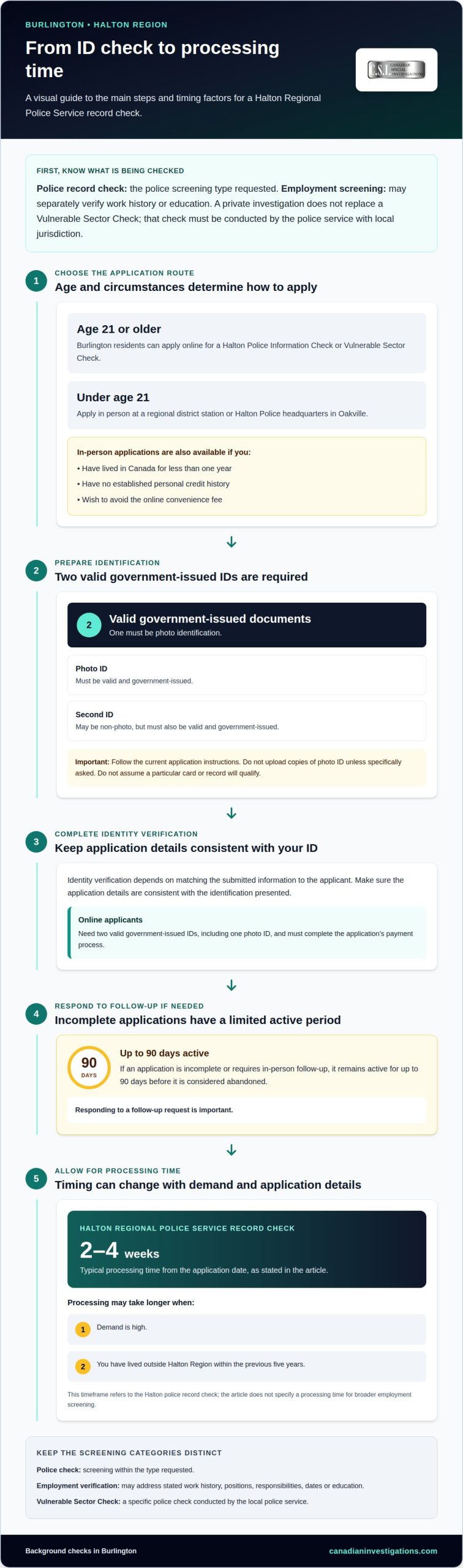
A background check isn’t always just a police record check. In Burlington, a Halton Regional Police Service record check typically takes two to four weeks from the application date, and processing may take longer during periods of high demand or if you’ve lived outside Halton Region within the previous five years. A background check service in Burlington may also involve identity verification and employment or licensing checks beyond the police record check itself.
Waiting for a background check service in Burlington can disrupt a hiring decision, volunteer placement or licensing process, especially when screening has several parts. The scope depends on what the organization requires: police record checks have different levels, while employment screening may also verify work history or education. This article explains what identification and personal details may be collected, what employment and licensing checks can cover, and why timelines vary. It also explains how a police record check differs from a broader employment investigation, so you can understand what each process is designed to establish.
Key Takeaways
- Prepare two valid government-issued IDs, including photo identification, and learn when identity documents should be submitted.
- Understand which personal details are collected for a record check and the Canadian laws that govern that process.
- See how employment history and education verification can complement a criminal record check, depending on the role.
- Identify how the requested screening level, follow-up requirements and application details can affect processing time.
Identification requirements
For a Halton Regional Police Service record check, applicants provide two valid government-issued identification documents, including one photo ID. The second document may be non-photo identification, but it must also be government-issued and valid. Follow the current application instructions rather than uploading copies of photo ID unless specifically asked. Identity verification is a required step in completing a Canadian criminal record check.
A police record check and a private background check serve different purposes. A police check provides the screening type requested, while employment screening may also verify details such as work history and education. A private investigation does not replace a vulnerable sector check: that check must be conducted by the police service with local jurisdiction.
In Burlington, residents aged 21 and older can apply online for Halton Police Information Checks and Vulnerable Sector Checks. Online applicants need two valid government-issued IDs, including one photo ID, and must complete the application’s payment process. Applicants under 21 can apply in person at a regional district station or Halton Police headquarters in Oakville. In-person applications are also available to people who have lived in Canada for less than one year, have no established personal credit history, or wish to avoid the online convenience fee.
Identity verification depends on matching the submitted information to the applicant. If an application is incomplete or requires in-person follow-up, it remains active for up to 90 days before being considered abandoned. That makes responding to a follow-up request important. Keep the application details consistent with the identification presented.
For non-photo identification to be accepted, it must be valid and government-issued; the photo document must meet those requirements too. Do not assume that a particular card or record will qualify. Canada Post identity verification also requires two appropriate pieces of ID, but its acceptance criteria may differ from those for a police record check.
Personal information collection and privacy
A Halton Regional Police Service record check involves personal information collected under specific Canadian and Ontario legislation. The service collects information under sections 6.3(2) and 6.3(3) of Canada’s Criminal Records Act, and sections 6, 7 and 8 of Ontario’s Police Record Checks Reform Act, 2015, S.O. 2015, Chapter 30. These legal provisions frame the collection and disclosure involved in police record checks.
The details provided should match the purpose and type of check requested. A criminal record check, a vulnerable sector check and an employment background review do not necessarily examine the same information. The organization requesting screening determines the required police check type. For a vulnerable sector check, the local police service conducts the check, and the role must meet the applicable requirements.
Additional screening may involve a separate step. Hitachi Energy Canada says candidates will be notified and, where required, asked to provide consent before additional background or security checks begin. Its pre-employment checks may verify employment history, education, criminal records and other relevant information. Sensitive information, financial responsibilities, client data and regulated environments can affect the scope of additional screening.
To assess whether a background check process is legitimate and secure, look for a clearly stated purpose, defined screening scope and transparent explanation of consent. For a police record check, the responsible police service and applicable Ontario legislation provide a clear reference point. A private employment review is different from a police-issued record check and should explain what information it seeks and why.
Before providing information, identify which organization is requesting it and which check it requires. Confirm whether the request is for a police record check, employment verification or additional security screening. This distinction helps individuals understand why particular details are collected and how the results relate to employment or volunteering. If an employment concern calls for information beyond a police record, discreet investigative support may be a practical next step.
Employment history verification
Employment screening can examine a candidate’s work history separately from a criminal record check. Verification may focus on stated employers, positions, responsibilities and dates, then compare those details with available records or references. For example, a hiring team may need to clarify whether a résumé describes a role as current or former. The purpose is to assess relevant experience, not to treat every discrepancy as proof of misconduct.
Education can also be part of screening. Hitachi Energy Canada says its pre-employment checks may verify employment history, education, criminal records and other relevant information. The role’s nature and business necessity shape the scope of the review. A position involving sensitive information or financial responsibilities may call for different screening than a role with different duties.
Keep the categories distinct. Police checks return information within the type of check requested; employment history verification addresses work-related claims. A vulnerable sector check is a specific police check, not a substitute for confirming a candidate’s previous job duties. Credit information is another distinct category. Do not assume it forms part of every employment screen; the role and stated screening purpose determine what information is relevant.
A clear review starts with the position’s requirements. The employer identifies which experience matters, then compares the candidate’s stated history with information gathered for that purpose. A mismatch in a job title may require clarification, while a missing employment period may need context. Consistent records help distinguish administrative differences from material questions about qualifications.
Consent and communication matter too. Hitachi Energy Canada says candidates will be notified and, where required, asked to provide consent before additional background or security checks begin. A private employment investigation can help address specific work history concerns, such as conflicting accounts or disputed credentials. It is not a police-issued criminal record check. For employers who need focused fact-finding tied to a hiring decision, an employment investigation provides a distinct way to assess the concern.
Employment, volunteering and licensing screening
The screening required in Burlington depends on the position and the requesting organization. Canada has three levels of criminal record checks, and the employer, volunteer agency or licensing body determines which type applicants need. A student applying for a placement, for example, may face different requirements from someone seeking a licence for another role. Start with the organization’s requested check type, not a generic label such as “background check.”
Halton Regional Police Service provides Police Information Checks and Vulnerable Sector Checks for eligible applicants in Burlington. A vulnerable sector check must come from the police service with local jurisdiction. It is tied to a role involving vulnerable people, and police must be satisfied that the check is a valid requirement for the position. If an agency letter requests a Criminal Record Check with a Vulnerable Sector Check, applicants request only the Vulnerable Sector Check.
For employment, a standard Canadian criminal record check searches the RCMP-managed National Repository of Criminal Records for one or more criminal convictions. A Criminal Record and Judicial Matters Check is a different check type. Employers should identify the exact check needed, since a police record check does not automatically verify employment history, education or professional qualifications. Licensing applicants should follow the screening instructions tied to the licence or position.
Volunteering has specific Halton fee rules: volunteers needing a Criminal Record Check or Criminal Record and Judicial Matters Check are not charged for the check itself. A Vulnerable Sector Check for volunteer work with vulnerable individuals has a fee. Applicants under 18 receive Halton checks only when volunteering or working for a government agency. These distinctions matter for a student placement or community role.
For the combined service question, Halton police handles police record checks, while employment screening addresses job-related information. Tenant screening is a distinct purpose and shouldn’t be treated as a police check or employment investigation. For a focused employment concern, request employment investigation support.
Canadian Special Investigations: AUTO-BACK Program
Canadian Special Investigations’ AUTO-BACK Program is a service to discuss when a standard police record check does not address the concern. Police checks and private investigations serve different purposes: an investigation can examine a specific employment, corporate or legal issue, but it does not replace a police-issued criminal record check or vulnerable sector check.
For example, an employer may need to investigate a discrepancy in work history, while a business may need facts relevant to a corporate concern. Canadian Special Investigations provides Employment Investigations, Corporate Investigations and Legal Investigations for these distinct needs. Domestic / Infidelity Investigations address personal concerns, not hiring or licensing screening.
Contact Canadian Special Investigations to discuss whether the AUTO-BACK Program or an investigative service fits your situation.
Choose the next step that fits your decision
Before starting a background check service in Burlington, define the decision the screening must support. A hiring decision, personal concern and corporate issue call for different investigative questions. Keep the objective specific: identify what needs clarification, which information is relevant, and how the findings will be used.
Canadian Special Investigations provides Employment Investigations, Domestic / Infidelity Investigations and Corporate Investigations. These services address focused concerns that may require investigation beyond a routine screening process. The right next step depends on the issue you need to resolve, not simply on the label attached to a check.
Bring the matter into focus before proceeding. A clear objective helps establish whether an employment, personal or corporate investigation is relevant to your situation. For assistance considering that next step, contact Canadian Special Investigations. A well-defined question gives the process direction and helps you move forward with greater clarity.
Frequently Asked Questions
Why does it take so long to get my check done?
Police checks can take longer when application demand is high, extra follow-up is needed, or address history requires broader review. For example, living outside Halton Region within the previous five years may extend processing. Incomplete information can also mean applicants need to provide clarification or attend in person. Build in time for these steps before a hiring date, volunteer placement or licensing deadline.
What background check services are available in Burlington, Ontario?
In Burlington, applicants can request police record checks, including Criminal Record Checks, Criminal Record and Judicial Matters Checks, and Vulnerable Sector Checks. A background check service in Burlington may also refer to private employment screening, which can examine job-related concerns rather than issue a police check. Canadian Special Investigations offers Employment Investigations, Corporate Investigations, Legal Investigations and Domestic / Infidelity Investigations.
How much does a background check cost in Burlington, Ontario?
Halton Regional Police Service record-check fees vary by check type and circumstances, including whether fingerprint submission is required. A private investigation is separate from a police check; its price depends on the case and is provided after a quote request. Relevant cost factors include the investigation’s purpose, scope and work required. Do not assume a police fee covers additional employment or investigative screening.
How long do background checks take in Burlington?
Halton Regional Police Service checks typically take two to four weeks from the application date. High demand, in-person follow-up or residence outside Halton Region within the previous five years can extend that period. A private employment investigation follows a different process, so its timeline depends on the questions being examined and the information available. Allow time before a firm start date or licensing deadline.
What identification and documents are required for a criminal record check in Burlington?
Applicants need two valid government-issued identification documents, including one photo ID. The requesting organization should specify the check type; an agency letter can identify whether it requires a Criminal Record Check, a Criminal Record and Judicial Matters Check or vulnerable sector screening. If a Vulnerable Sector Check is needed for multiple agencies, Halton requires a separate application for each agency.

