The most compelling surveillance footage in your file is a liability, not an asset, if it fails to survive a challenge in chambers. With the 2026 overhaul of the Rules of Civil Procedure shifting Ontario toward an “evidence-first” model, the window to secure and disclose admissible evidence for ontario court has narrowed significantly. You likely understand the frustration of gathering proof only to face the looming threat of it being thrown out due to a perceived privacy violation or a failure to meet the strict three-part test for admissibility affirmed in R. v. Singh.
We recognize that in high-stakes litigation, there’s no room for technical errors or amateur recordings that backfire under cross-examination. This tactical guide provides the framework you need to master complex rules and ensure every piece of proof is utilized effectively. You’ll gain a clear understanding of the Ontario Evidence Act, the strategic benefits of professional-grade surveillance logs, and how to choose a licensed investigator who operates with the precision required by these recent reforms. From UAV deployment to the modified disclosure standards, we’re equipping you with the confidence to turn raw data into a decisive, court-ready advantage.
Key Takeaways
- Identify how the 2026 “evidence-first” model in Ontario requires immediate, high-quality disclosure to prevent your proof from being excluded at the outset.
- Understand the core criteria of relevance and reliability that determine the weight a judge assigns to your documentation under the Ontario Evidence Act.
- Master the tactical requirements for capturing admissible evidence for ontario court using professional UAV surveillance and “silent witness” video protocols.
- Implement a rigorous chain of custody to protect your files from tampering allegations and ensure your investigator’s logs withstand aggressive judicial scrutiny.
- Recognize the specific evidence thresholds for Ontario insurance defence and family law, including the precise methods needed to prove cohabitation or fraudulent activity.
The Fundamentals of Admissible Evidence in Ontario Courts
Admissible evidence is information a judge permits to be used to prove a fact in a legal proceeding. It’s the gatekeeper of the courtroom. In the Ontario Superior Court of Justice, not every piece of information qualifies as proof. To be considered admissible evidence for ontario court, data must pass through a rigorous screening process governed by the Ontario Evidence Act and established common law. This process ensures that the court relies on facts rather than speculation. Understanding these Admissible Evidence Principles is the first step in building a resilient legal strategy.
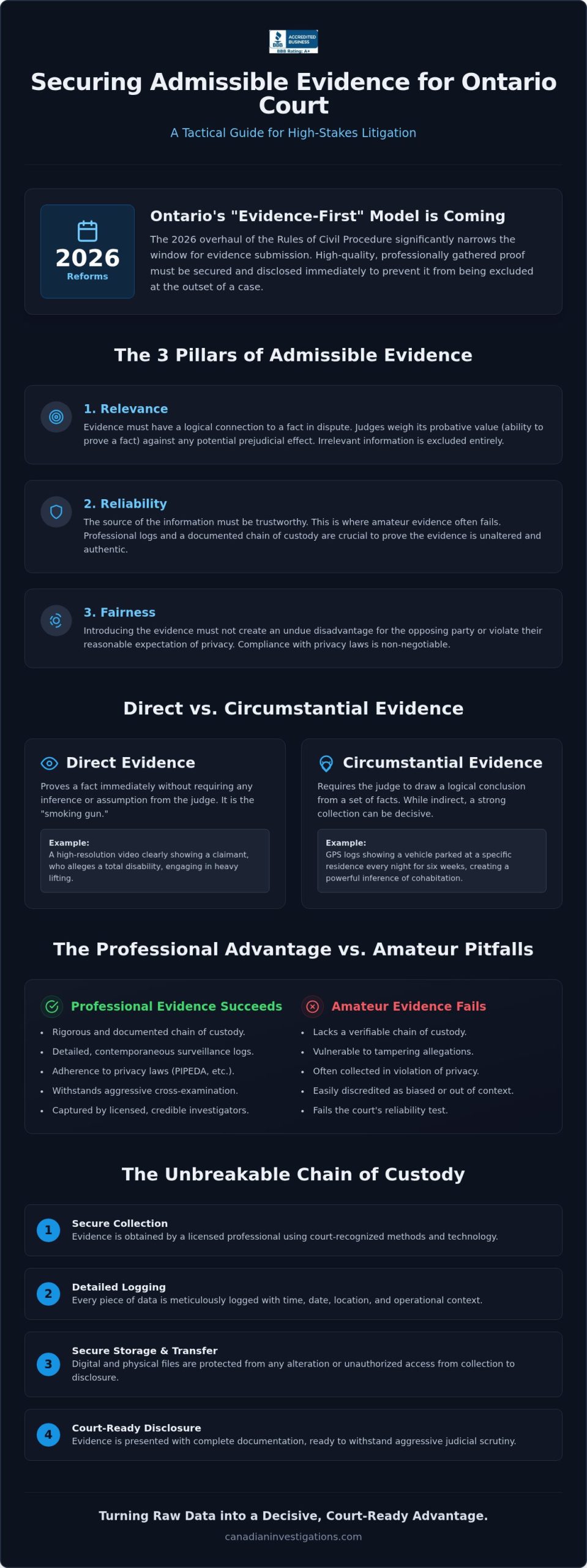
Ontario courts operate on three core pillars: relevance, reliability, and fairness. Evidence is relevant if it has a logical connection to a fact at issue in the case. Reliability focuses on whether the source of the information is trustworthy. Fairness ensures that the introduction of the evidence doesn’t create an undue disadvantage for the opposing party. Evidence typically falls into three categories: physical evidence (tangible objects), documentary evidence (written records, logs, or digital files), and oral testimony (sworn statements from witnesses).
Amateur evidence often collapses during the reliability test. DIY surveillance or unverified digital screenshots frequently fail because they lack a documented chain of custody. Without a professional’s verification, a judge cannot be certain the proof hasn’t been altered or taken out of context. This is why professional investigative logs are far more effective than amateur recordings; they provide the technical foundation the court requires to accept the information as fact.
The Threshold of Relevance and Materiality
For a judge to admit a piece of evidence, it must be both relevant and material. This means the evidence must logically prove or disprove a specific fact that’s actually in dispute. Ontario judges apply a strict balancing test to determine if a piece of proof should be heard. They weigh the probative value against the potential prejudicial effect. In the context of a 2026 Ontario civil trial, probative value is the specific capacity of a piece of evidence to make a material fact more or less likely to be true. If the risk of unfair bias outweighs the usefulness of the information, the judge will exclude it entirely.
Direct vs. Circumstantial Evidence in Civil Litigation
Distinguishing between direct and circumstantial evidence is vital for tactical planning. Direct evidence proves a fact immediately without requiring the judge to make an assumption. A high-resolution surveillance video showing a claimant performing heavy lifting while alleging a total disability is a prime example of direct proof. It shows the act itself.
Circumstantial evidence requires the judge to draw a logical inference from the facts presented. While it’s sometimes viewed as less powerful, it’s often the deciding factor in complex litigation. For instance, GPS tracking logs that show a vehicle parked at a specific residence every night for six weeks provide a tactical advantage in spousal support disputes. While the logs don’t “show” the person living there, they create a powerful inference of cohabitation that’s difficult to refute. Securing high-quality admissible evidence for ontario court often involves combining both types to leave no room for doubt.
Navigating the Ontario Evidence Act and Privacy Compliance
Securing admissible evidence for ontario court requires more than just capturing an event on camera; it demands strict adherence to evolving privacy standards. If a collection method infringes on a subject’s “reasonable expectation of privacy,” the resulting proof is often excluded to maintain judicial integrity. While monitoring in public spaces is generally permissible, investigators must avoid intrusive methods that cross into private zones. Engaging a licensed investigative partner ensures your file remains compliant with these strict legal boundaries.
For corporate and employment investigations, the Personal Information Protection and Electronic Documents Act (PIPEDA) dictates the framework for evidence gathering. This federal act governs how private sector organizations collect and use personal information during commercial activities. Evidence obtained in clear violation of PIPEDA can lead to significant legal pushback, potentially rendering the findings unusable in a commercial dispute or employment tribunal. Our tactical approach balances the need for results with the necessity of legislative compliance.
Section 35 and 52: Business Records and Medical Reports
The Ontario Evidence Act provides specific pathways for admitting records without requiring the original creator’s testimony. Section 35 allows for the admission of business records, provided they were made in the ordinary course of business. This is a critical component of our tactical claims verification pillar, where digital logs and transaction histories serve as foundational proof. Section 52 simplifies the process for personal injury cases by allowing expert medical reports to be admitted as evidence, provided proper notice is given to the opposing party well in advance of the trial.
The “Intrusion upon Seclusion” Tort in Ontario
The 2012 Jones v. Tsige precedent established the tort of “intrusion upon seclusion,” a legal concept that continues to shape admissibility in 2026. This tort applies when someone intentionally intrudes upon the private affairs of another in a way that a reasonable person would find highly offensive. Licensed investigators avoid this pitfall by maintaining a clear distinction between “observation” and “harassment.” Observation from a public vantage point is a tactical necessity. Peering into private windows or using unauthorized tracking devices on private property constitutes a violation. We operate with the discipline required to gather admissible evidence for ontario court without triggering these costly privacy torts.
Admissibility of Tactical Surveillance and UAV Proof
Professional surveillance video serves as a “silent witness” in Ontario proceedings. Unlike a human witness whose memory may fade or be influenced by bias, a properly captured video provides an objective, chronological record of events. For this footage to qualify as admissible evidence for ontario court, the party presenting it must prove its authenticity. This requires a licensed investigator to testify regarding the time, location, and technical methods used to capture the recording. Without this foundational testimony, even the most revealing footage may be dismissed as unverified or manipulated.
GPS tracking data follows similar admissibility hurdles. In commercial or domestic litigation, GPS logs are often used to establish patterns of movement or to prove cohabitation. To be admitted, the data must be shown to be accurate and obtained through lawful means. This typically involves demonstrating that the device was installed by a licensed professional and that the data was secured in a way that prevents tampering. While the Ontario Court of Justice Criminal Rules provide a strict framework for state-led surveillance, civil courts apply similar rigorous standards to ensure the reliability of digital tracking proof.
Drone Surveillance: Aerial Advantage and Legal Constraints
In 2026, the use of Unmanned Aerial Vehicles (UAVs) provides a decisive tactical advantage in rural or hard-to-reach surveillance scenarios. However, admissibility is strictly tied to compliance with NAV Canada and Transport Canada regulations. Pilots must operate within the “visual line of sight” (VLOS) and respect specific “privacy heights” to avoid claims of unreasonable search or intrusion. Aerial proof captured from a height that respects a subject’s reasonable expectation of privacy is more likely to be admitted than footage taken at an intrusive, low-altitude hover. Metadata is the digital fingerprint of drone evidence. Every file must contain embedded GPS coordinates, timestamps, and altitude data to survive the authentication process in court.
Surveillance Logs: The Foundation of Reliable Testimony
A professional investigative log is the backbone of any surveillance file. These logs follow a disciplined structure, documenting every minute of activity with precise dates, times, and locations. A licensed investigator’s notes carry significant weight because they are “contemporaneous notes,” which are defined in Ontario courts as records made at the time of the event or as soon as reasonably practicable thereafter. While a friend or family member might provide a vague account of an event, an investigator’s log provides a granular, second-by-second breakdown that is difficult to challenge. This level of detail is essential for establishing the credibility of the observer and ensuring the captured data is recognized as admissible evidence for ontario court.
Evidence Gathering for Specific Ontario Litigation Types
Admissibility standards often shift depending on the specific legal arena. While the underlying principles remain the same, the application of admissible evidence for ontario court varies between family, insurance, and corporate litigation. Each sector demands a tailored tactical approach to ensure the proof survives judicial scrutiny and provides a clear advantage in the courtroom.
Family Law: Proving Infidelity and Custody Issues
In corporate settings, ensuring the reliability of your evidence begins with due diligence; you can explore Pre-Employment Background Checks to verify the history of personnel and protect your organization from future liability.
Identifying malingering in WSIB or personal injury claims requires indisputable visual proof of physical capability. In rural Ontario, standard vehicle surveillance is often impossible without detection. We utilize specialized Camo Ghillie Suit Surveillance Services to maintain a covert presence in challenging terrain. This method allows for the collection of high-impact admissible evidence for ontario court that directly contradicts a claimant’s reported limitations.
Adhering to the “Fairness” rule is critical. Surveillance must never cross the line into entrapment or harassment. If an investigator influences a subject’s actions or creates a situation that forces a physical response, the evidence becomes tainted. Our protocols follow the insurance fraud surveillance pillar to ensure all gathered proof is beyond reproach and ready for trial.
Corporate fraud and employment due diligence rely heavily on background reports. These reports are admissible when they’re based on verifiable, public-domain data and professional observations. They provide the necessary foundation for termination for cause or litigation against fraudulent entities. If you require court-ready proof for a sensitive legal matter, secure our professional investigative services today.
Ensuring Your Evidence Withstands Judicial Scrutiny
Cross-examination is the ultimate test for admissible evidence for ontario court. Opposing counsel will scrutinize the methods used to acquire proof long before they address the facts within it. The first point of attack is almost always the private investigator’s licence. In Ontario, an unlicensed individual gathering evidence is a significant liability; their findings are frequently deemed inadmissible because they lack the legal standing to conduct professional surveillance. A valid licence serves as the court’s baseline assurance that the investigator understands the provincial regulations and privacy boundaries required for a fair trial.
The Chain of Custody Protocol
A rigorous chain of custody is the only defense against claims of evidence tampering. If a gap exists in the history of a digital file, its reliability is compromised. We follow a strict three-step protocol to maintain the integrity of every file:
- Step 1: Secure Source Material. All original digital files or SD cards are secured immediately with encrypted timestamps. We never edit or alter the original master file.
- Step 2: Establish an Audit Trail. Every individual who handles the evidence, from the field investigator to the legal clerk, is logged. This prevents “unaccounted for” periods that lawyers exploit during discovery.
- Step 3: Secure Storage. Evidence is held in a tamper-proof digital environment or a locked physical facility. This ensures the version presented in court is identical to the one captured in the field.
Cross-Examination: Preparing the Investigator for Trial
CSI investigators don’t just provide reports; they defend them in the witness box. Preparing for trial involves a thorough review of investigative logs to ensure every entry is objective. Judges give little weight to biased conclusions or emotional language in a report. A professional log describes actions-“subject walked 50 metres without assistance”-rather than offering medical opinions like “subject appeared healthy.” This objectivity is what transforms a simple observation into expert witness testimony that carries weight in an Ontario proceeding.
To evaluate if your proof meets the standard of admissible evidence for ontario court, use this tactical professionalism checklist:
- Is the investigator’s licence current and verified?
- Does the report contain contemporaneous notes with precise timestamps?
- Is there a clear, documented path from the camera to the courtroom?
Ensuring your evidence is court-ready requires a partner who understands the high stakes of the Ontario justice system. Contact Canadian Special Investigations for a confidential consultation.
Tactical Precision for Your Courtroom Advantage
Success in Ontario litigation depends on the unwavering integrity of your proof. We’ve established that technical compliance, from the strictures of the Ontario Evidence Act to rigorous chain of custody protocols, is non-negotiable. Amateur recordings or unverified logs don’t survive the scrutiny of a 2026 civil trial; they often become liabilities. You need a partner who understands that the method of acquisition is as vital as the proof itself. Securing admissible evidence for ontario court requires a disciplined approach that balances high-tech surveillance with absolute legal precision.
Canadian Special Investigations (CSI) provides this strategic edge through our team of licensed Ontario investigators. We utilize specialized assets, including UAV drone monitoring and Ghillie suit surveillance, to capture results where traditional methods fail. Our firm delivers the confidential support required by legal and insurance professionals who cannot afford to have their primary evidence excluded. By maintaining an objective audit trail and professional logs, we ensure your case is built on a foundation of facts that withstand cross-examination.
Secure Court-Admissible Evidence with CSI Tactical Surveillance. With the right tactical partner by your side, you can move forward with absolute confidence in your legal strategy.
Frequently Asked Questions
Is video surveillance admissible in Ontario family court?
Video surveillance is admissible in Ontario family court if it is relevant to a material issue, such as proving cohabitation or documenting conduct that affects a child’s best interests. To be accepted, the footage must be obtained legally without violating a subject’s reasonable expectation of privacy. Amateur recordings often face challenges regarding authenticity. Professional logs and testimony from a licensed investigator provide the necessary foundation to ensure the video is treated as a reliable “silent witness.”
Can I use a GPS tracker to gather evidence for a court case in Ontario?
GPS tracking data is admissible for Ontario court cases when gathered through lawful investigative methods. In commercial or domestic litigation, these logs establish patterns of movement or verify residency. However, unauthorized installation on a private vehicle can lead to the evidence being excluded under privacy torts like “intrusion upon seclusion.” Utilizing a licensed professional ensures the device is deployed within legal boundaries, providing a verifiable audit trail that survives judicial scrutiny during discovery.
What makes evidence “inadmissible” in an Ontario civil trial?
Evidence becomes inadmissible in an Ontario civil trial if its prejudicial effect outweighs its probative value or if it fails the test of relevance. Common reasons for exclusion include privacy violations, a broken chain of custody, or a lack of authentication. If a judge determines that the information was obtained through illegal means or that its source is inherently unreliable, it will be thrown out. This is why amateur proof often fails to qualify as admissible evidence for ontario court.
Do I need a licensed private investigator to testify for the evidence to be valid?
While not every document requires an investigator’s testimony, a licensed private investigator is essential for authenticating surveillance and digital proof. The investigator acts as a professional witness who can verify the time, location, and technical integrity of the evidence. Without this expert testimony, opposing counsel can easily challenge the footage as being manipulated or unverified. A licence provides the court with immediate assurance of professional standards and regulatory compliance.
How does the Ontario Evidence Act handle digital photographs and videos?
The Ontario Evidence Act treats digital photographs and videos as electronic records that require proof of integrity. For these to be admitted, the proponent must demonstrate that the computer system or device used to capture the data was operating properly. Authentication usually involves a witness who can testify that the digital file is an accurate representation of the scene. Professional investigative logs provide the contemporaneous notes required to satisfy these legislative standards for reliability.
Can drone footage be used as evidence in a property or insurance dispute?
Drone footage is highly effective in property and insurance disputes, provided the flight complies with 2026 Transport Canada regulations. Admissibility hinges on the pilot maintaining a visual line of sight and respecting privacy altitudes. Metadata embedded in the file, such as GPS coordinates and timestamps, is critical for court authentication. Aerial proof is particularly valuable for documenting hard-to-reach rural locations or verifying the extent of property damage without trespassing.
What is the “Chain of Custody” and why does it matter for my case?
The chain of custody is a documented history that tracks every person who handled a piece of evidence from the moment of collection. It matters because it prevents allegations of tampering or unauthorized editing. If you cannot account for where a digital file was stored or who accessed it, the court may deem it unreliable. A secure, professional audit trail ensures that the version seen by the judge is the exact original captured in the field.
Is hearsay ever admissible in Ontario Small Claims Court?
Hearsay is often admissible in Ontario Small Claims Court, but judges typically give it significantly less weight than first-hand evidence. While the rules are more relaxed than in Superior Court, relying on “what someone else said” is a weak tactical position. To succeed, hearsay should be supported by reliable, documentary proof or professional surveillance logs. Direct evidence remains the standard for those seeking a decisive outcome and admissible evidence for ontario court in any legal proceeding.

